
Kundli, panchang and KP charts that state the ayanamsa they used and the classical rule behind each verdict.
Kundli · Panchang · Choghadiya · Vedic Hora · Vimshottari Dasha · Nakshatra · Mangal Dosha · Kaal Sarp Dosha · Sade Sati · Kundli Matching · Porutham · Papasamyam · Navamsa · KP Astrology · KP Ruling Planets · KP Daily Finance · Daily Gochara · Muhurta · KP Horary · Divisional Chart · Vedic Yoga · Shadbala · Ashtakavarga · Bhava Bala · Bhav Chalit · Graha Asta · Arudha Lagna · Atmakaraka · Avastha · Upagraha · Vedic Transit · Drishti · Sidereal Ephemeris · Rashi and 26 more
Included with every plan (at no extra cost)
D1 Rashi chart with nakshatras and padas
Navamsa and divisional charts to D60
An editorial reading of every graha and bhava
Lahiri, Raman and KP ayanamsa
Vimshottari from Mahadasha to Prana
The current period at every level
Antardasha and Pratyantardasha drill-down
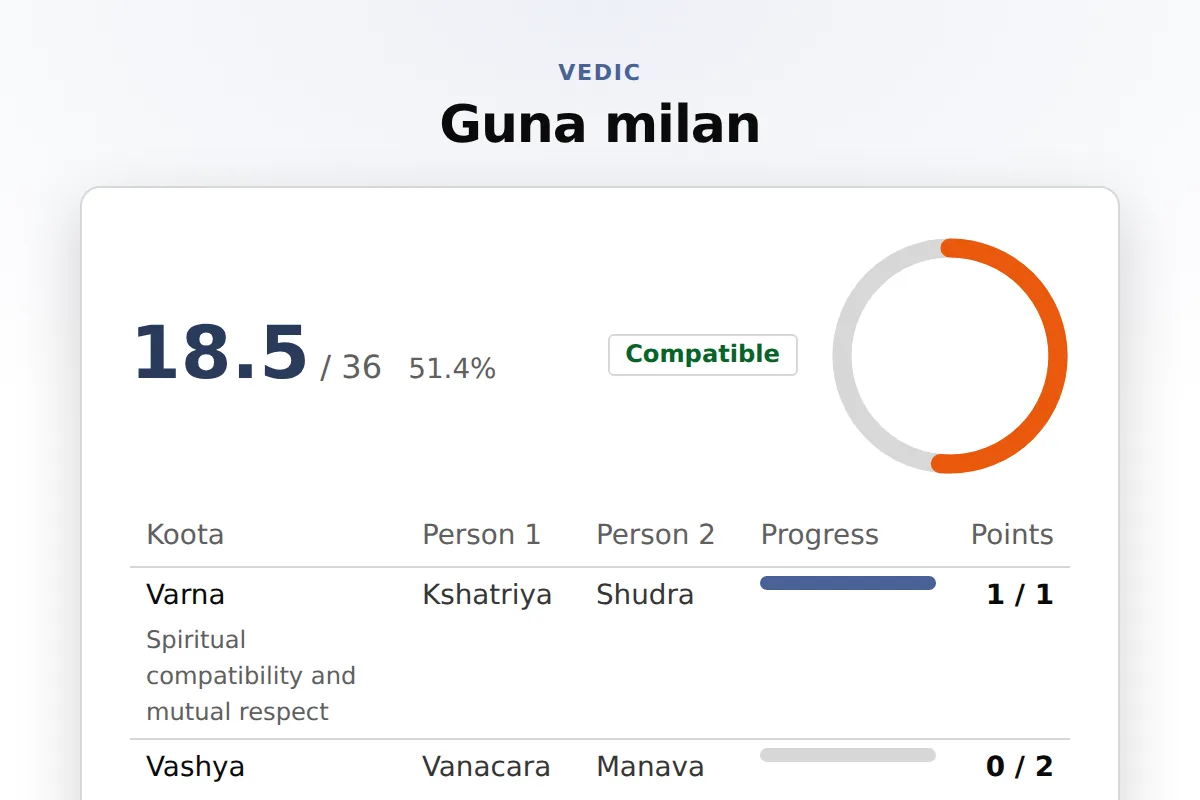
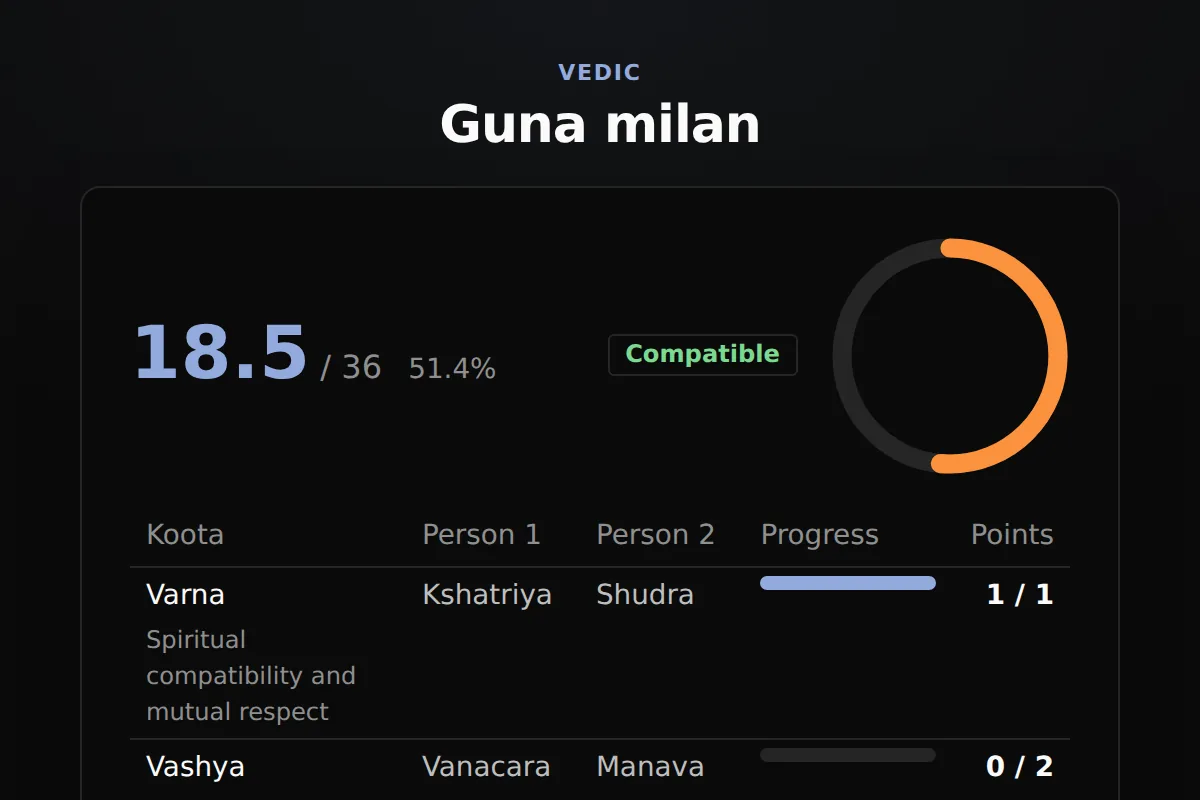
Ashtakoot Gun Milan score
South Indian Dashakoot porutham with Rajju
Papasamyam malefic comparison
Manglik with cancellation rules
Manglik, Kalsarpa and Sade Sati checks
Sade Sati rising, peak and setting phase
Gemstone and other remedies per dosha
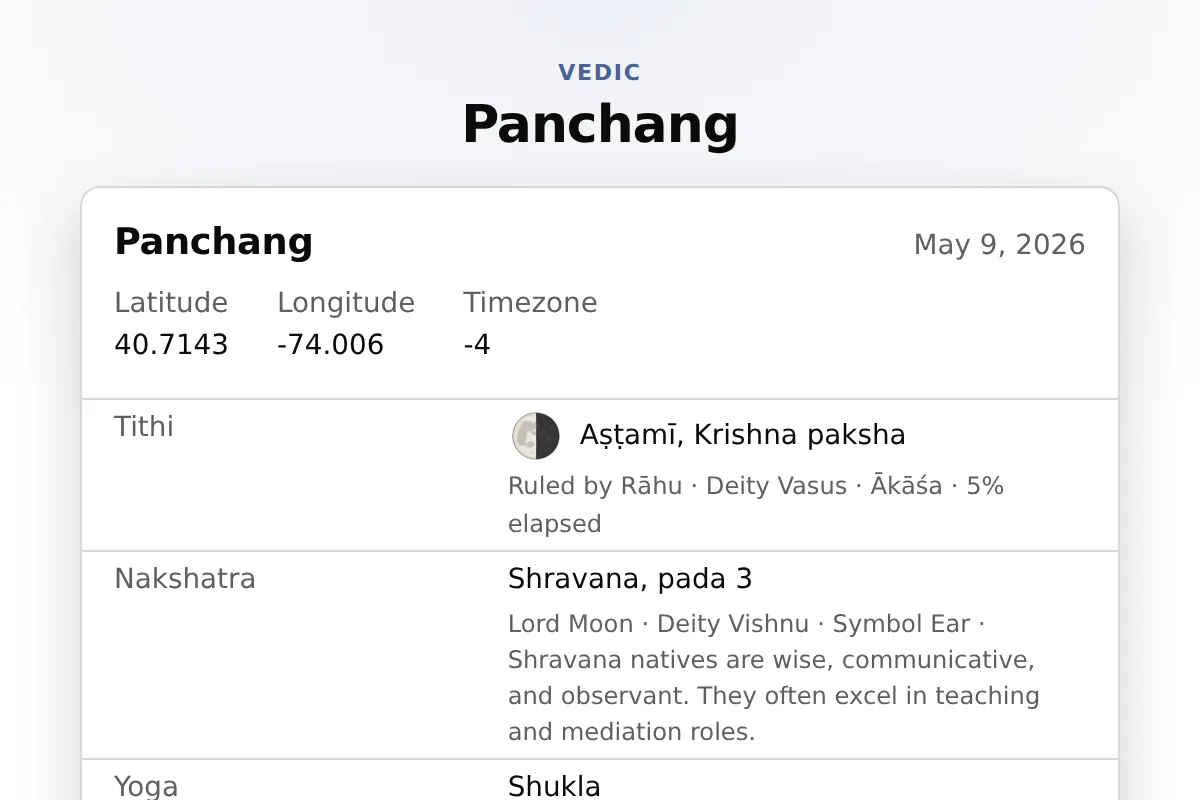
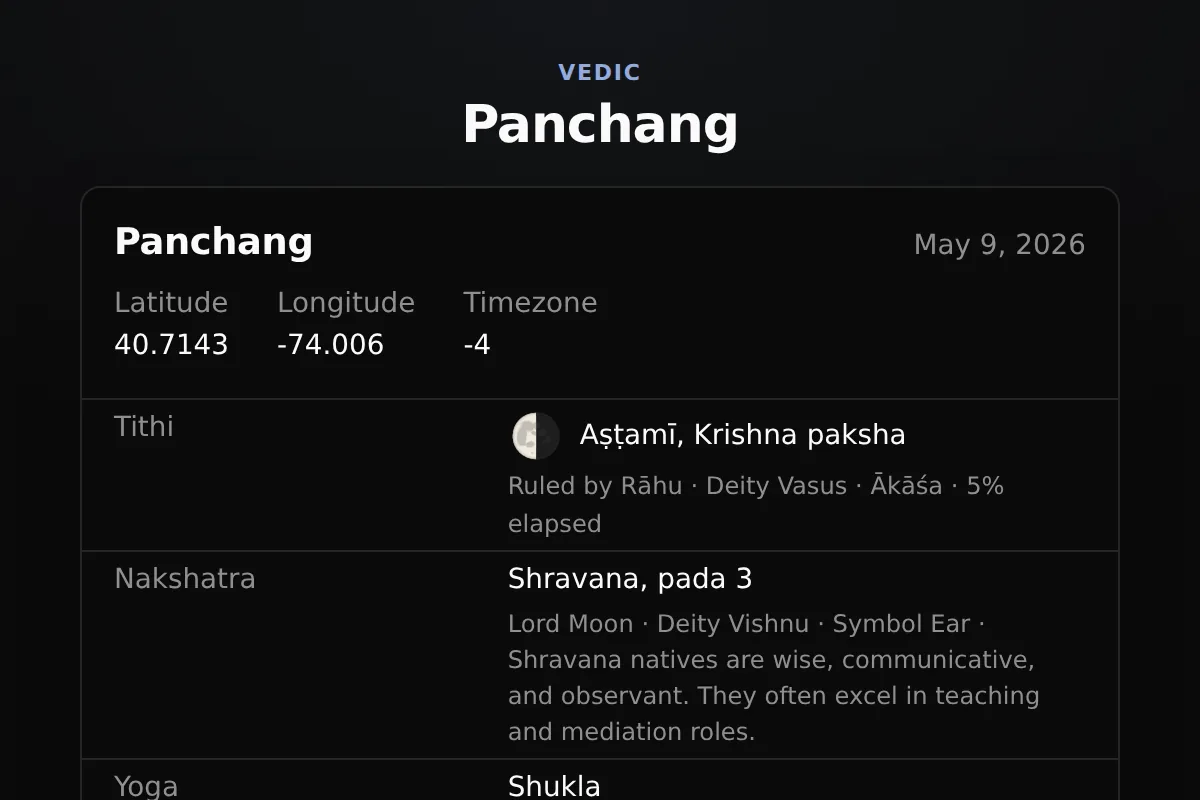
Tithi, nakshatra, yoga and karana
Rahu Kaal, Yamaganda, Gulika and Abhijit
Choghadiya and Hora for the day
Sunrise and sunset for any city
Shadbala planetary strength
Bhava Bala house strength
Ashtakavarga and Sarvashtakavarga
Avastha planetary states
Classical yoga detection with the evidence
Arudha padas and Arudha Lagna
Chara Karakas with Atmakaraka
Upagraha positions
Sub-lords for planets and Placidus cusps
Ruling planets with significators
KP horary Prashna chart
Sub-lord and rasi change times
Gochar against the natal chart
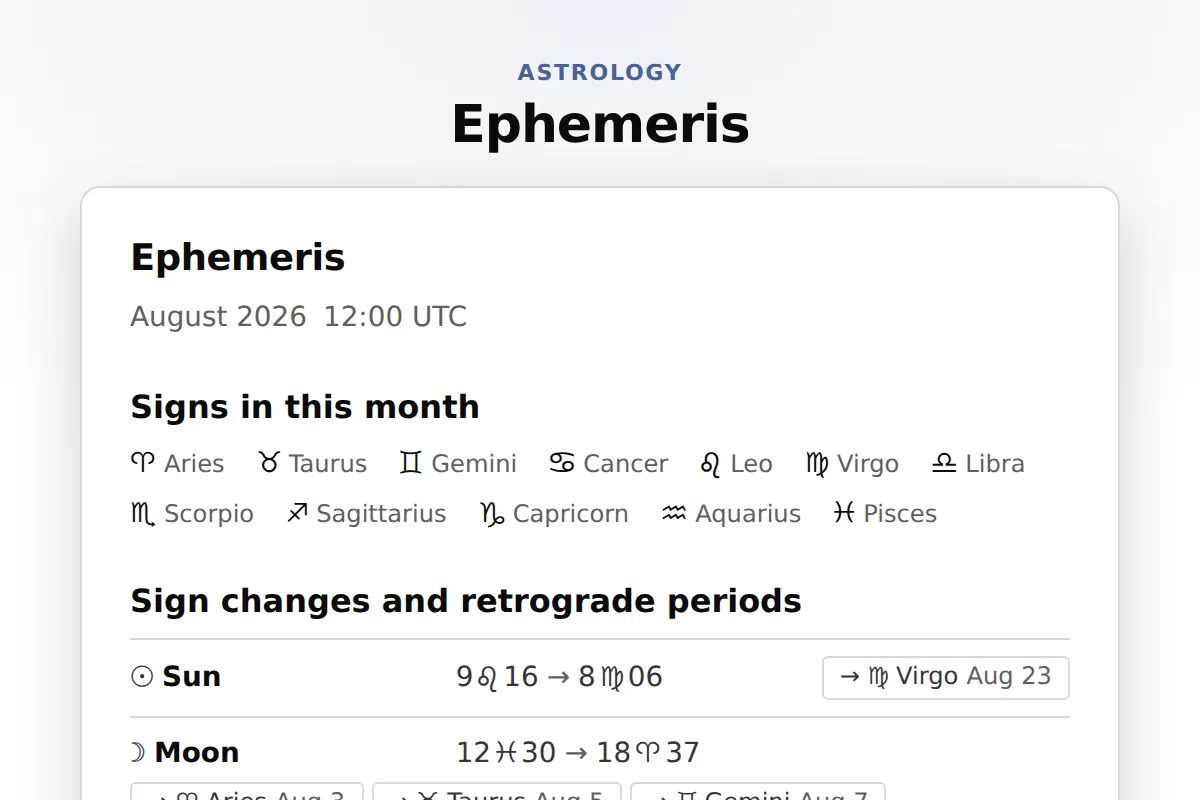
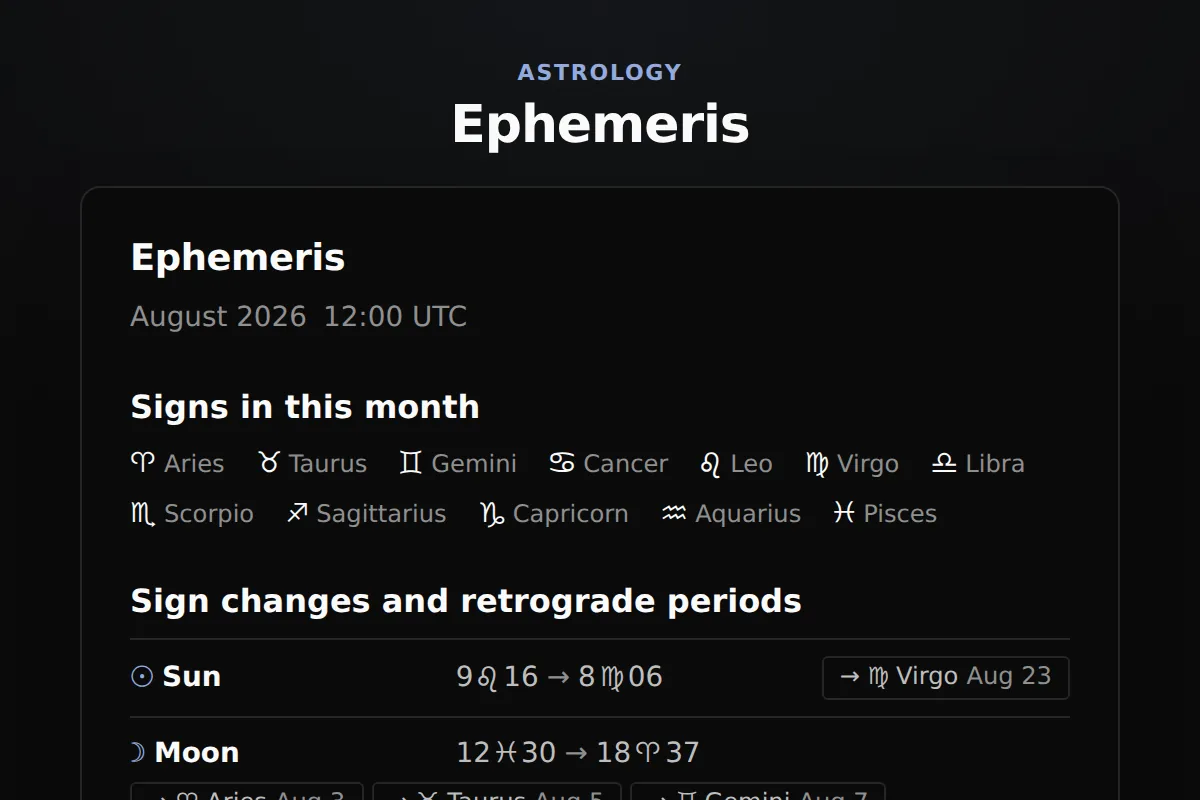
Monthly sign changes and aspects
Monthly lunar aspect calendar
Heliacal rising and setting
Vedic astrology (Jyotish) and KP API for kundli generation with an editorial reading of the whole chart, the sixteen Shodasavarga divisional charts (D1 to D60), panchang with choghadiya, hora and the classical muhurta windows, kundli matching by Ashtakoot Gun Milan, the South Indian ten porutham with Rajju and Vedha vetoes and Papasamyam, Vimshottari Dasha predictions, dosha detection with remedies, a 301-entry planetary yoga glossary with 48 of them chart-detected and evidenced, and KP horary with 249-level sub-lord analysis. Calculations verified against NASA JPL Horizons at arc-second-level accuracy. Built for matrimonial apps, horoscope platforms, spiritual wellness services, and AI-powered astrology chatbots. One key covers every RoxyAPI domain, with Remote MCP and typed SDKs.
Every Vedic Astrology calculation is covered by 15,481 automated tests per deploy, 3,683 of them gold-standard tests locked to named external references such as NASA JPL Horizons, with a public MIT benchmark repo anyone can clone and re-run. See how we test.
Interpretations in English, Deutsch, Español, Français, हिन्दी, Português, Русский, Türkçe, one query parameter away.
Paste a widget into any site builder, install the WordPress plugin, or start from an MIT template you can white-label. Results render from the Vedic Astrology API with no backend.
A Remote MCP server exposes every endpoint as a tool for Claude, ChatGPT, Cursor and any MCP client, with no local install. Opt-in compact responses cut the tokens your agent reads by roughly 40 to 52 percent, and one call stays one request.
Typed SDKs for TypeScript, Python, PHP, C#, Go, Rust, and Dart, generated from the live spec, each with an AGENTS.md so your coding assistant calls the Vedic Astrology API correctly.
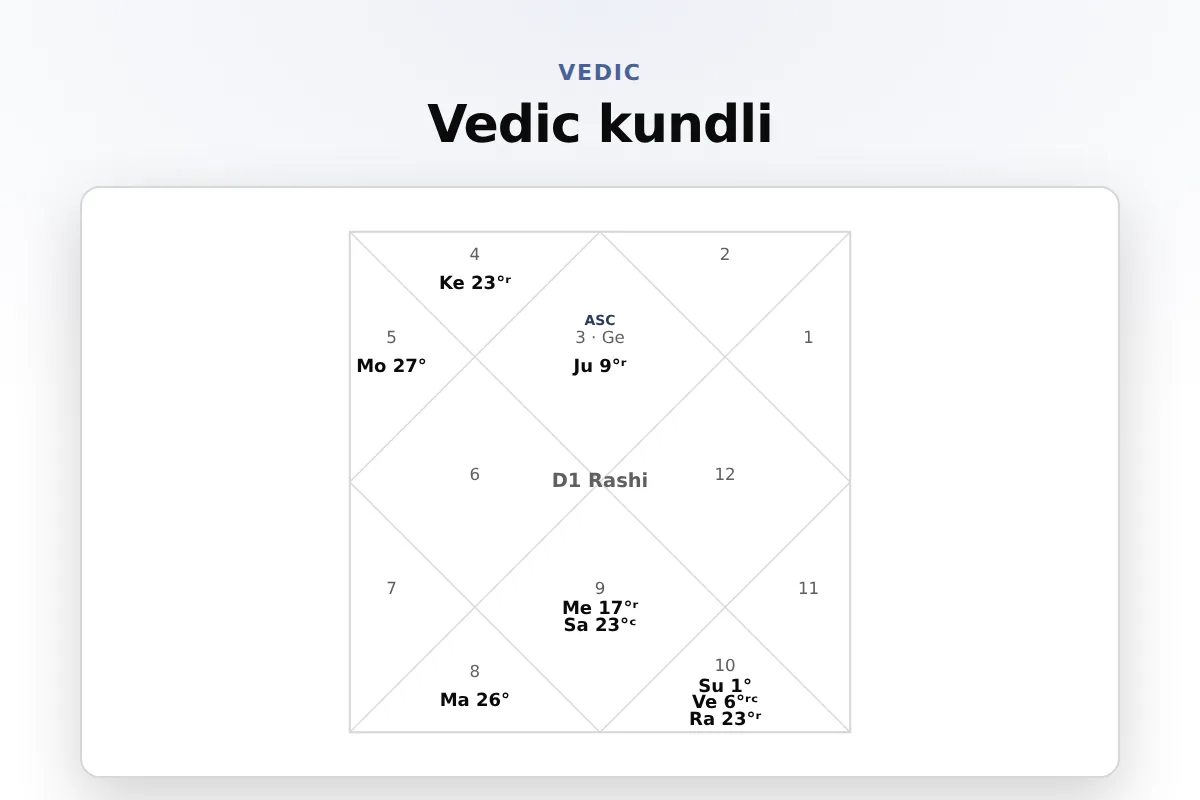
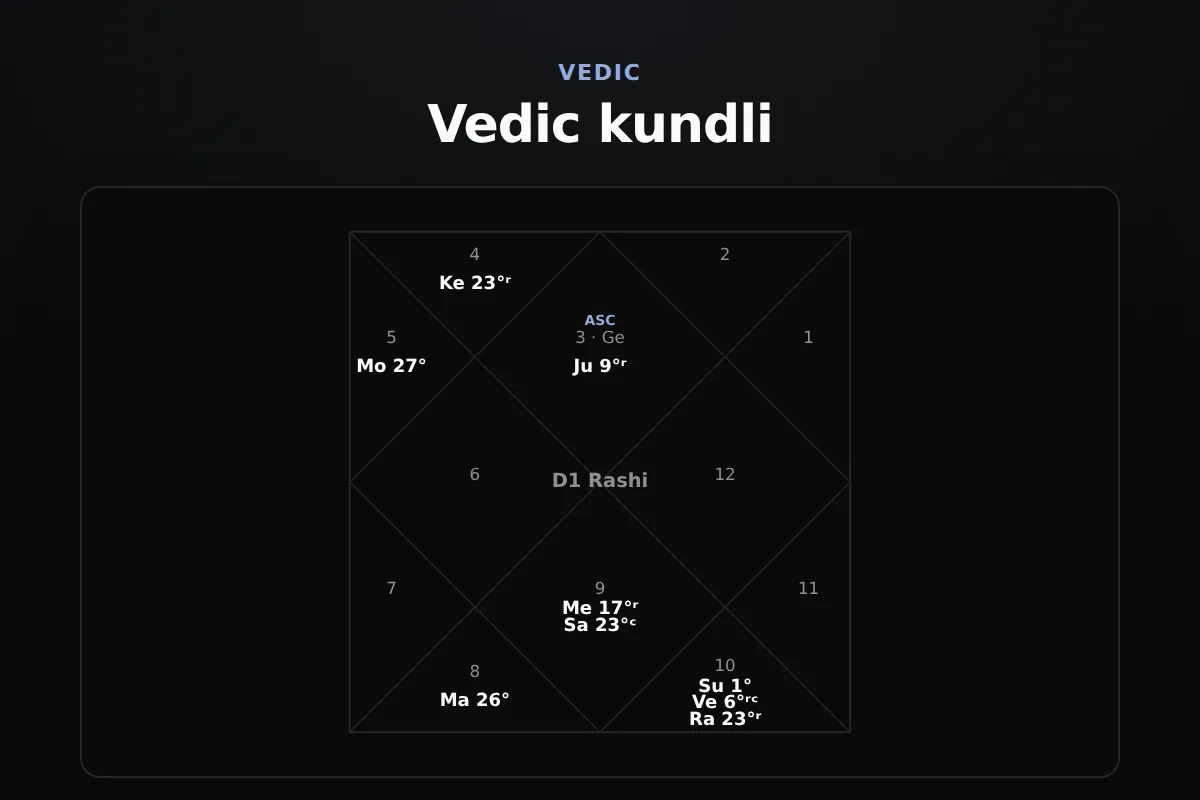
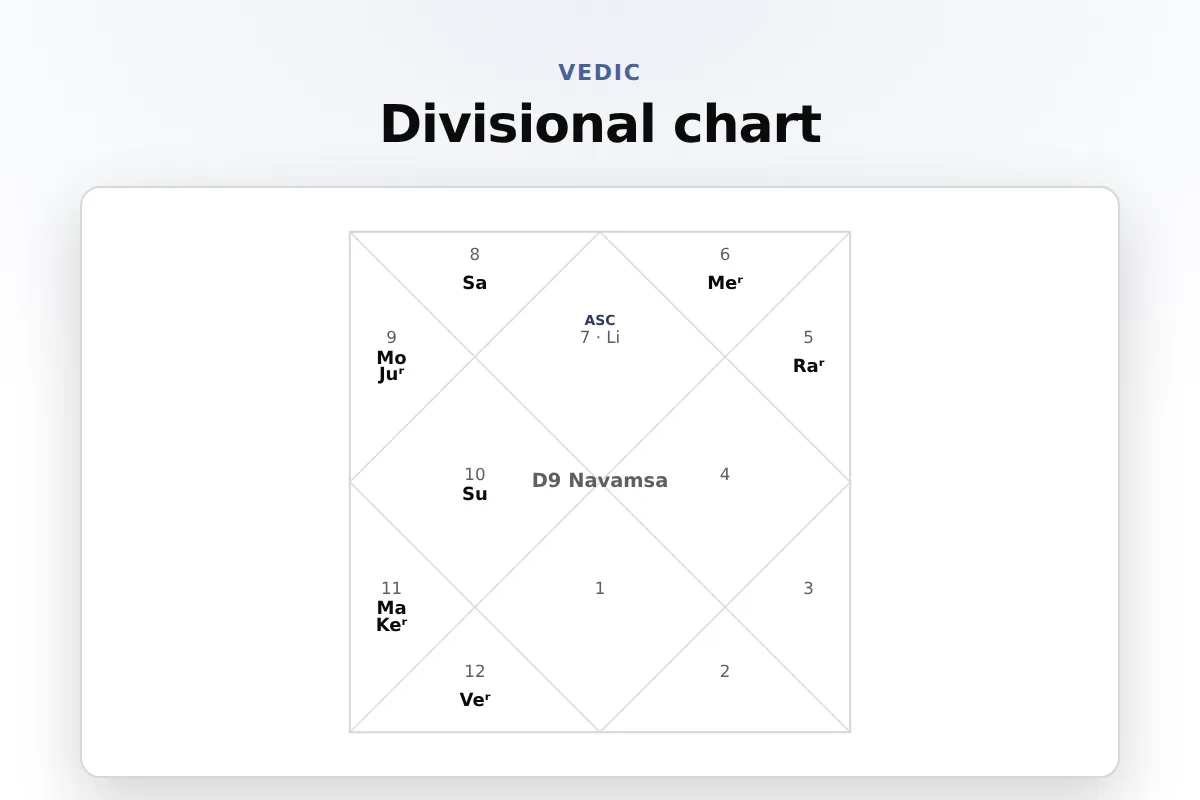
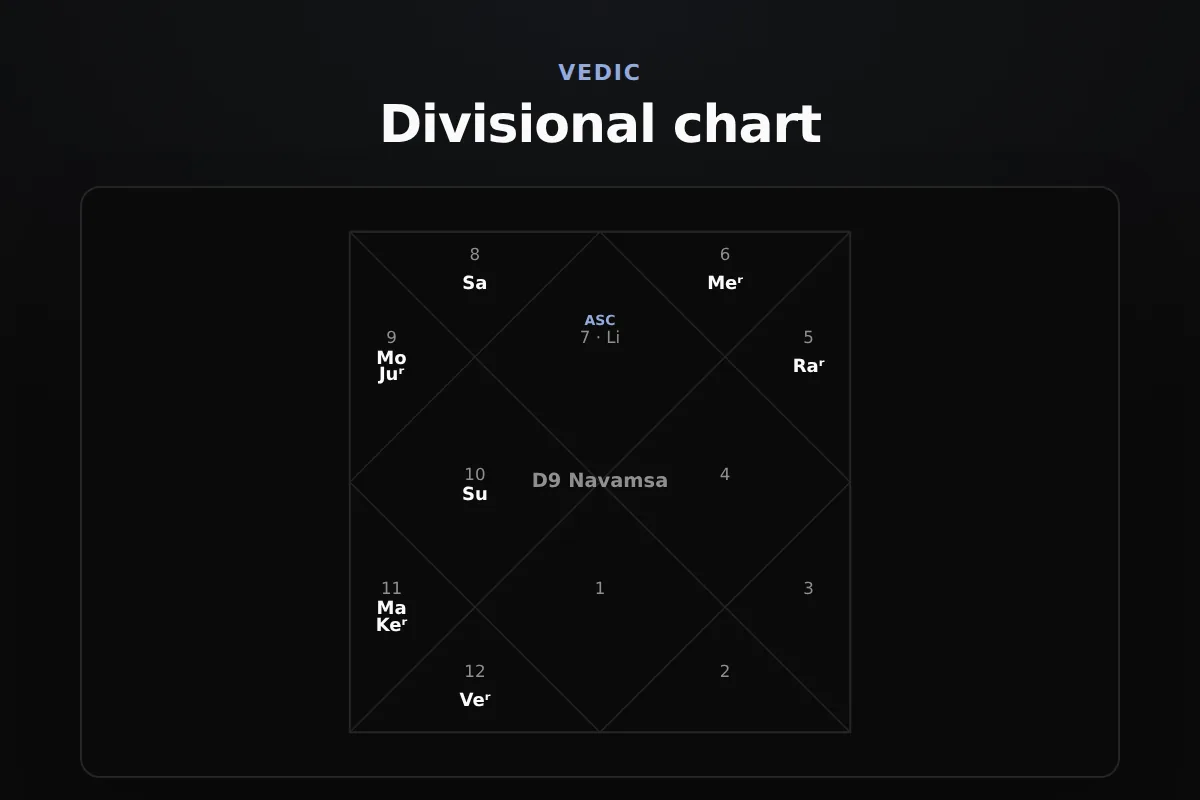
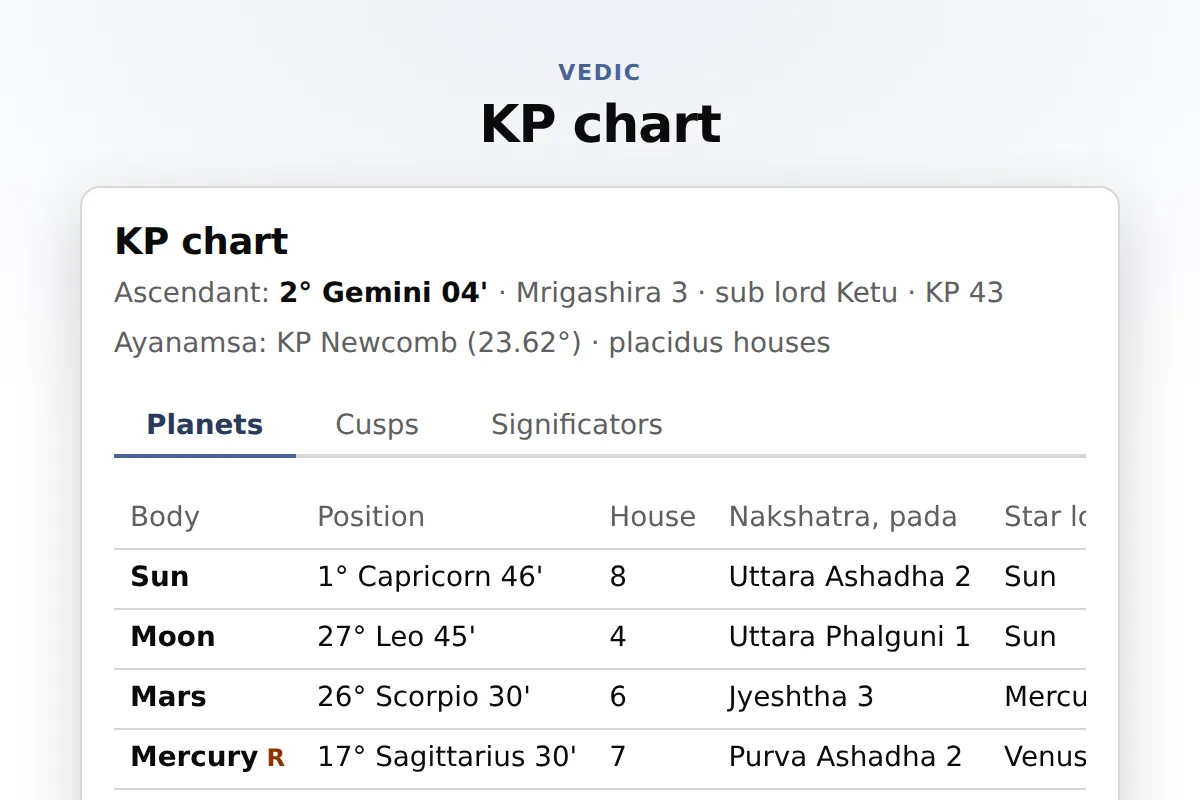
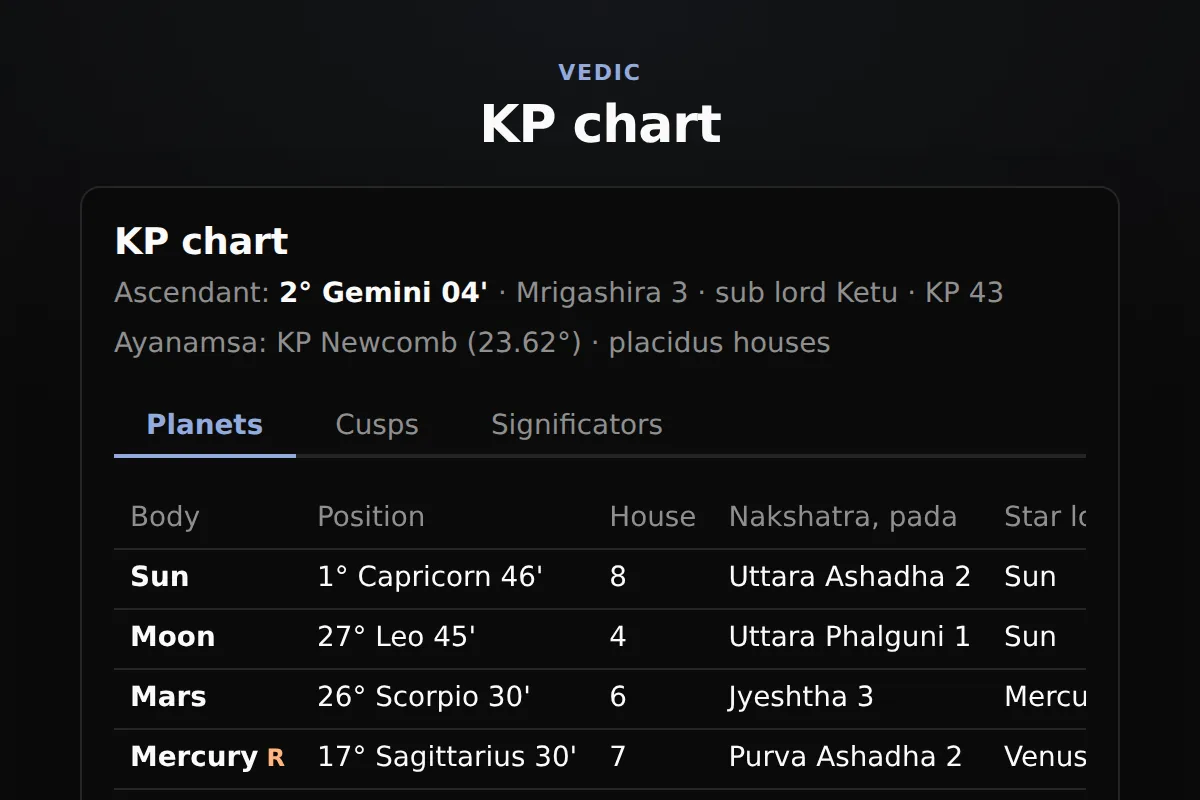
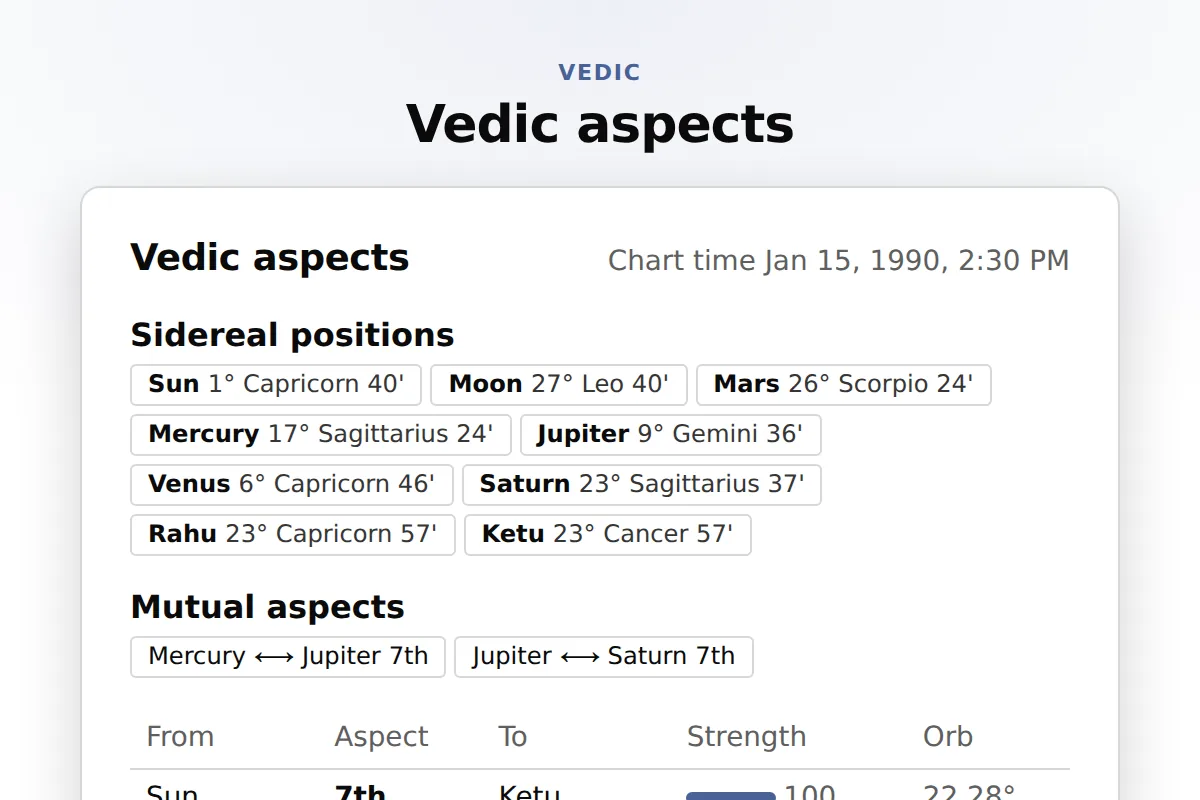
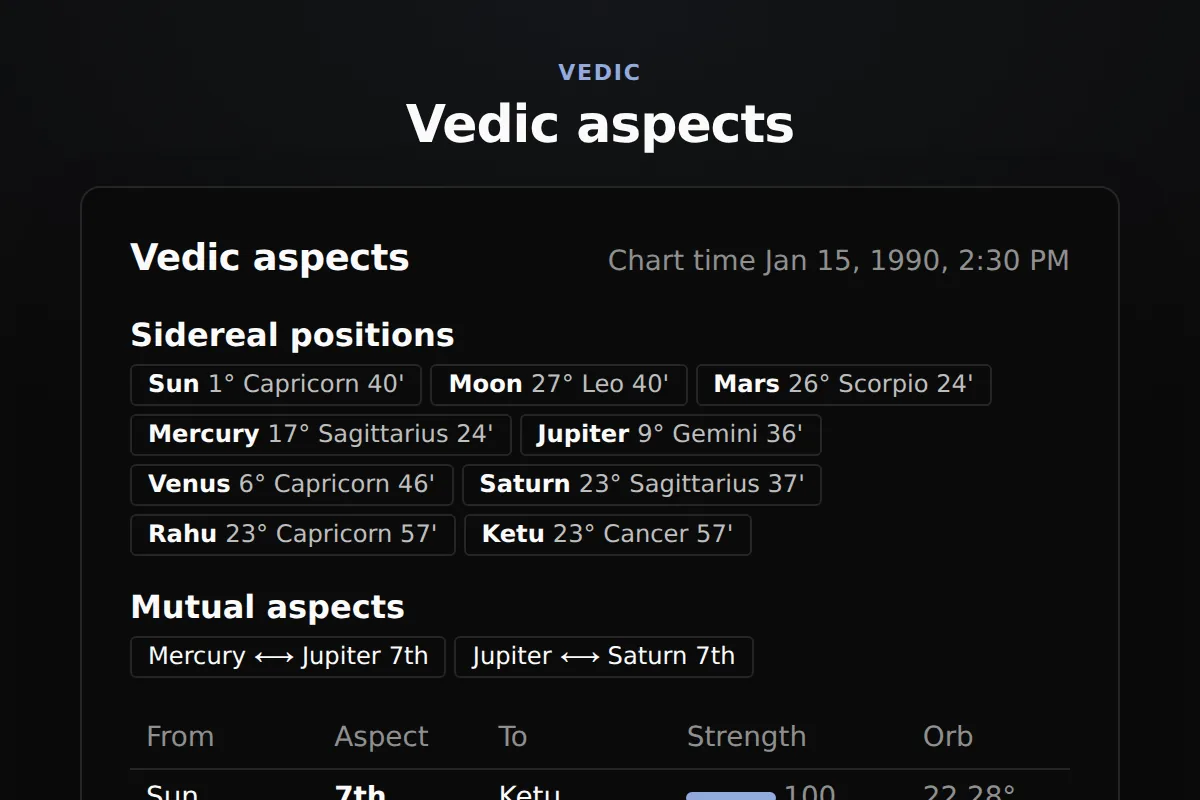
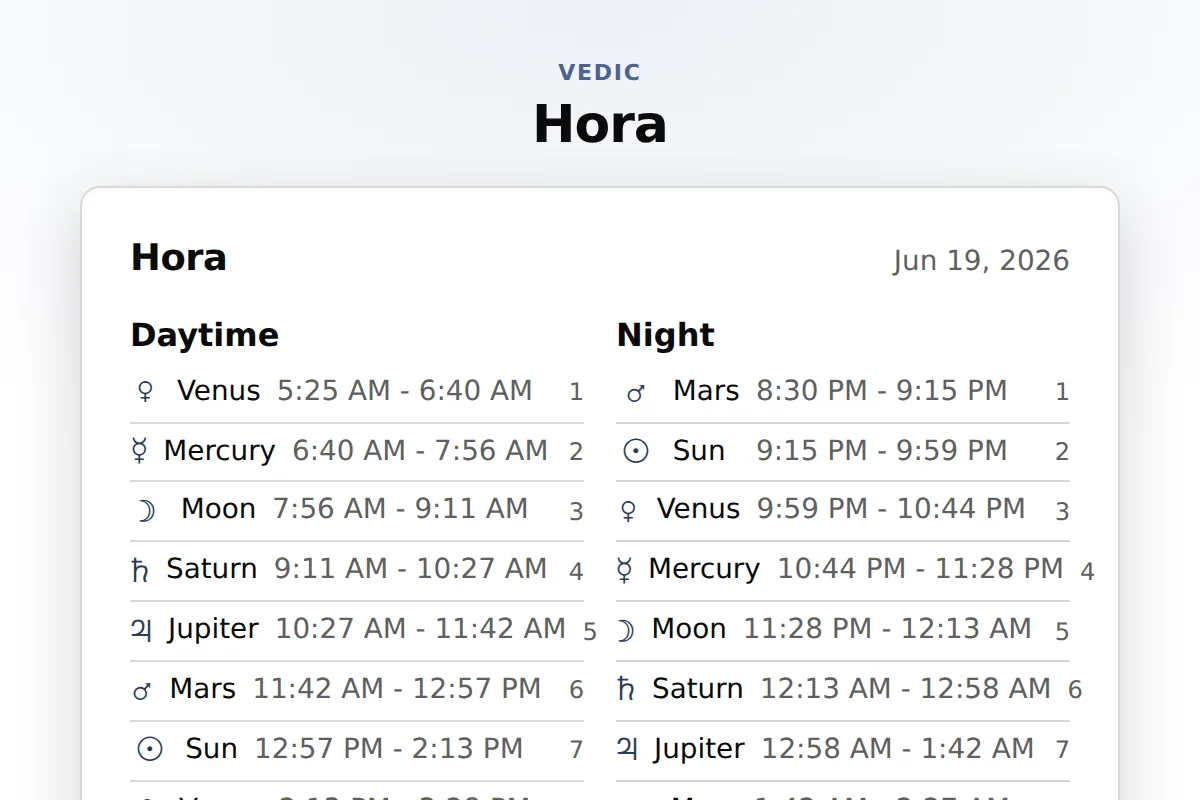
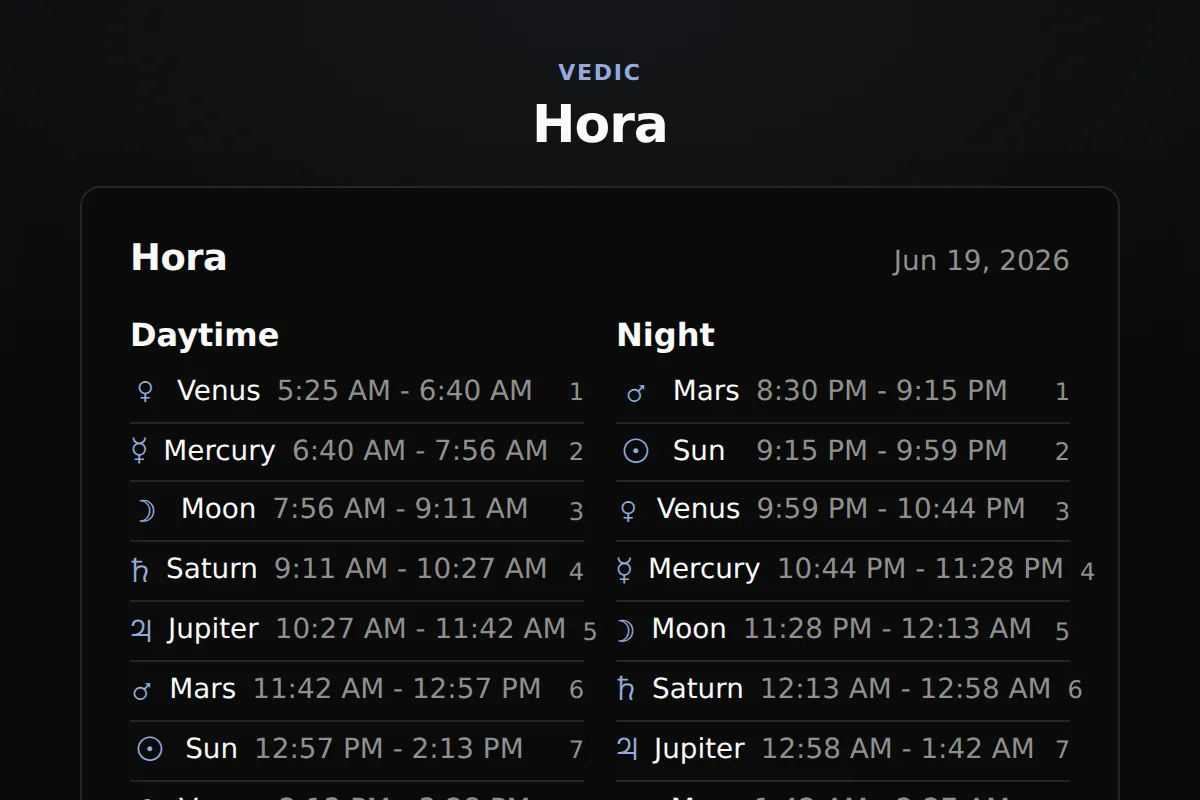
This is what your visitors see. Paste one snippet into Wix, Squarespace, or WordPress and the Vedic Astrology API reading appears on your site, with no code and no backend. Developers install the same components from npm for Next.js, React, Vue, Svelte, Angular, or plain HTML. MIT licensed and included in every plan.
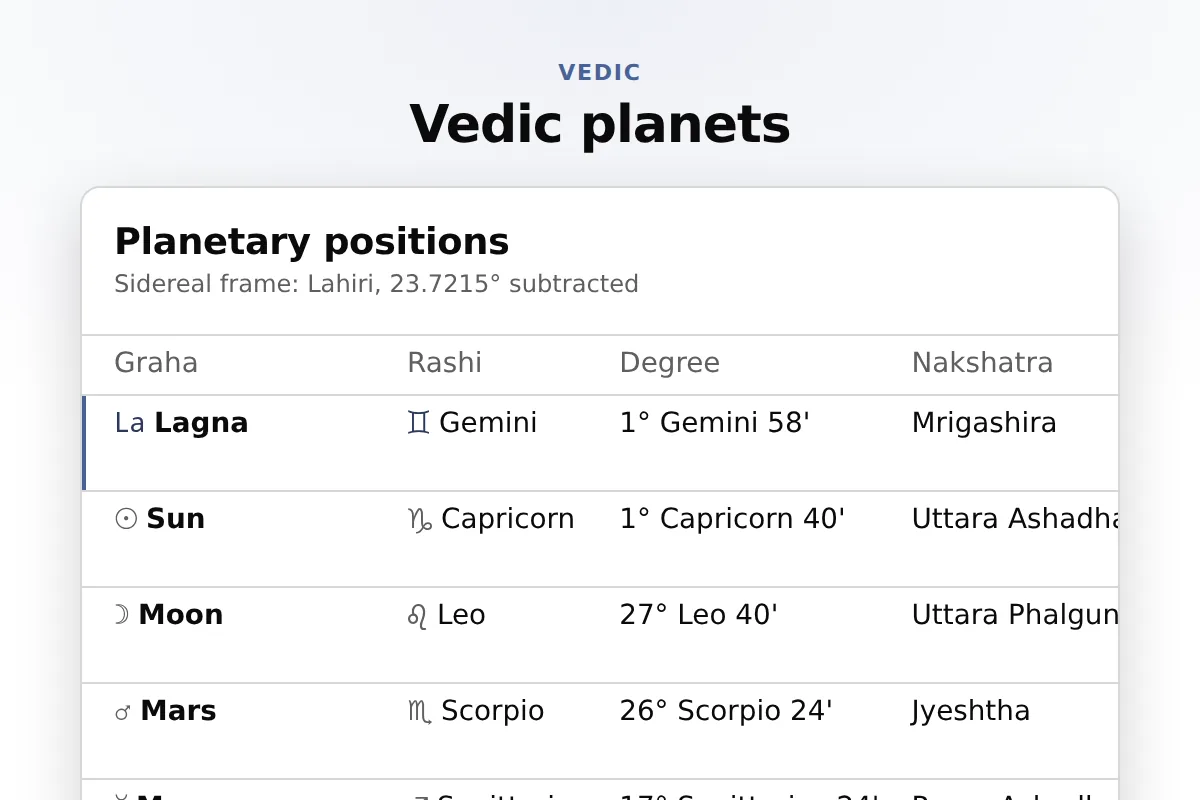
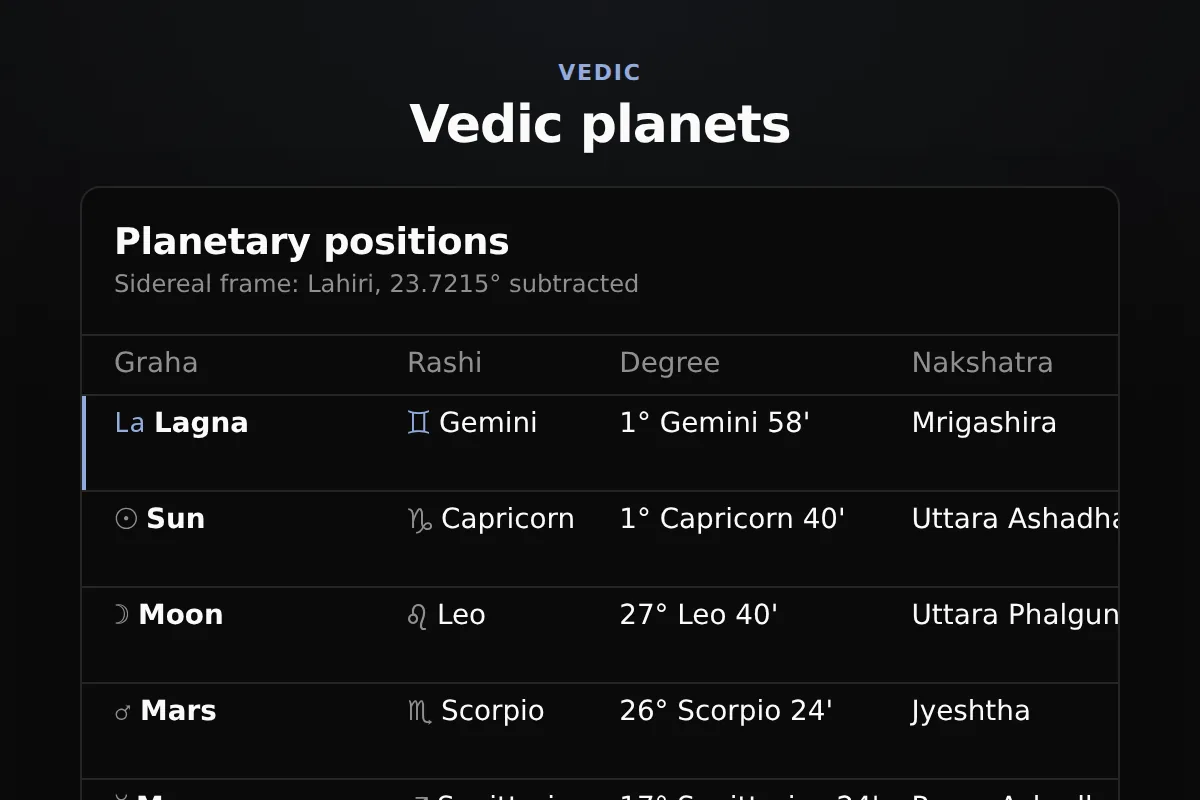
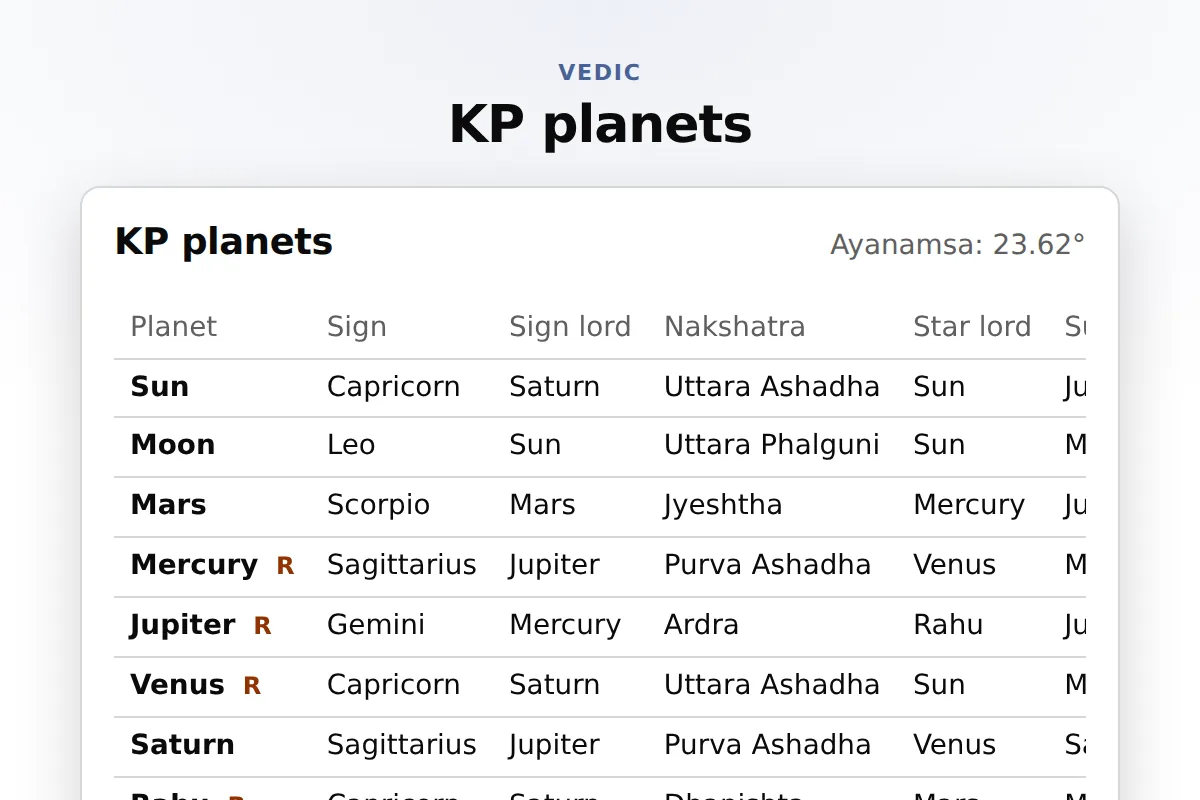
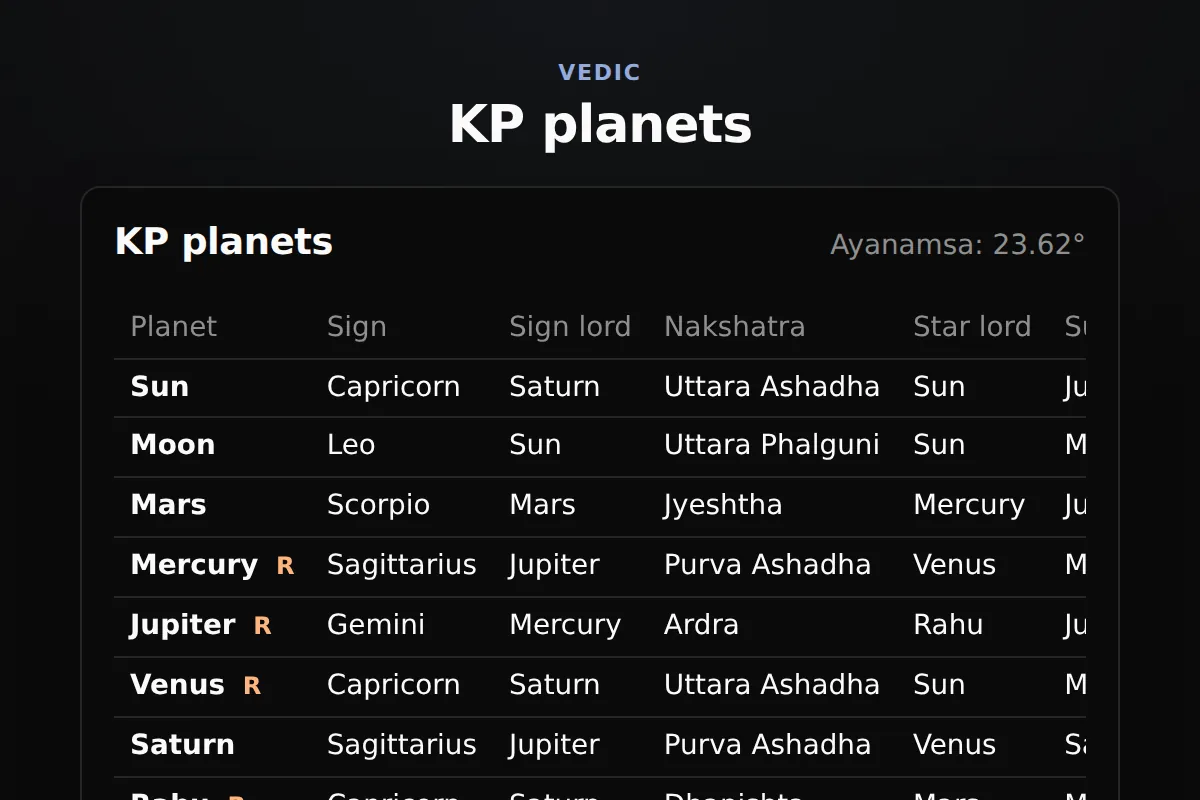
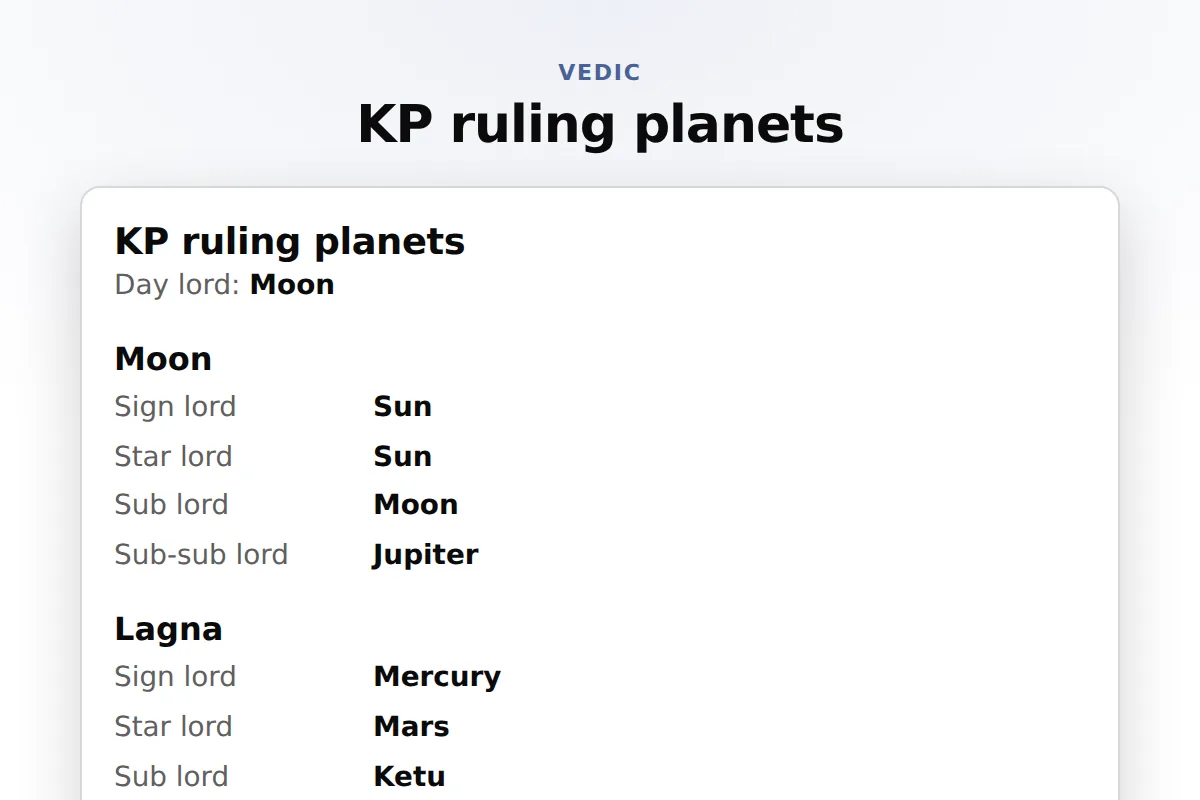
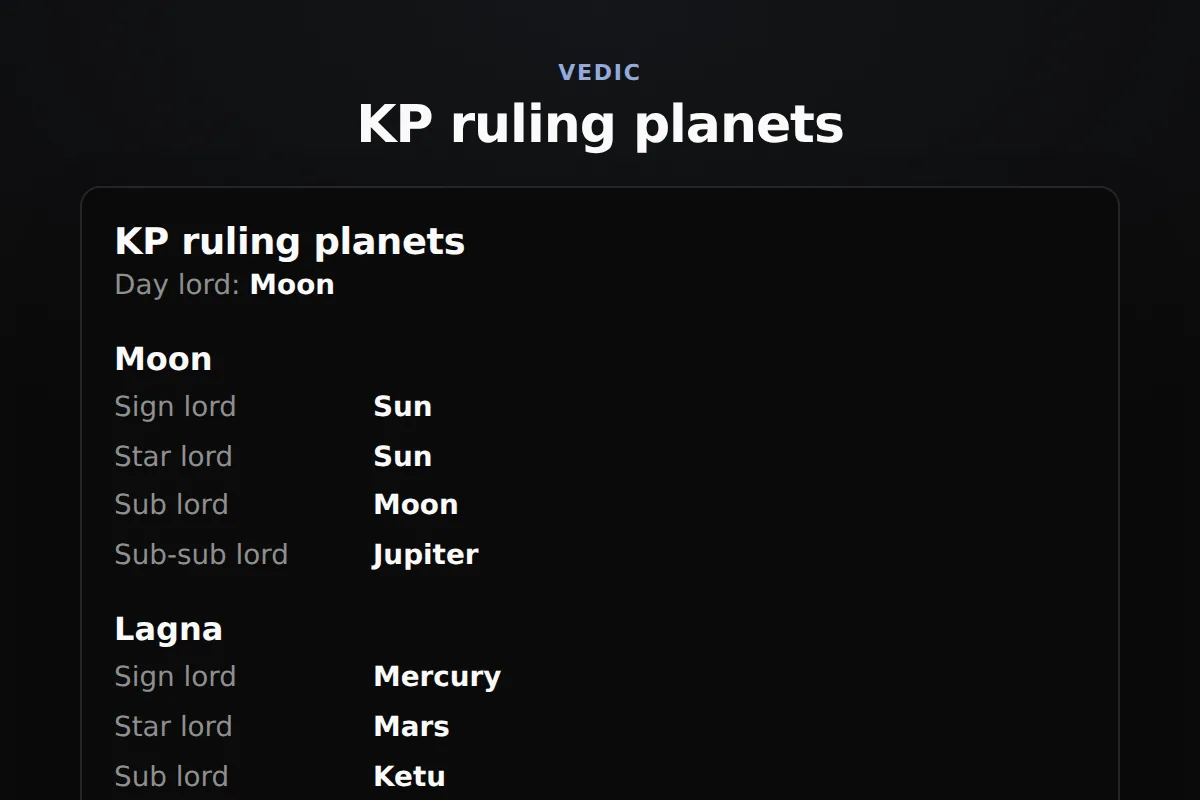
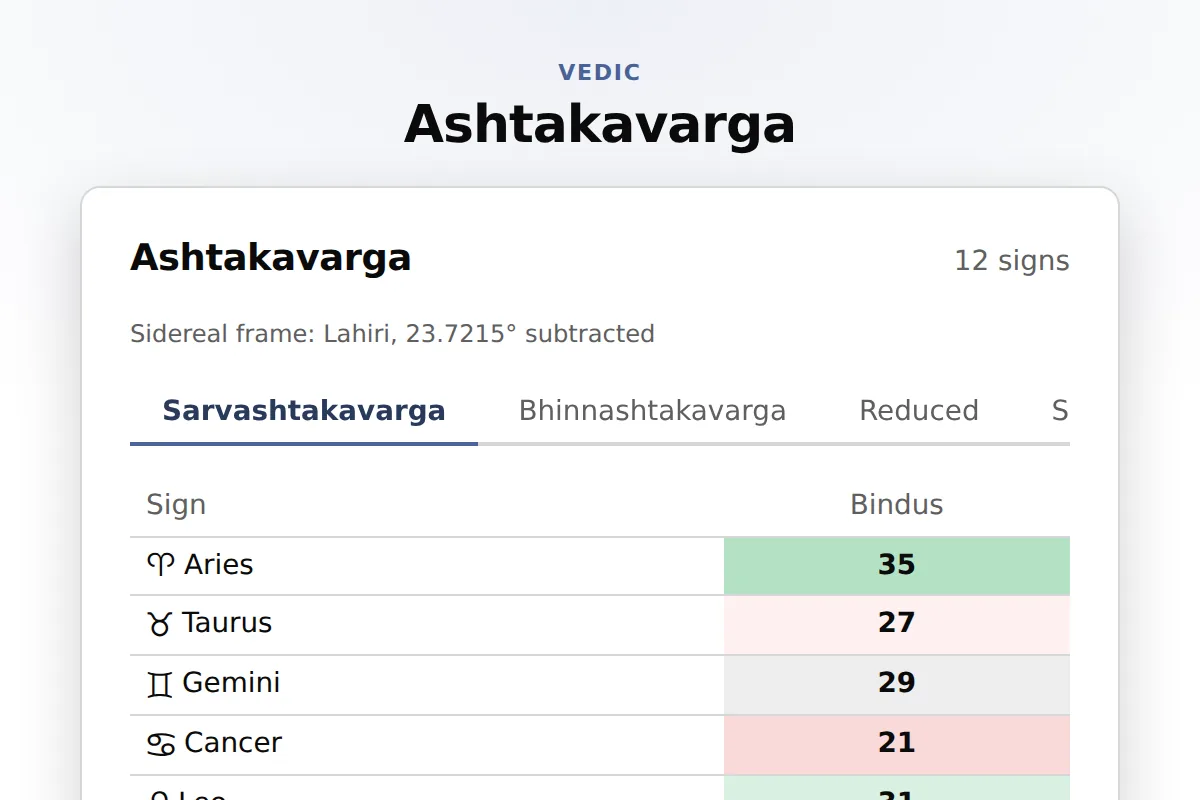
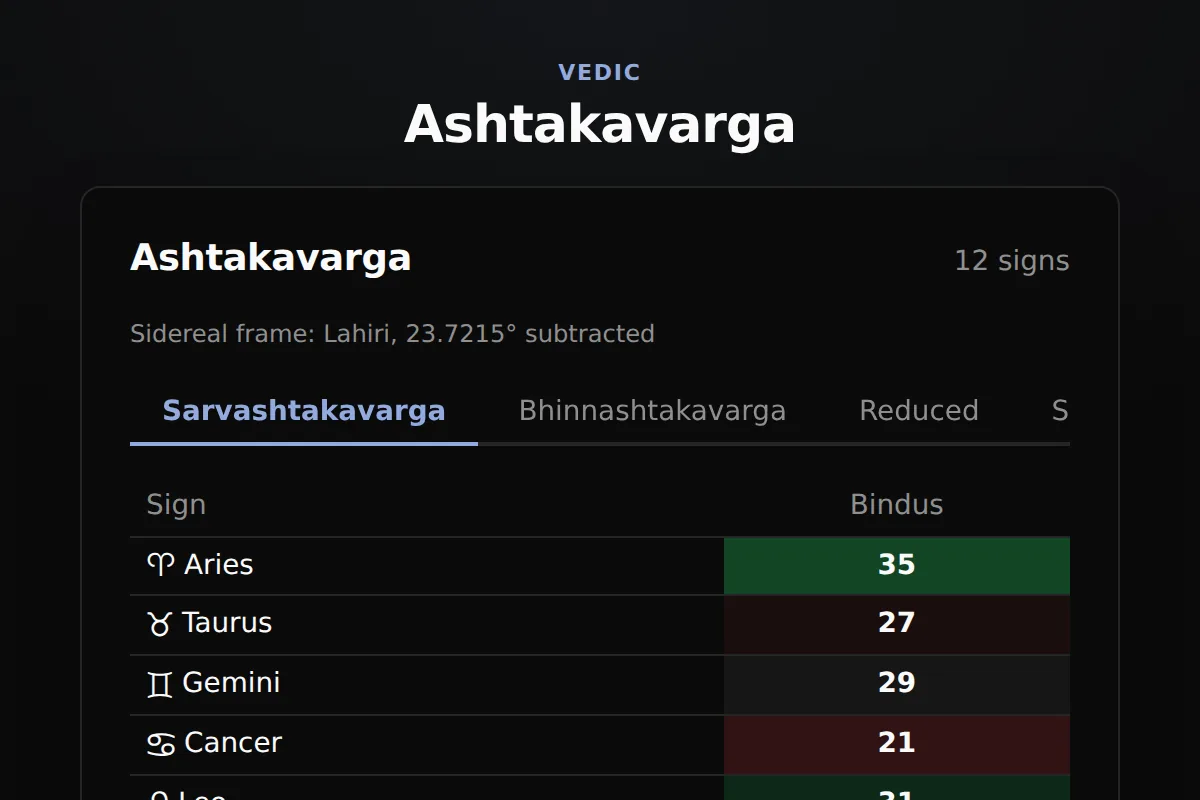
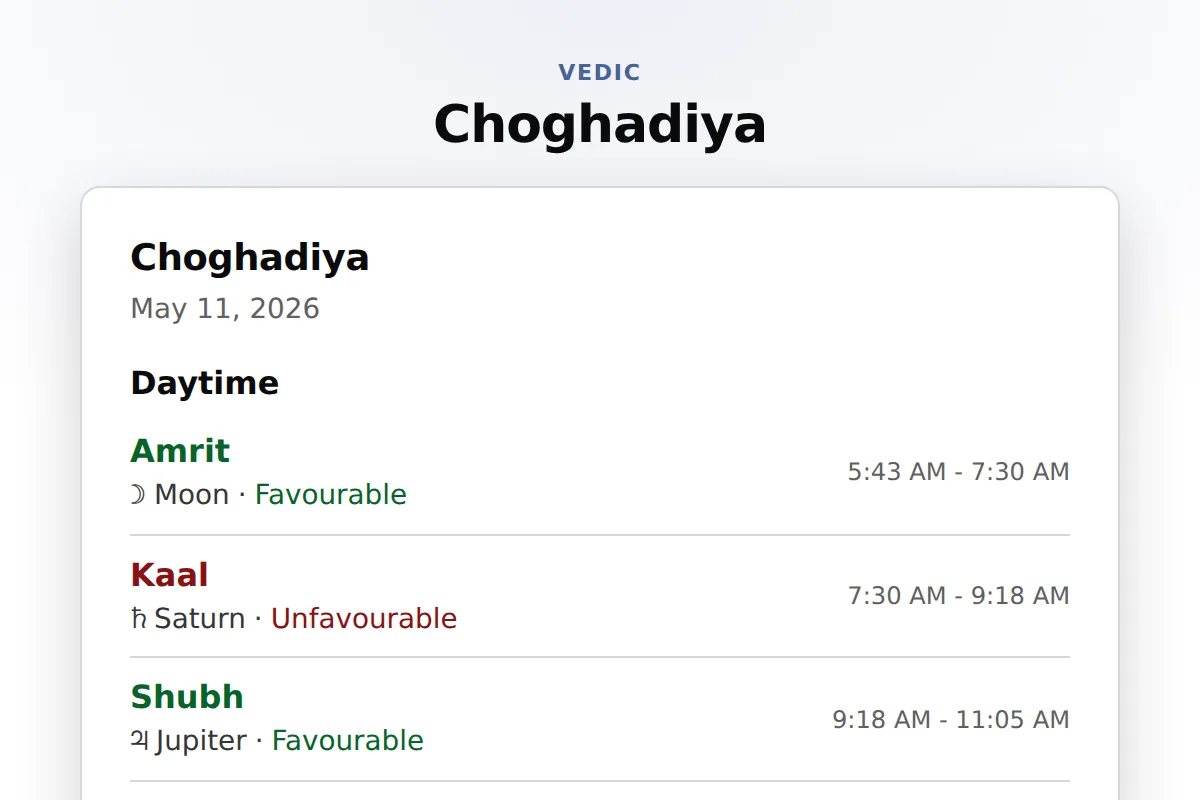
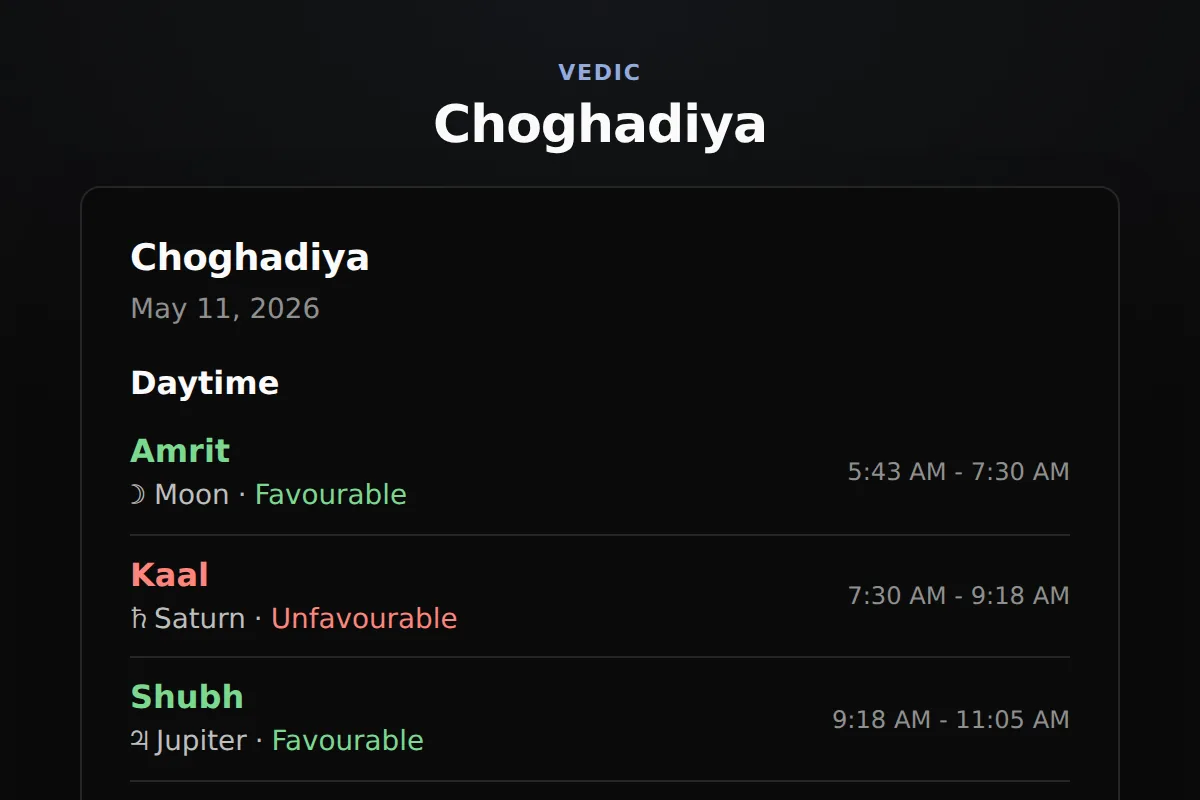
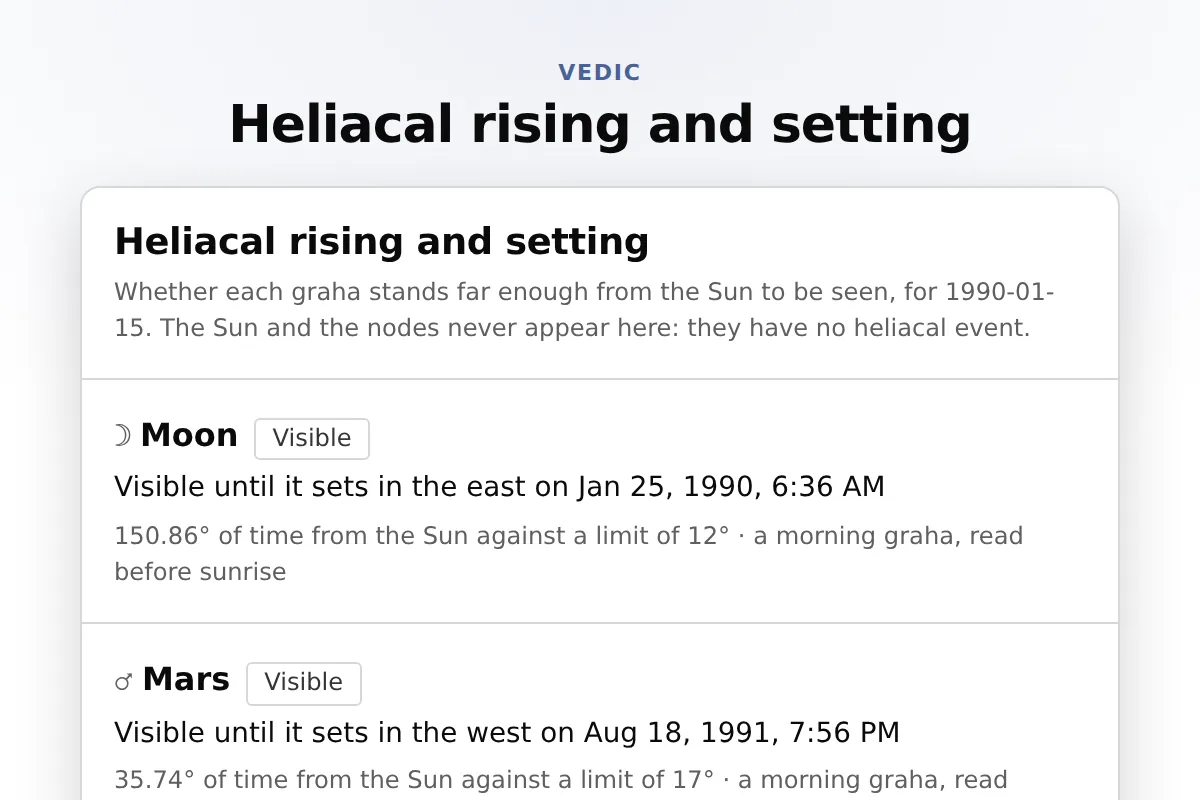
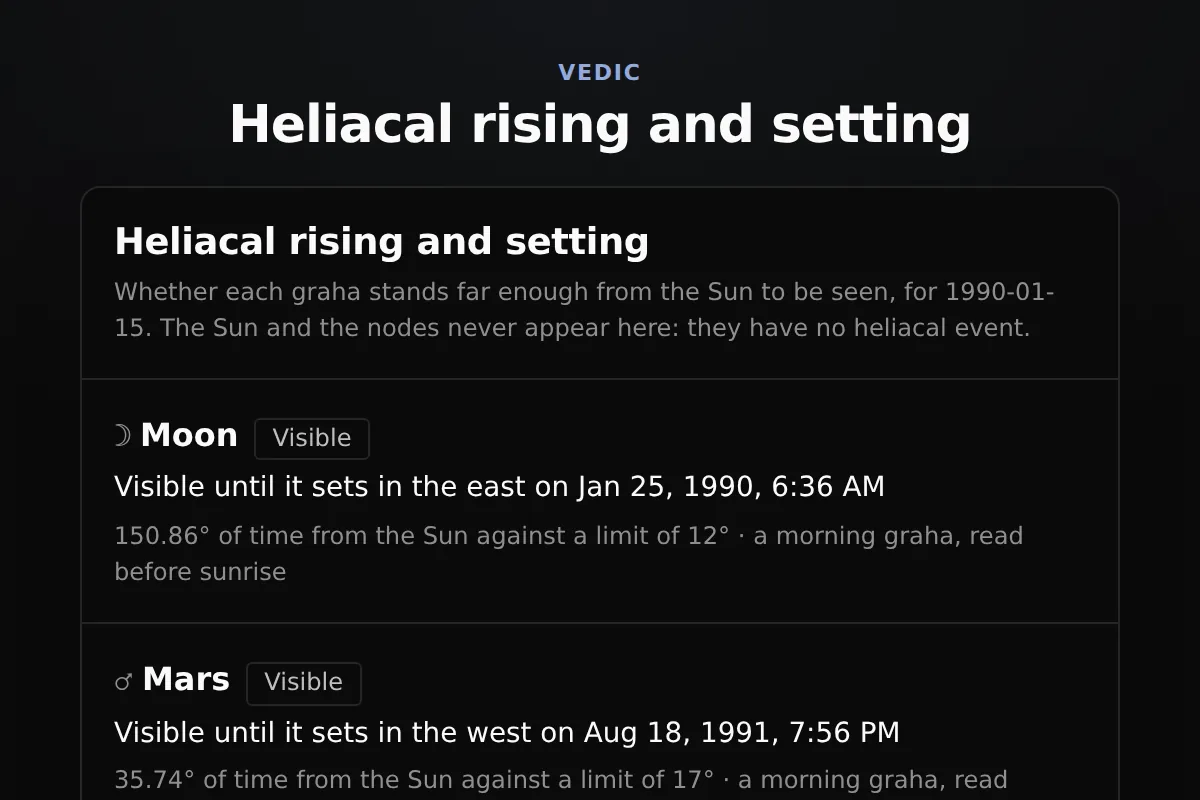
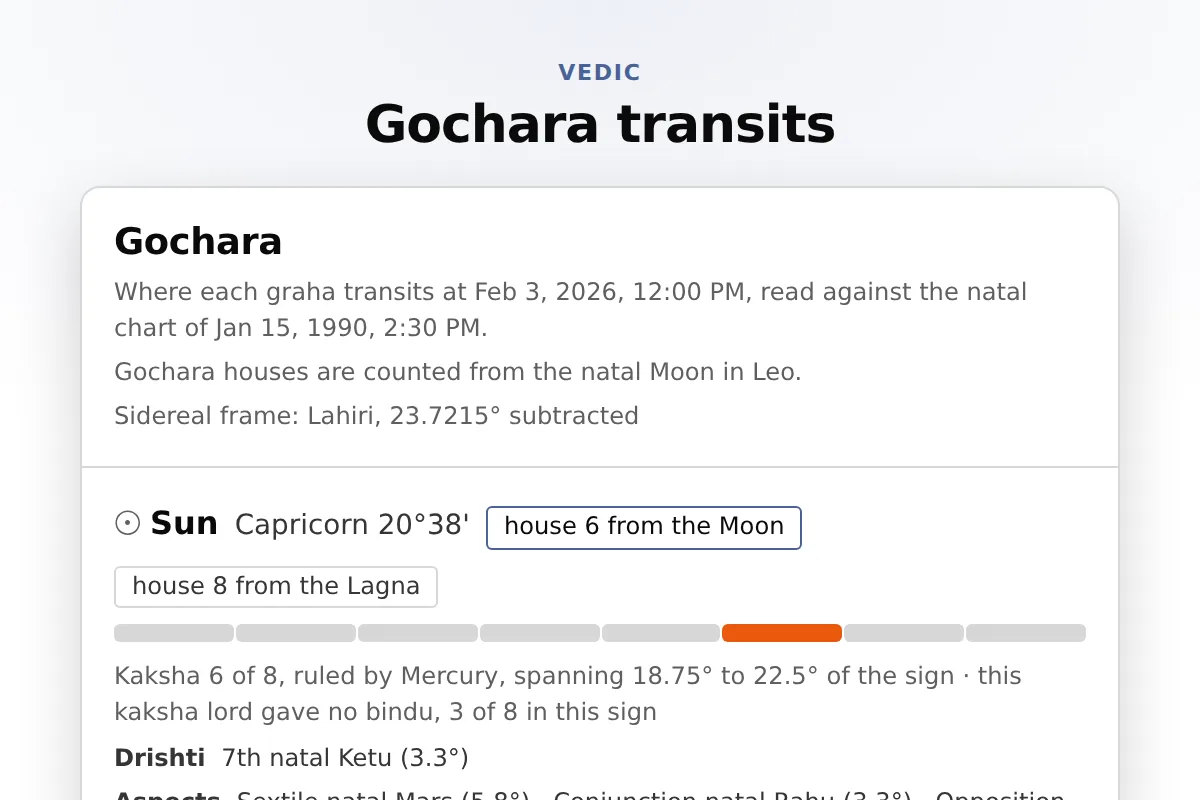
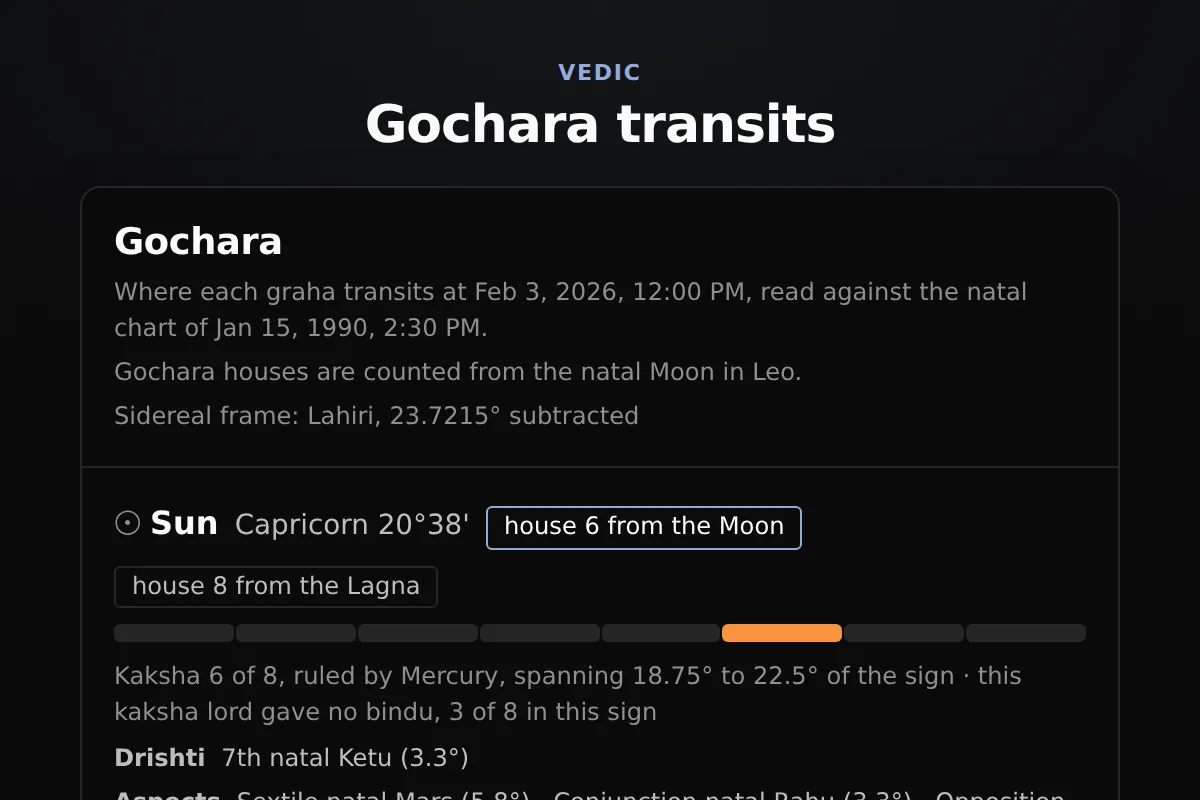
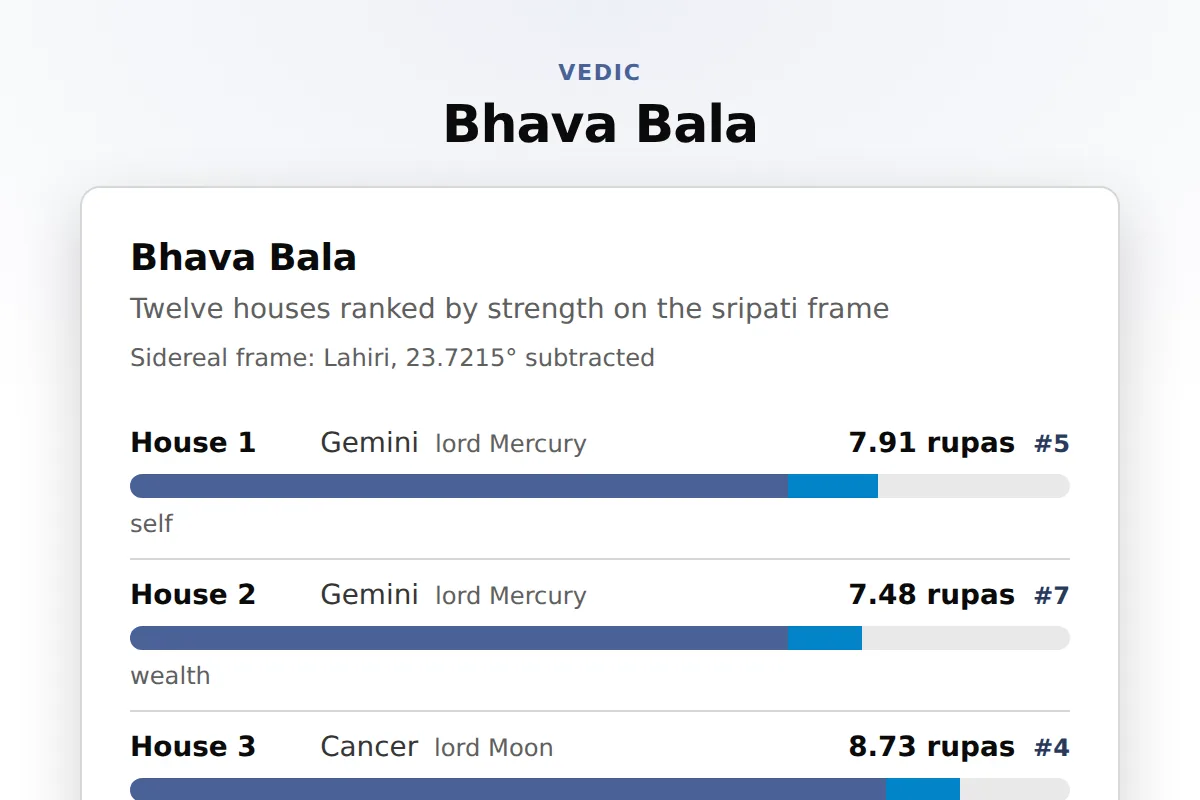
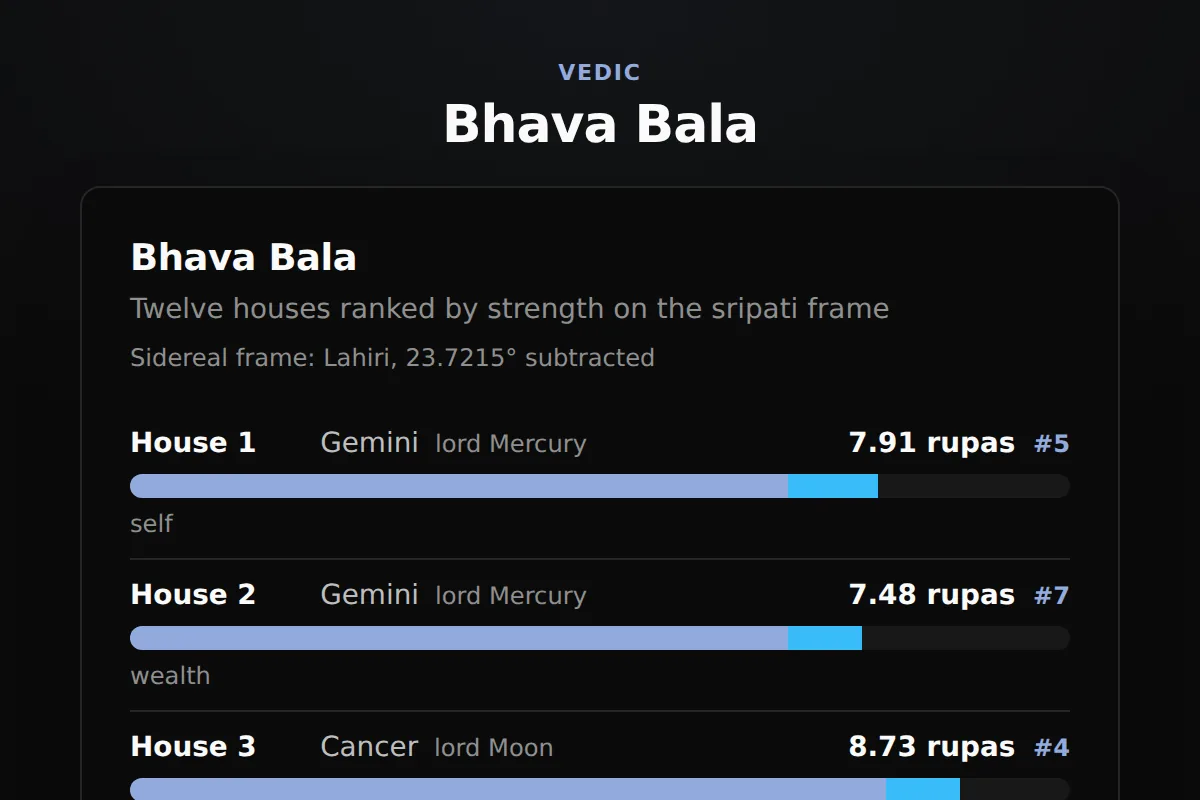
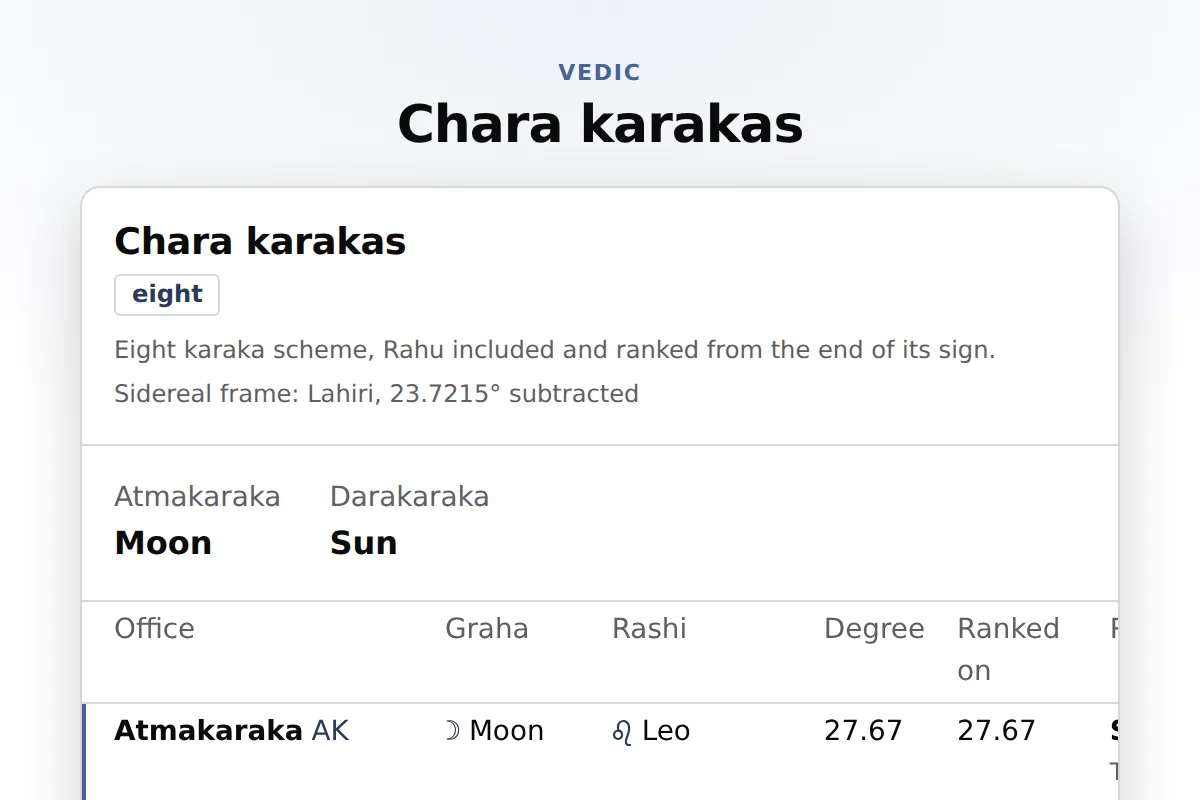
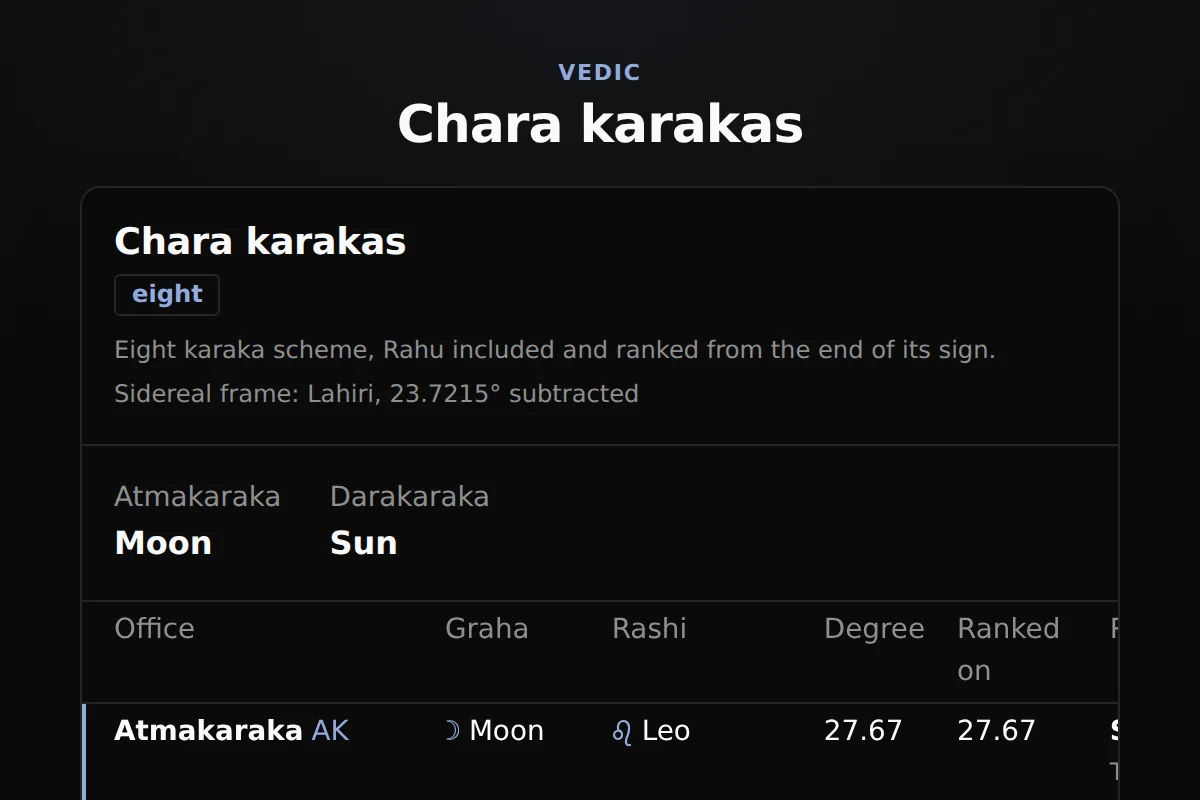
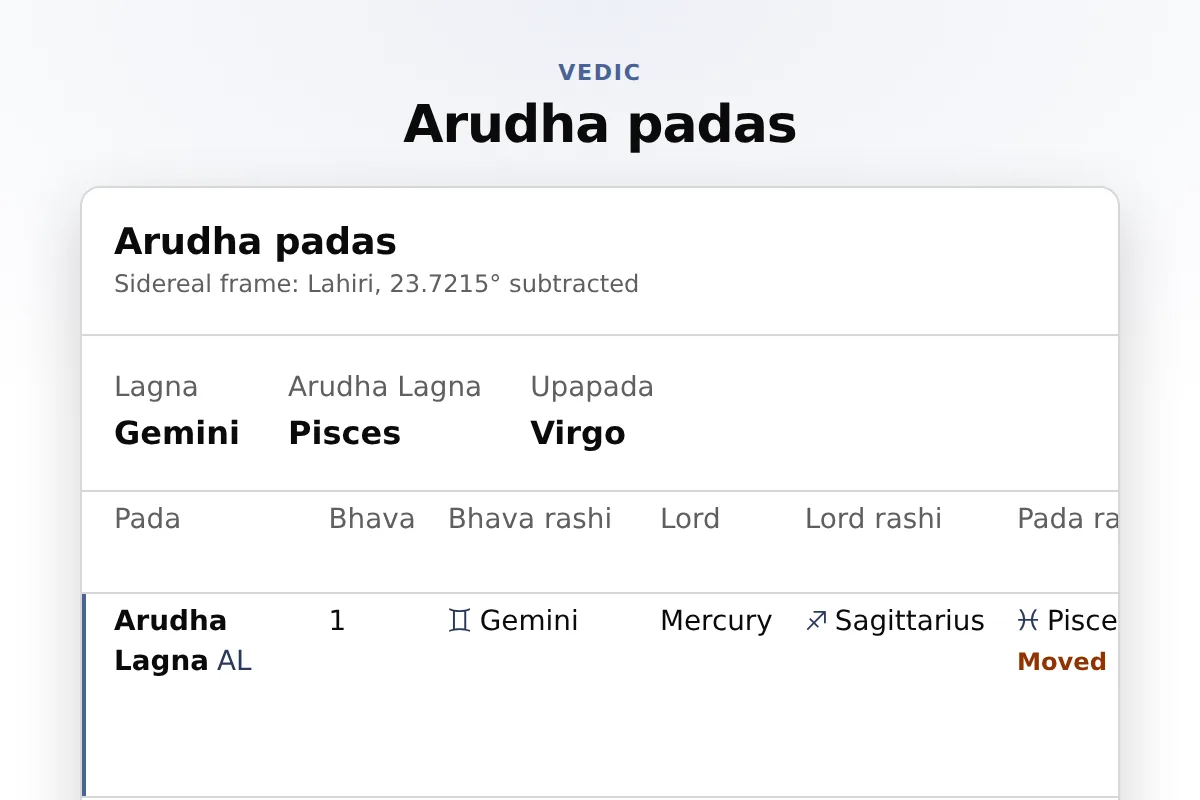
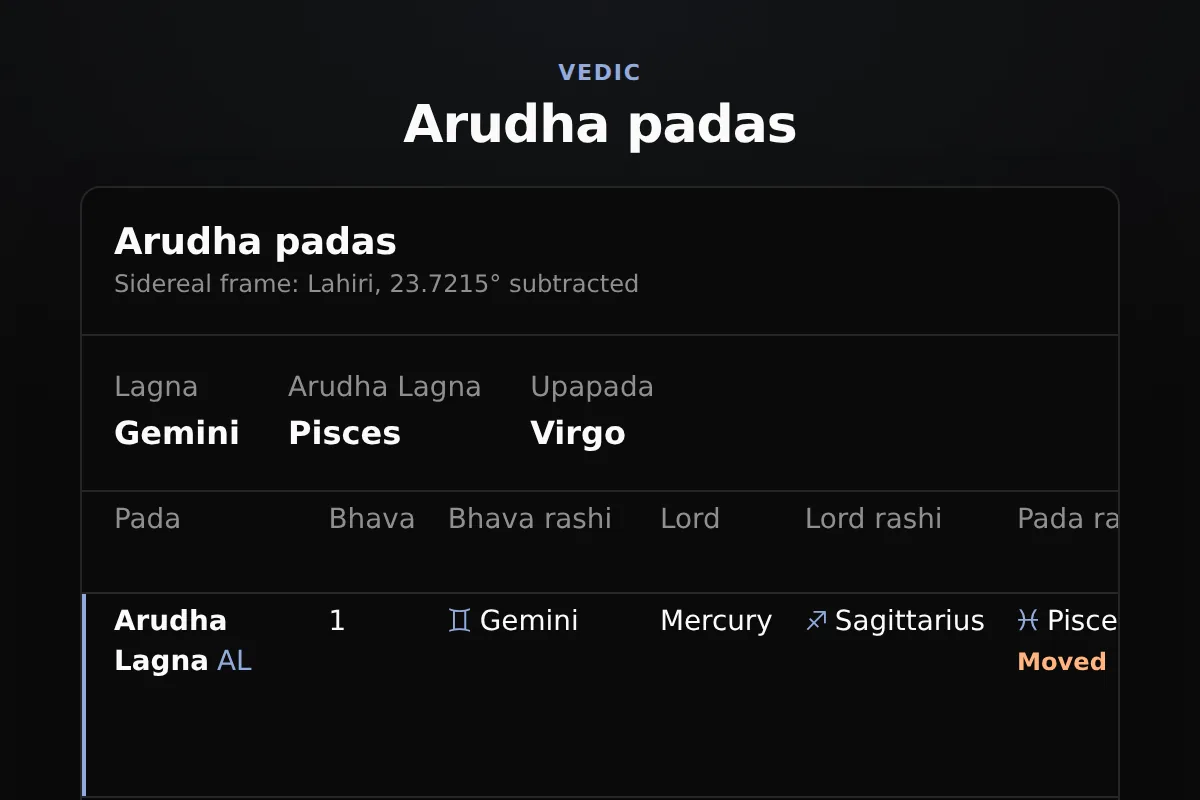
| Element | Renders |
|---|---|
<roxy-ephemeris-table> | Per-body sign changes and retrograde windows for the month, over the full daily position grid |
<roxy-vedic-kundli> | South, North, or East Indian kundli with degree detail and optional Chandra Lagna view |
<roxy-divisional-chart> | Generic divisional varga wheel from D2 Hora to D60 Shashtiamsa |
<roxy-kp-chart> | Ascendant, cusps, planets and nodes with KP stellar hierarchy and house meanings |
<roxy-vedic-planets-table> | Degree, nakshatra, pada, lord, bhava, Baladi, Jagradadi and Deeptadi columns |
<roxy-kp-planets-table> | Sub-lord and sub-sub-lord columns |
<roxy-kp-ruling-planets> | Day lord, Moon/Lagna hierarchies, ruling planets, significators with house meanings |
<roxy-ashtakavarga-grid> | Sarva, Bhinna, and Shodhya Pinda views in a tabbed heatmap |
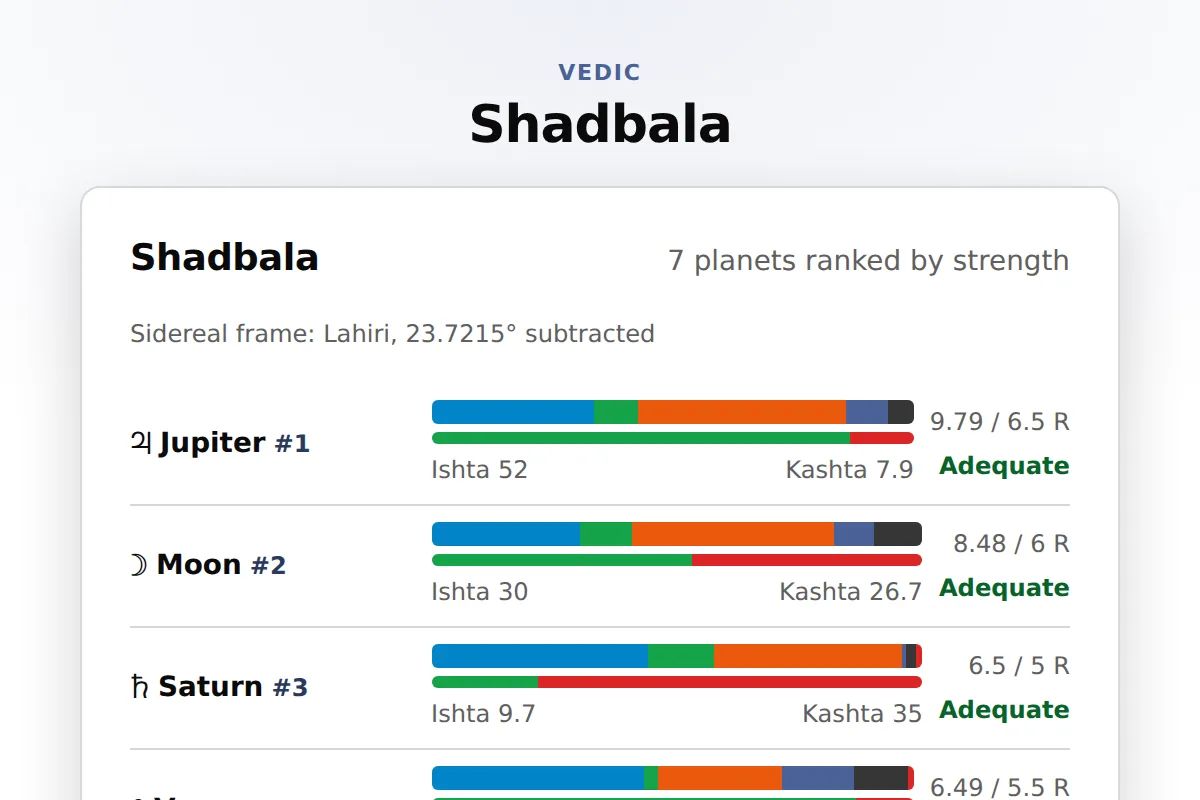
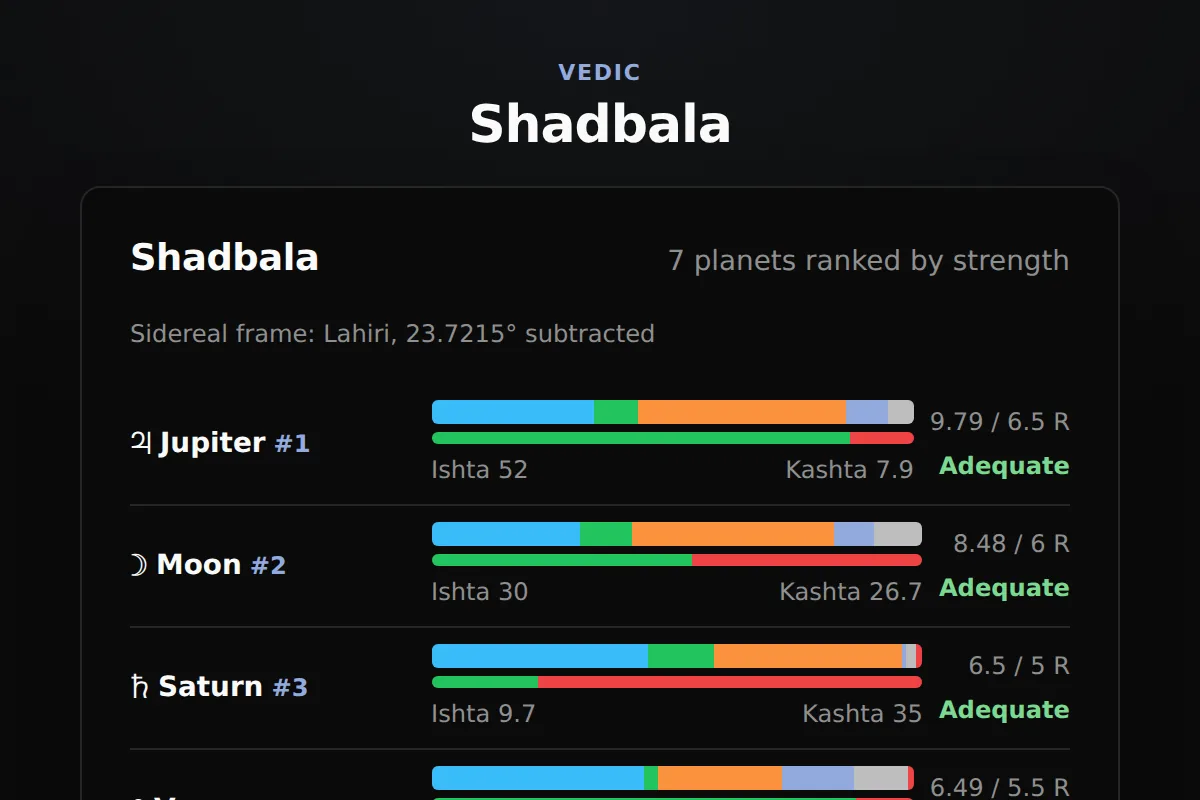
<roxy-shadbala-table> | Six-fold planetary strength bar plus rupas and adequacy badge |
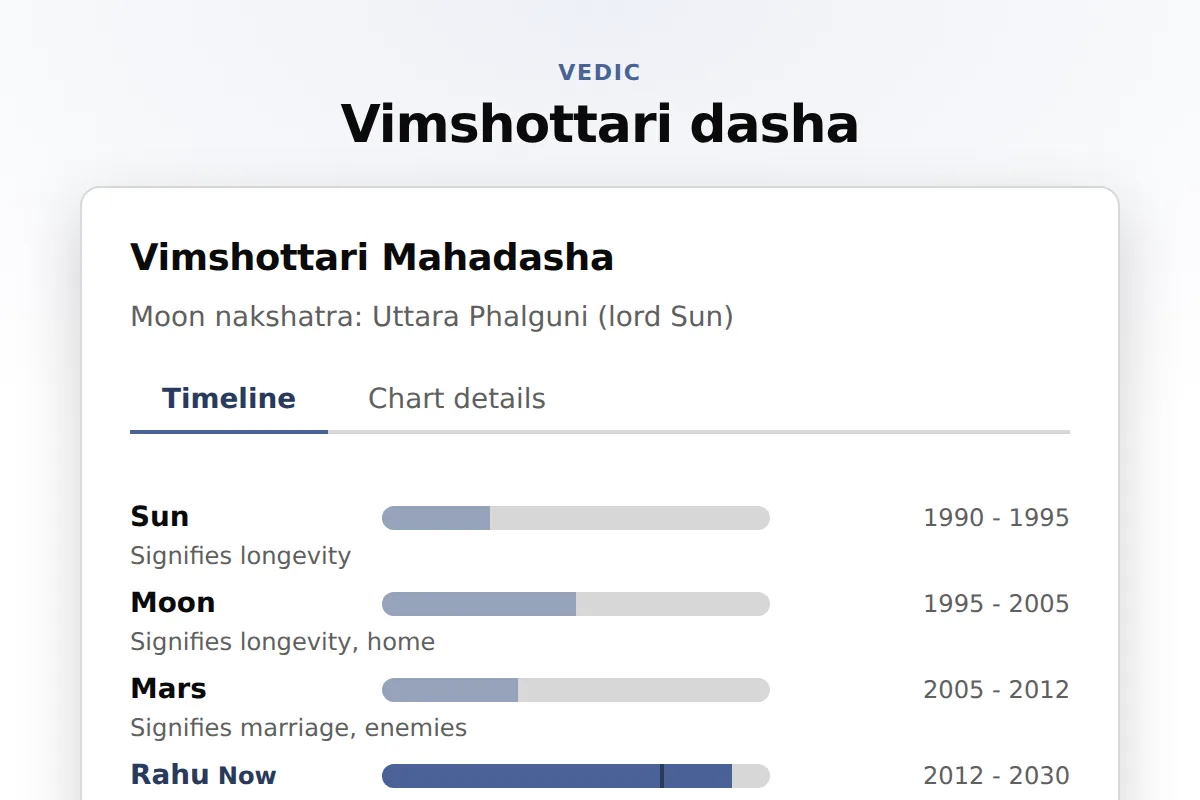
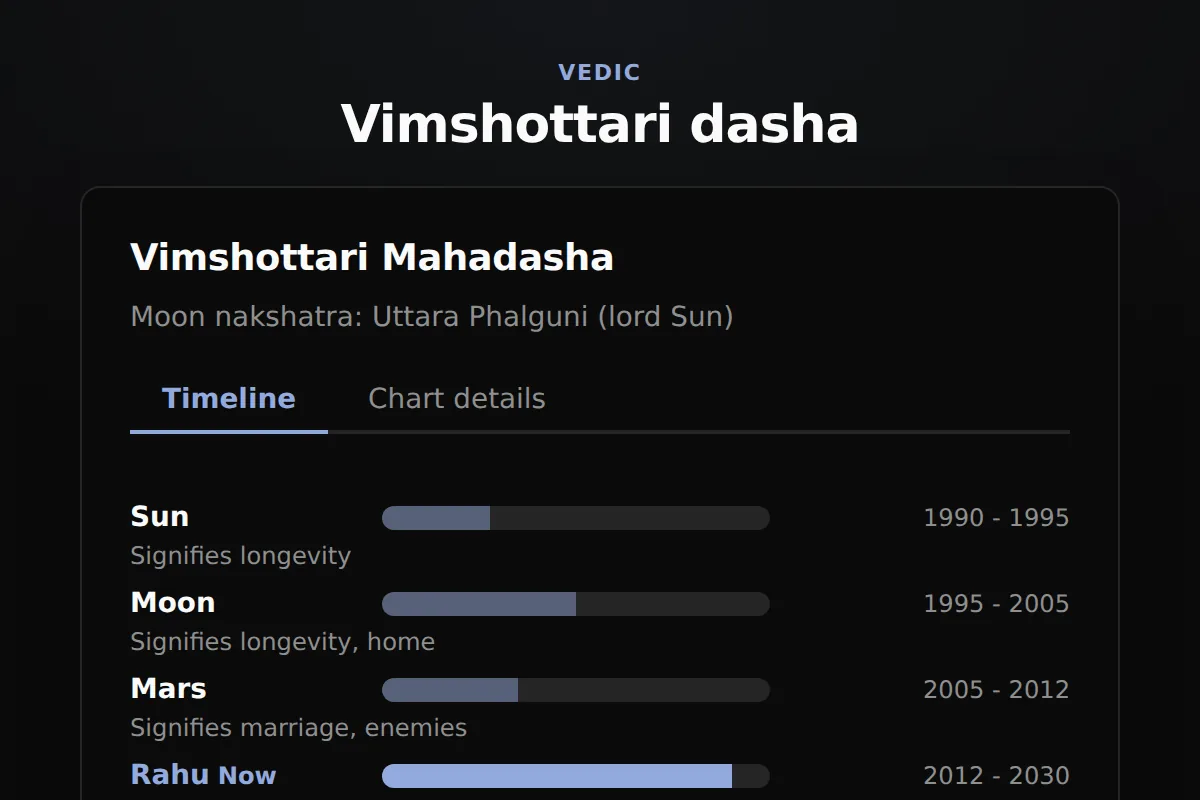
<roxy-dasha-timeline> | Vimshottari mahadasha, antardasha, pratyantardasha, sookshma and prana, drill-down at every level |
<roxy-guna-milan> | 36-point Ashtakoota with eight sub-scores |
<roxy-panchang-table> | 15+ muhurtas in detailed mode |
<roxy-vedic-aspects> | Graha drishti rows with aspect type, strength, and orb, plus mutual aspects |
<roxy-hora-table> | Day and night planetary hours with ruling planet and window |
<roxy-choghadiya-grid> | Day and night Choghadiya muhurta tiles colored by effect |
<roxy-heliacal-table> | Udaya and asta windows for the six visible grahas, the calculation behind Guru Asta and Shukra Asta |
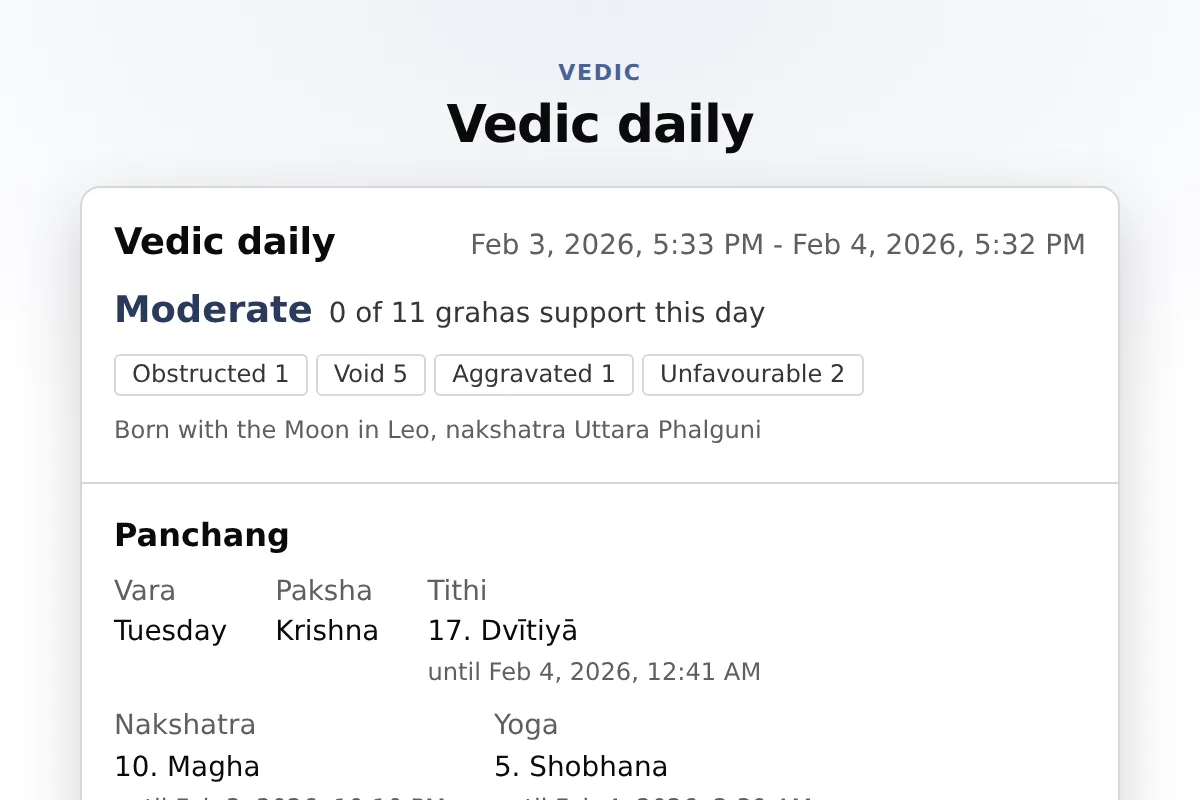
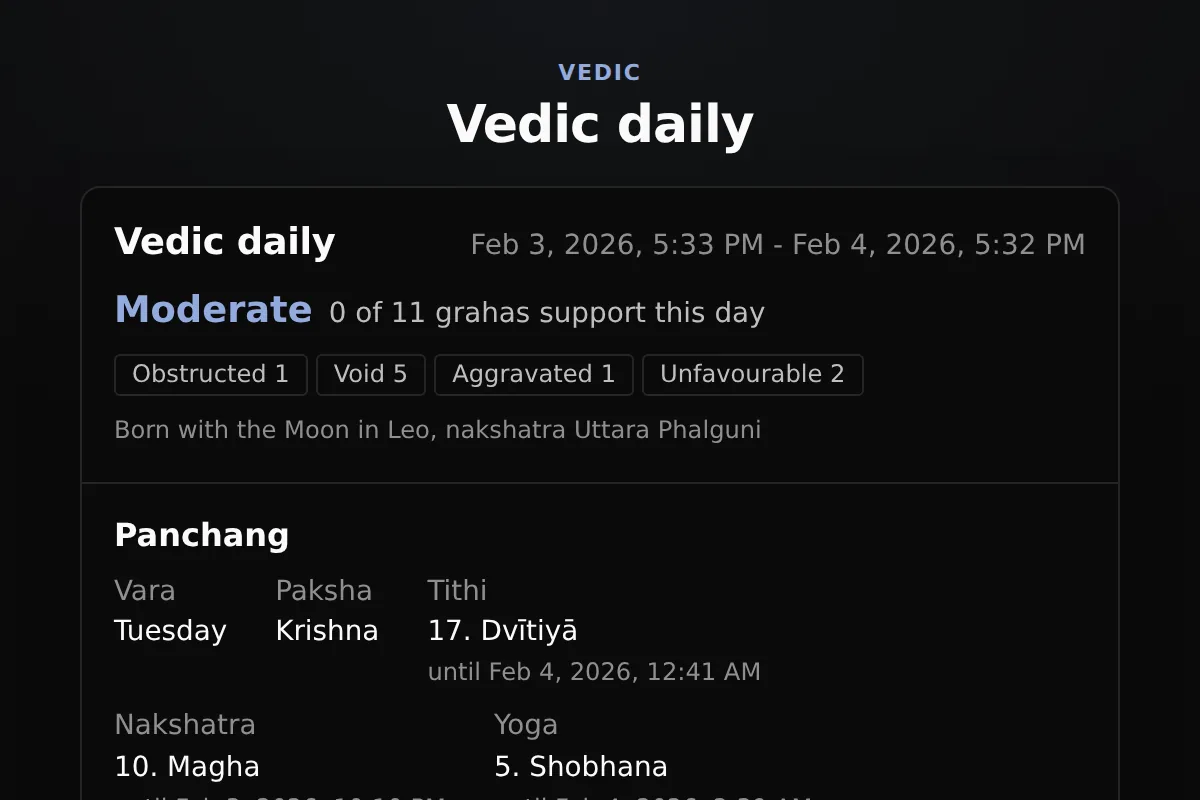
<roxy-vedic-daily> | Composed Vedic daily reading with the classical rule behind every graha state, the Tara and Chandrabala windows in full, and all three sidereal frames named |
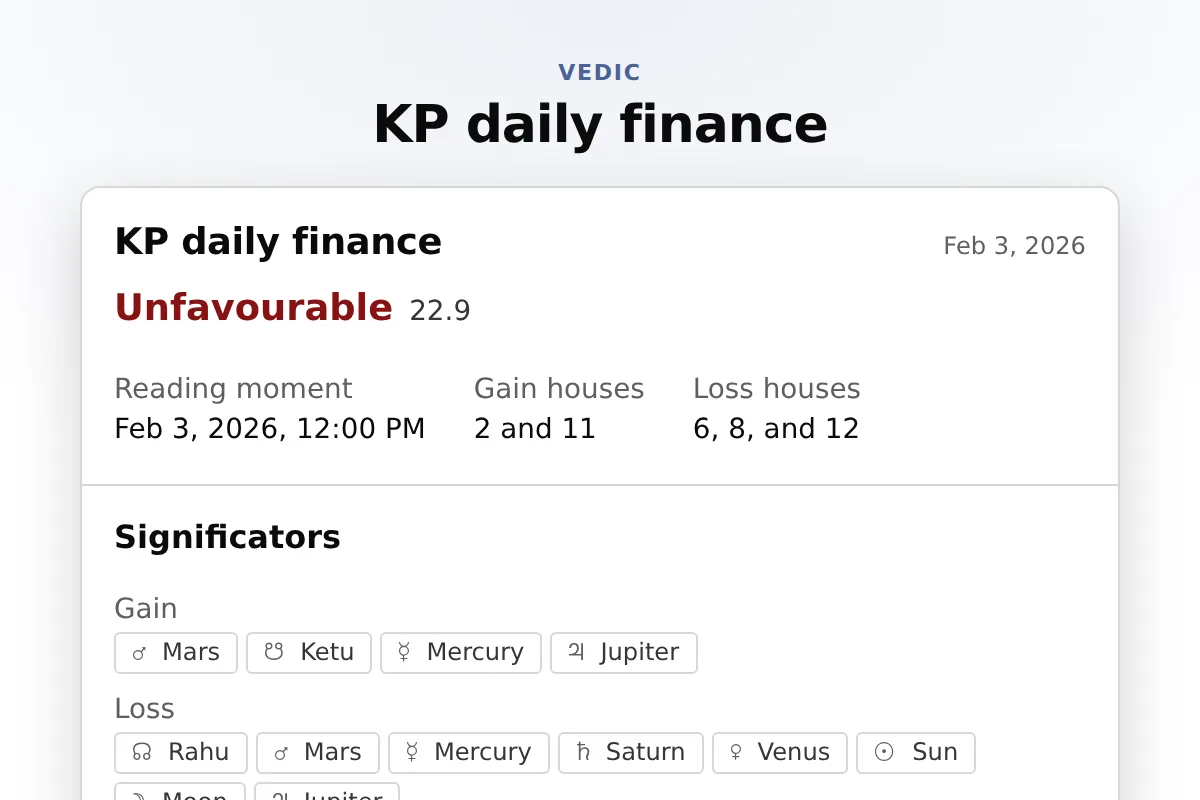
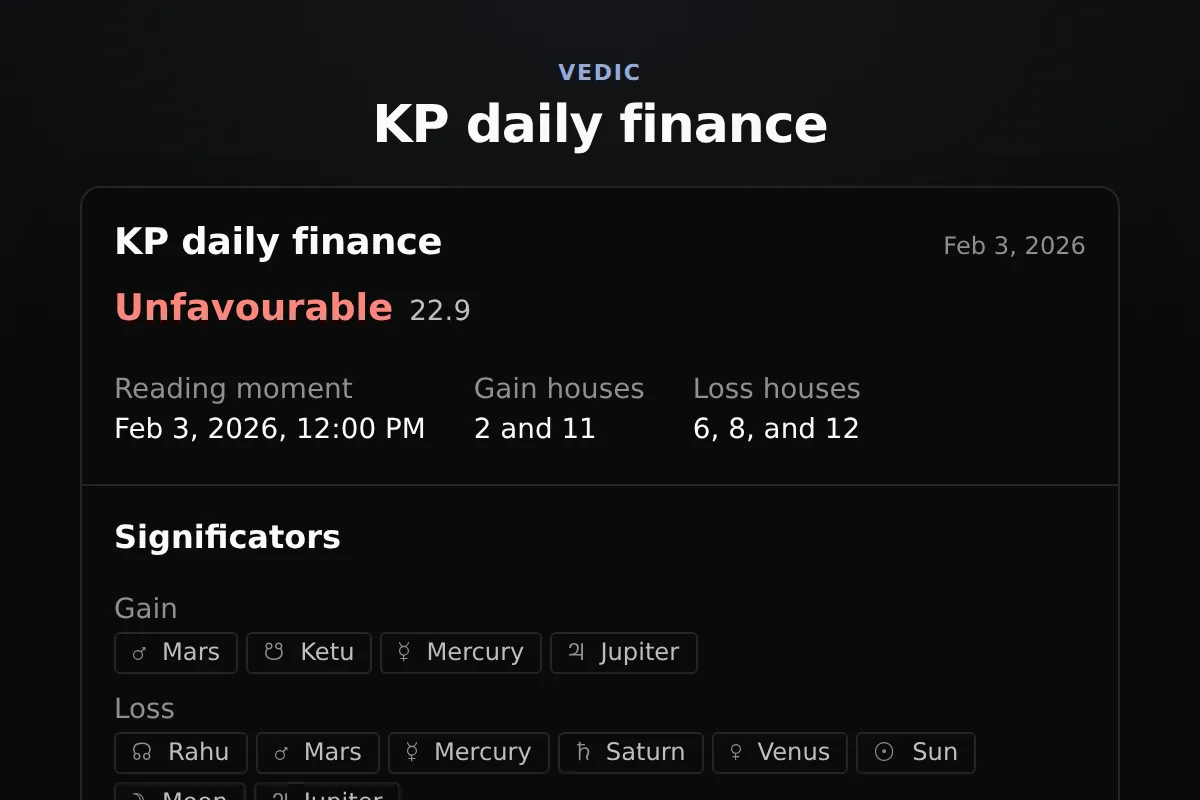
<roxy-kp-finance-card> | KP daily finance reading with the cusp sub lords, the running dasha lords, the ruling planets and the Moon sub lord windows each scored against the gain and loss houses, weighed into one band for the day |
<roxy-gochara-table> | Vedic gochara with aspects to the natal chart and the Gochara Kaksha reading drawn as a position within the sign |
<roxy-bhava-bala-table> | House strength in rupas and virupas, ranked, with Bhavadhipati, Dig and Drishti Bala shown as proportions of the total |
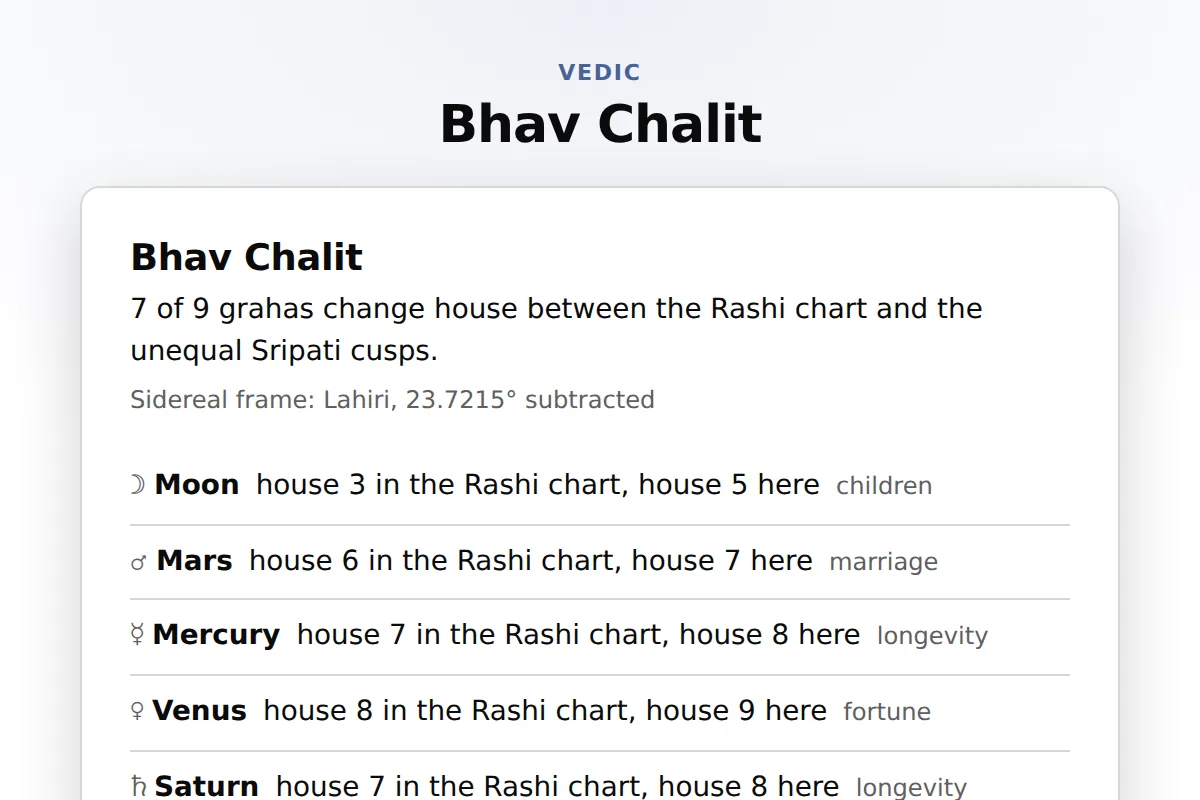
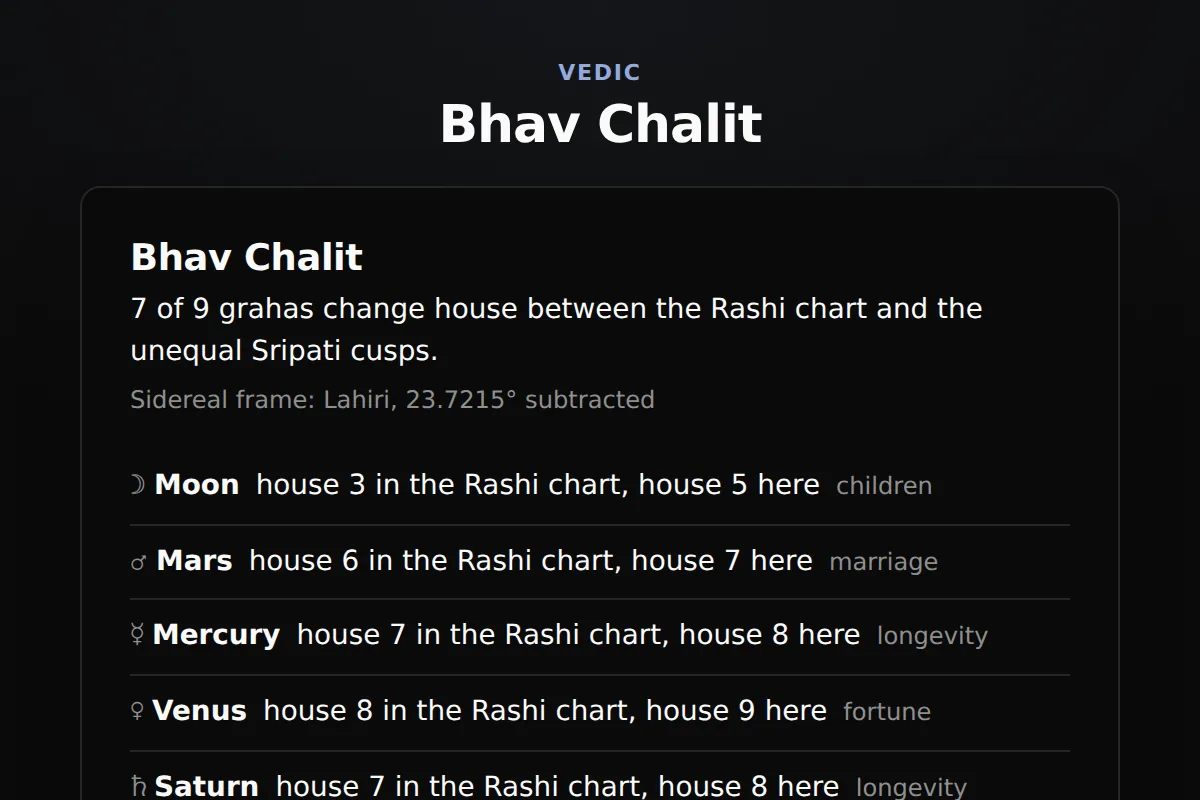
<roxy-bhav-chalit-table> | The Chalit chart against the Rashi chart, leading with how many grahas move and which, plus the unequal bhava spans |
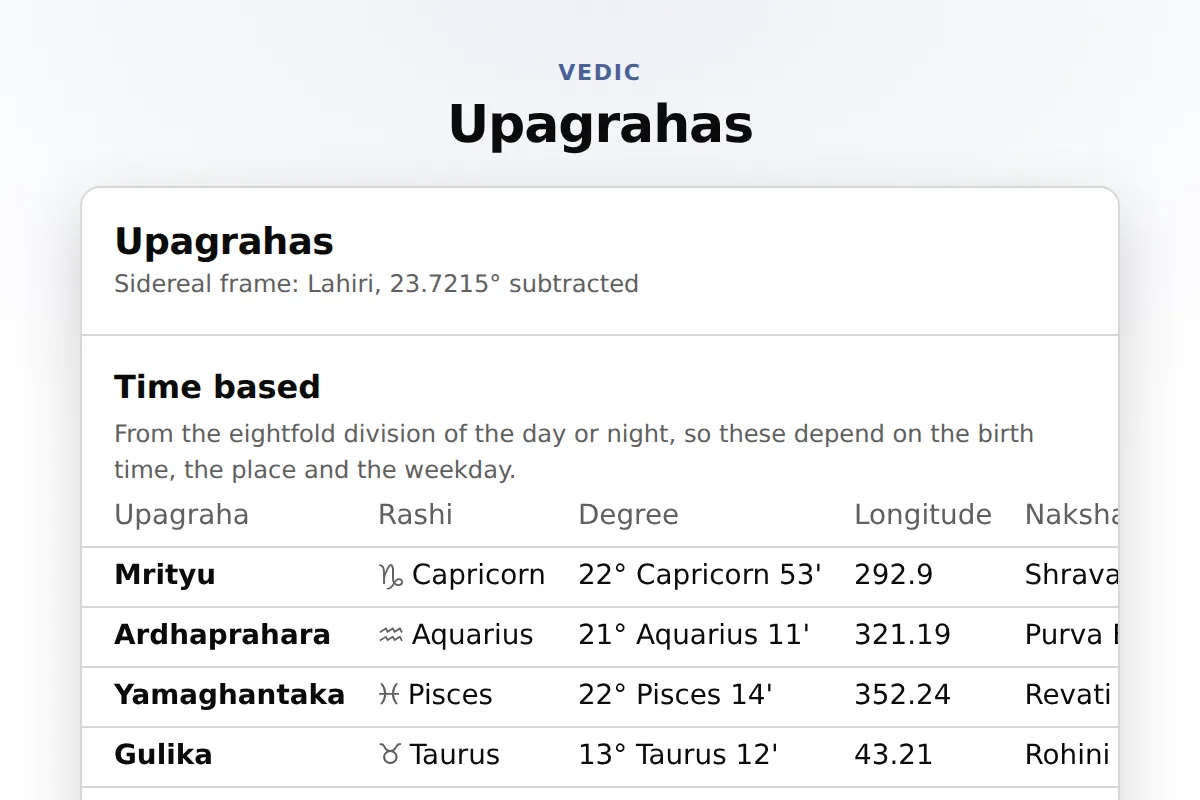
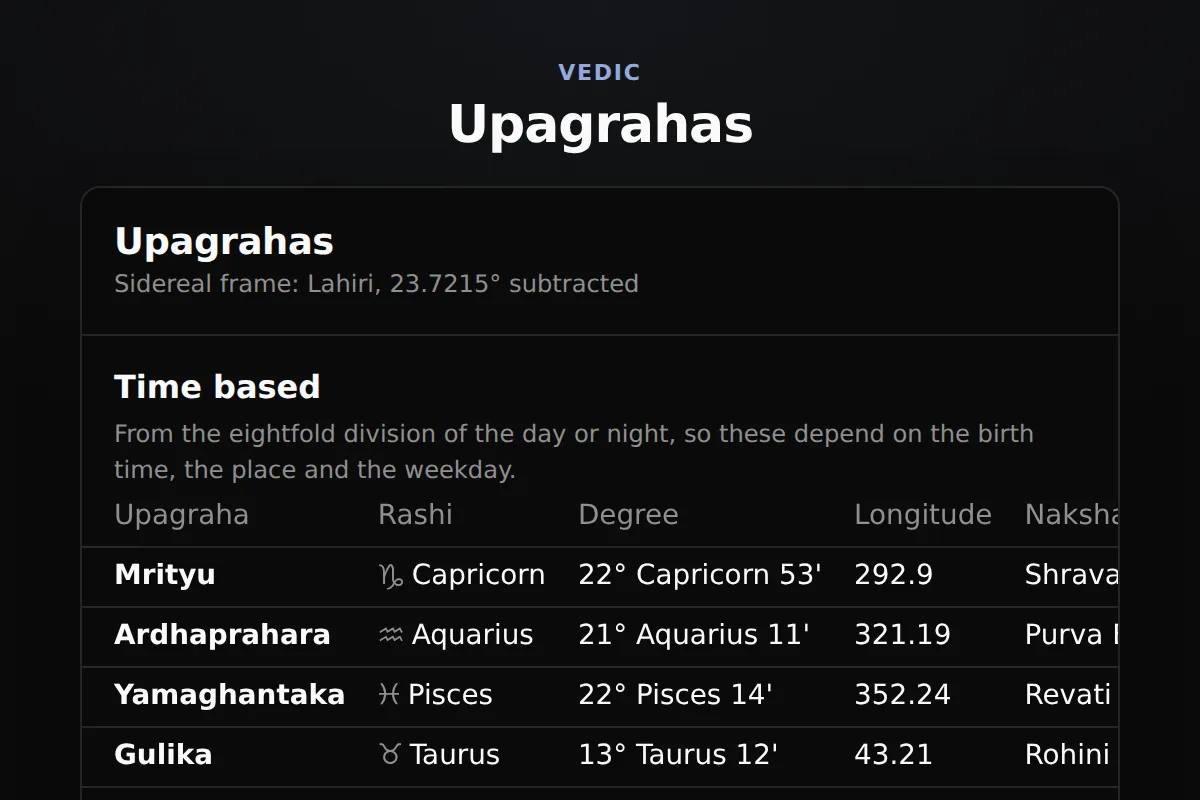
<roxy-upagraha-table> | Time-based and Sun-based upagrahas with rashi, degree, longitude and nakshatra |
<roxy-chara-karakas> | Karaka offices in rank order with graha, degree, scheme, and what each is read for |
<roxy-arudha-padas> | Twelve padas with bhava, lord, pada rashi, house from Lagna, and the classical exception marked |
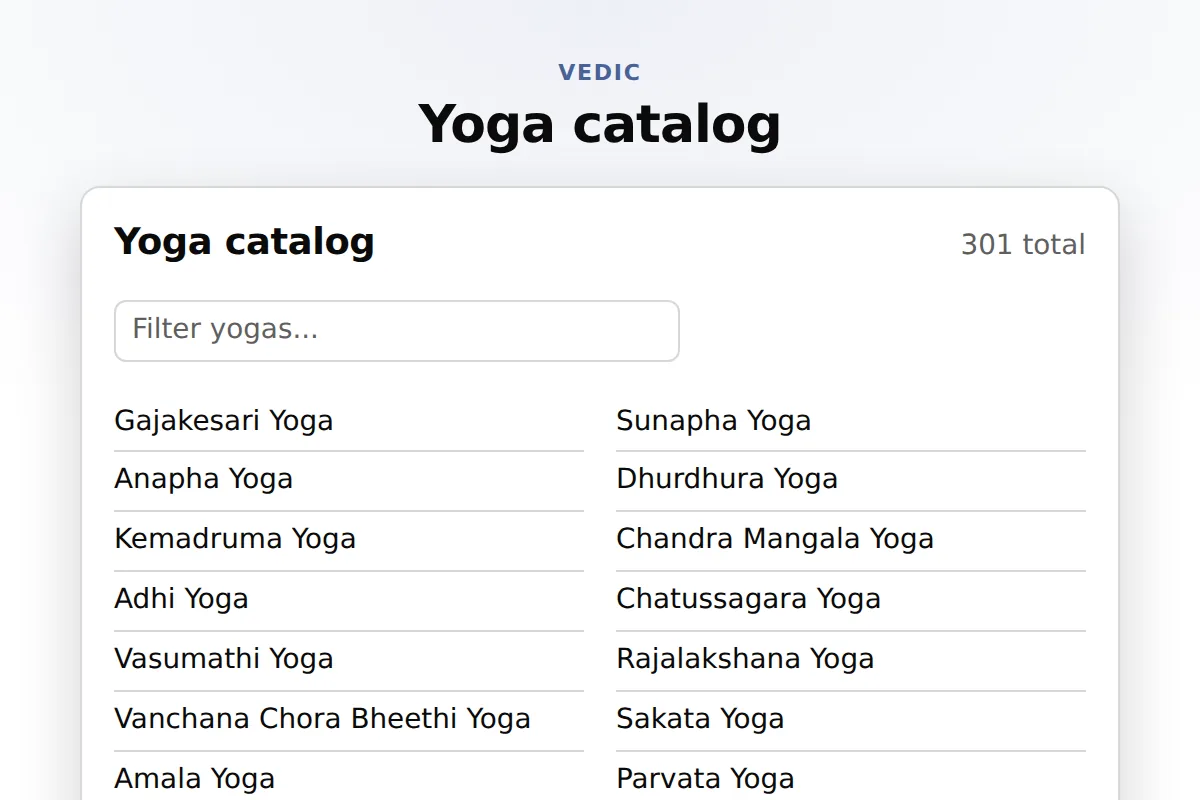
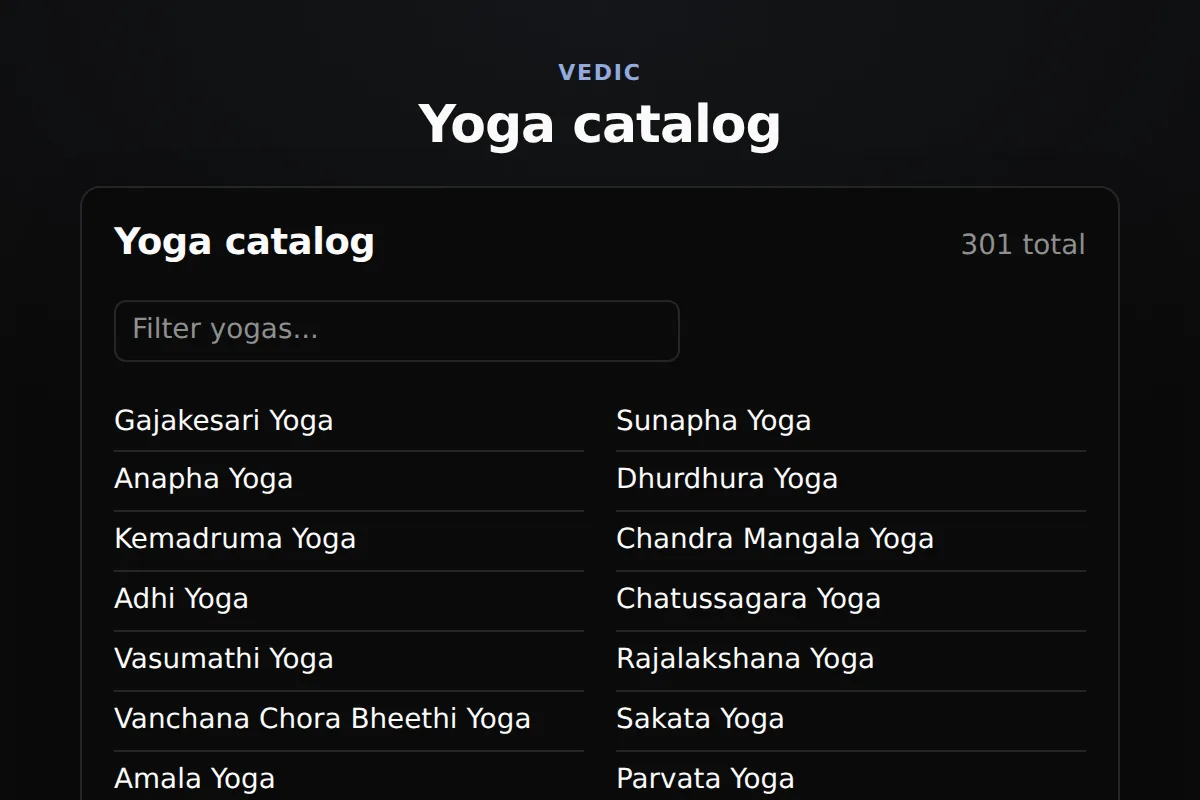
<roxy-yoga-list> | Filterable yoga cards from the 300 plus yoga catalog, grouped by verdict in detect mode |
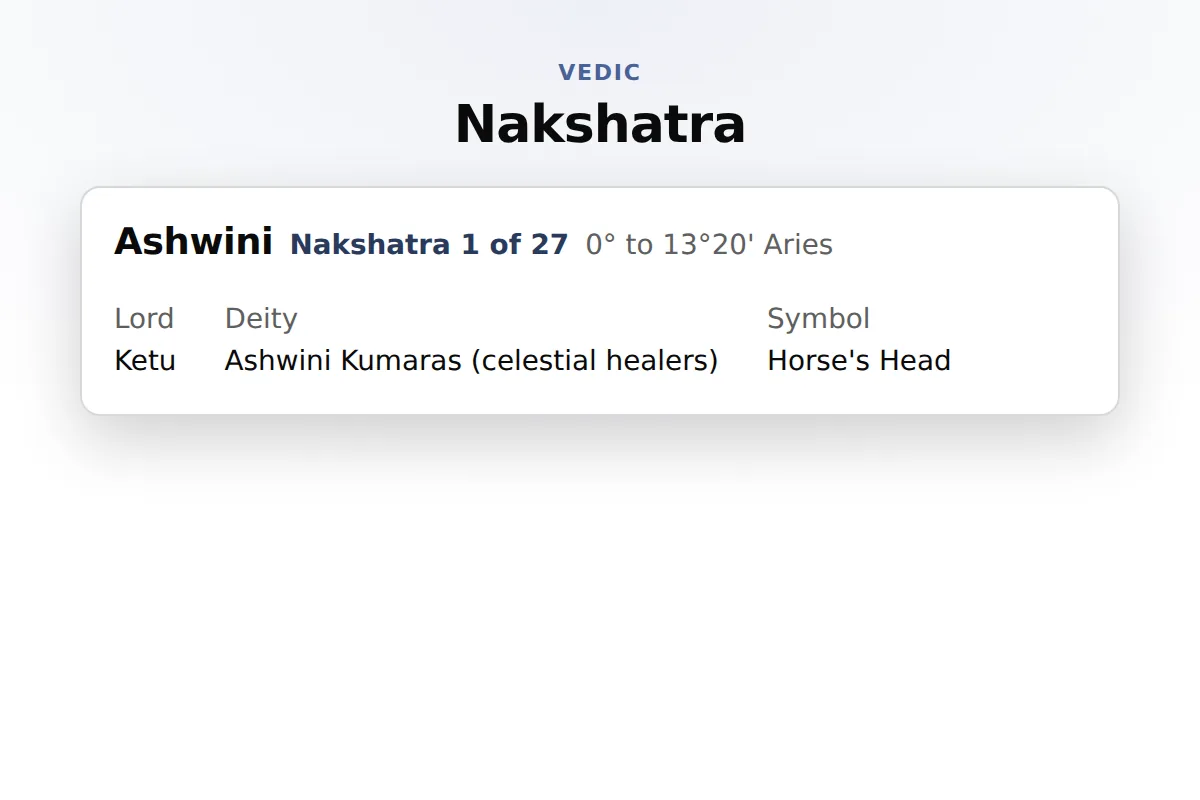
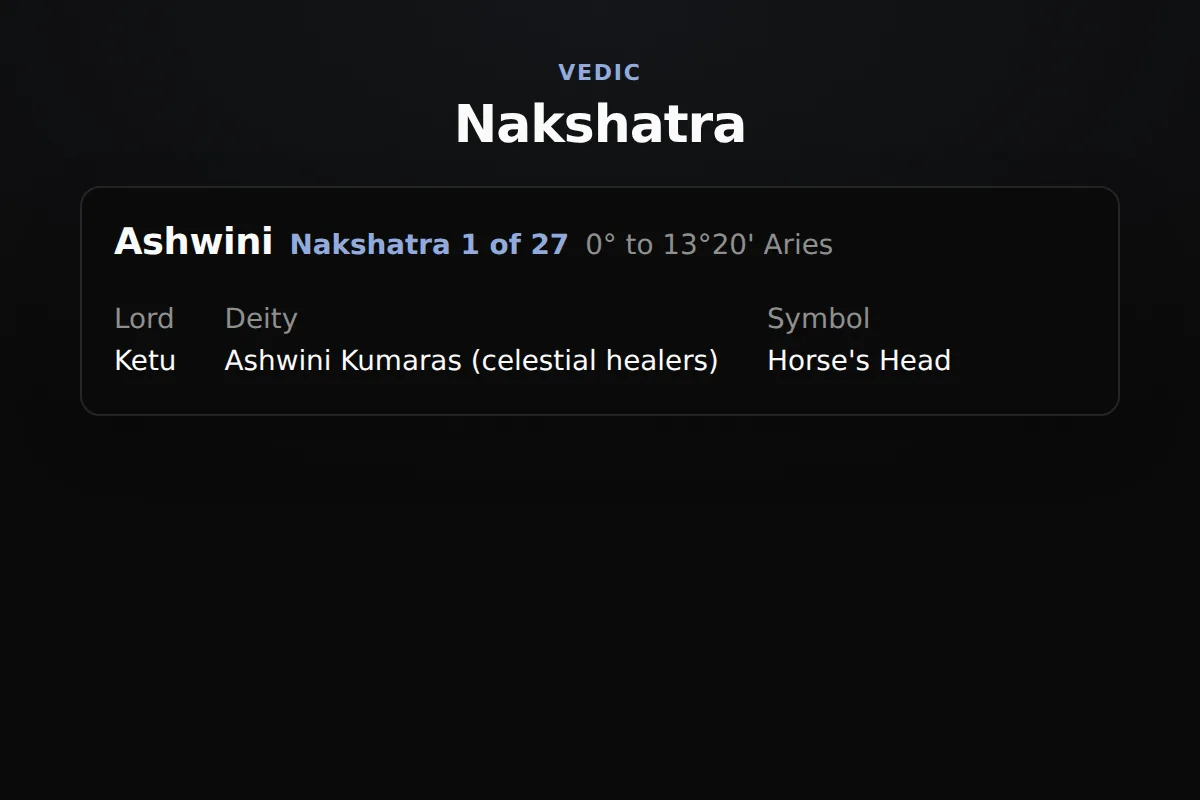
<roxy-nakshatra-card> | Lord, deity, symbol, characteristics, remedies |
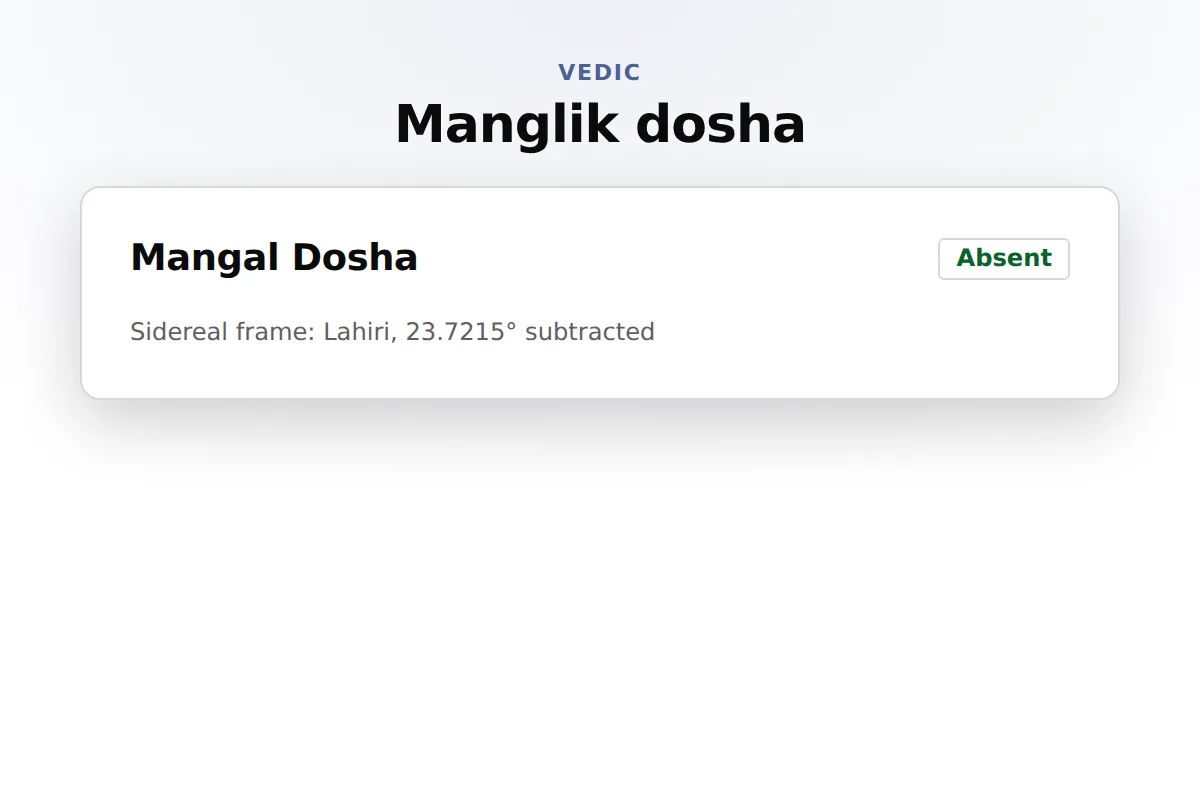
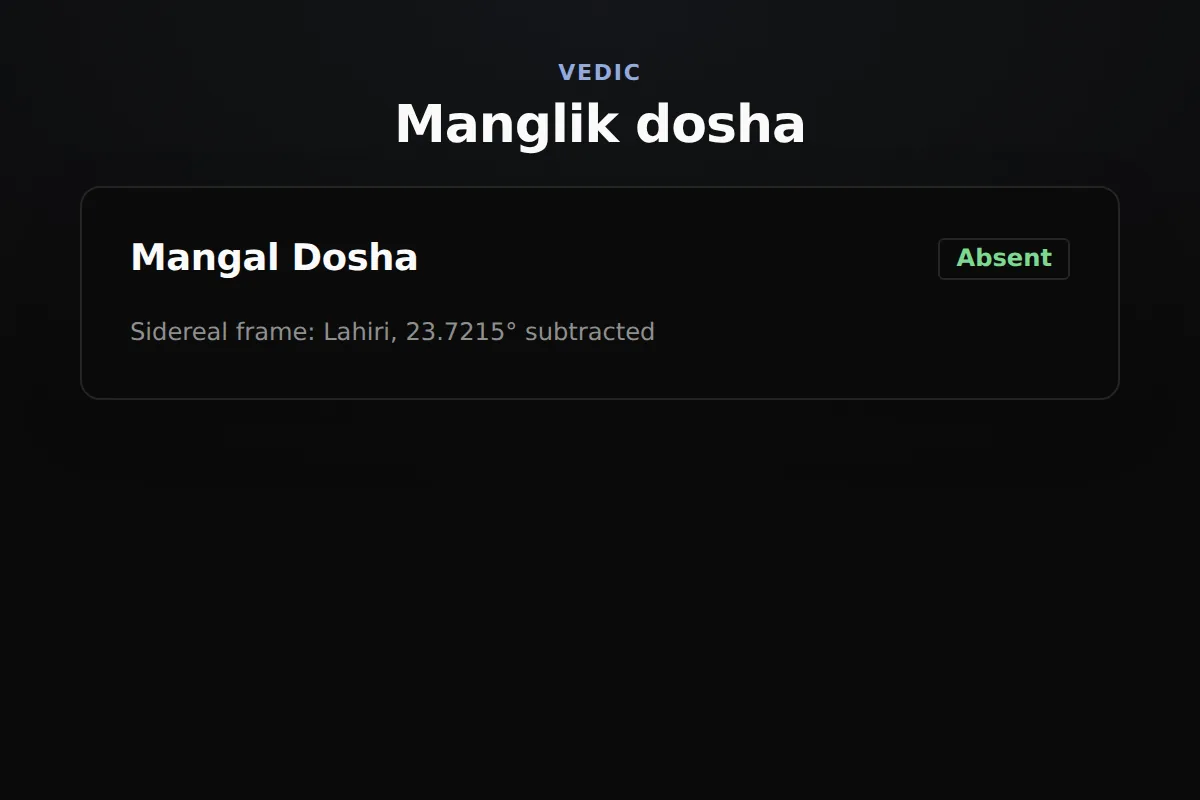
<roxy-dosha-card> | Presence, severity, remedies, scoped effects |
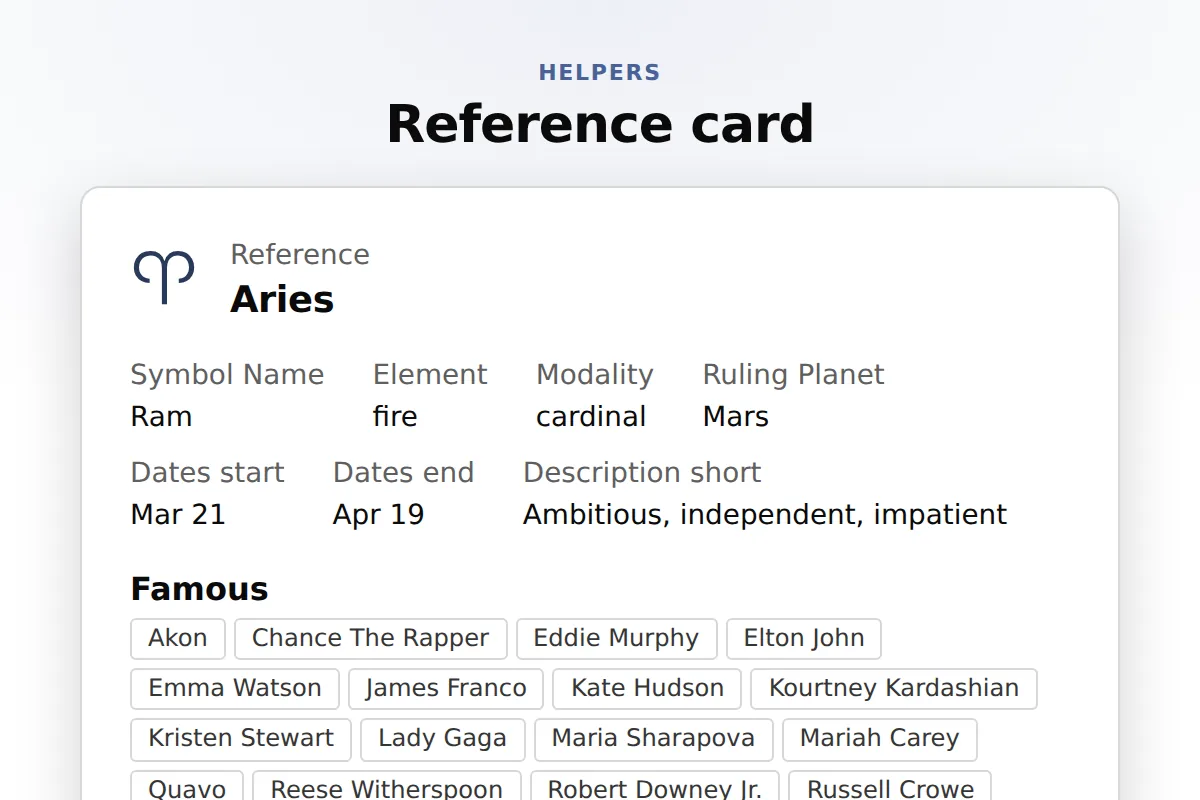
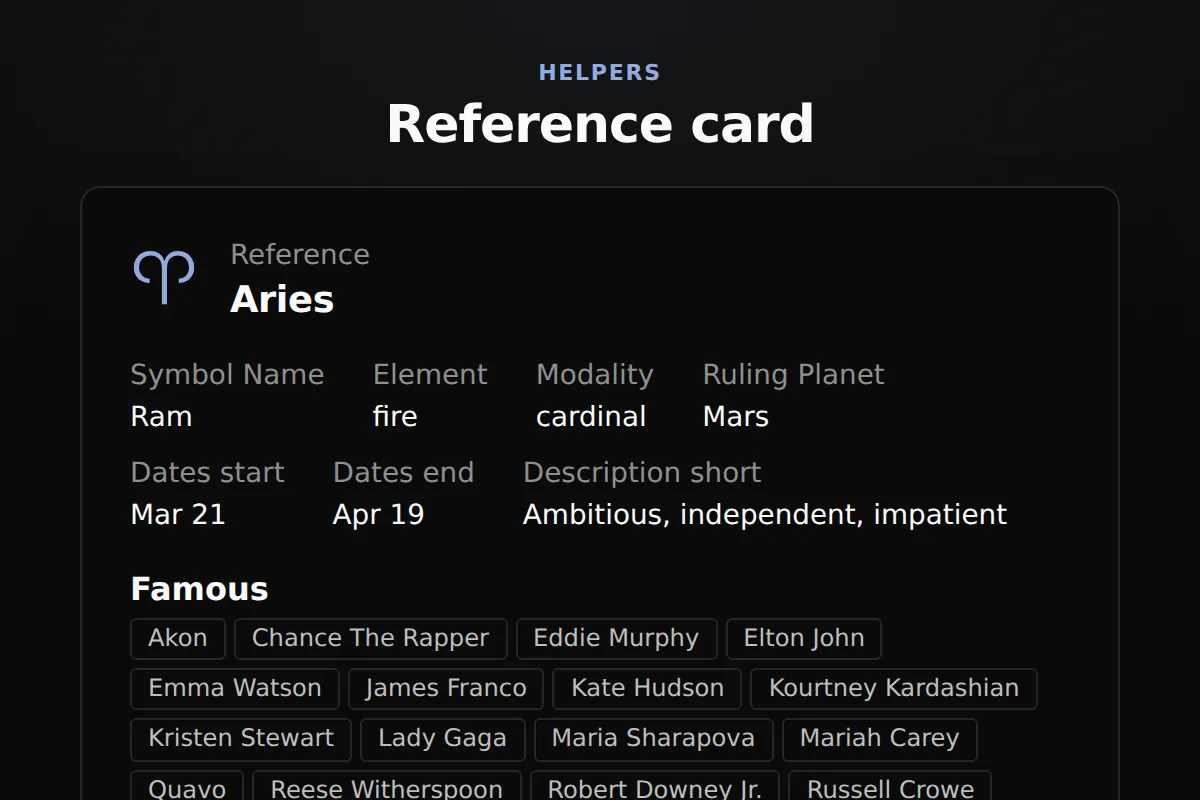
<roxy-reference-card> | Symbol, name, description, keyword chips, and an attribute grid for any glossary lookup |
The depth behind every line above, written out in full.
Want to try without writing code? Try this domain live in API playground →
npm install @roxyapi/sdkimport { createRoxy } from '@roxyapi/sdk'
const roxy = createRoxy(process.env.ROXY_API_KEY!)
const domain = roxy.vedicAstrologypip install roxy-sdkfrom roxy_sdk import create_roxy
roxy = create_roxy("your-api-key")
domain = roxy.vedic_astrologycomposer require roxyapi/sdkuse function RoxyAPI\Sdk\createRoxy;
$roxy = createRoxy(getenv('ROXY_API_KEY'));
$domain = $roxy->vedicAstrology;dotnet add package RoxyApi.Sdkusing RoxyApi;
var roxy = new RoxyClient(Environment.GetEnvironmentVariable("ROXY_API_KEY")!);
var domain = roxy.VedicAstrology;go get github.com/RoxyAPI/sdk-goimport roxyapi "github.com/RoxyAPI/sdk-go"
roxy, _ := roxyapi.NewRoxy(os.Getenv("ROXY_API_KEY"))
domain := roxy.VedicAstrologycargo add roxyapiuse roxyapi::Roxy;
let roxy = Roxy::new(std::env::var("ROXY_API_KEY")?)?;
let domain = roxy.vedic_astrology();dart pub add roxyapiimport 'package:roxyapi/roxyapi.dart';
final roxy = Roxy(Platform.environment['ROXY_API_KEY'] ?? '');
final domain = roxy.vedicAstrology;claude mcp add --transport http \
roxy-vedic-astrology https://roxyapi.com/mcp/vedic-astrology \
--header "X-API-Key: YOUR_KEY"AI agents auto-discover all endpoints as callable tools. Zero configuration. Responses can come back token-optimized and lossless, cutting the tokens your agent spends per call by roughly 40 to 52 percent.
Full MCP setup guidecurl -H "X-API-Key: YOUR_KEY" \
https://roxyapi.com/api/v2/vedic-astrology/Generating your own client? Get the Vedic Astrology OpenAPI schema.
Want to ship faster? Clone a free template and white-label it as your own app.
Building with Cursor, Claude Code, or Bolt? Use our AI prompts to generate a complete app.
Building on WordPress? Install the RoxyAPI plugin and drop a shortcode, no code required.
{
"frame": {
"ayanamsa": "lahiri",
"ayanamsaDegrees": 23.728208791839048
},
"aries": {
"rashi": "aries",
"signs": [
{
"graha": "Mars",
"nakshatra": {
"anga": "nakshatra",
"key": 1,
"ratio": 0.03861131691362409,
"abhijit": false,
"left": 12.818515774485013,
"name": "Ashwini",
"pada": 1,
"lord": "Ketu"
},
"longitude": 0.5148175588483213,
"isRetrograde": false,
"house": 9,
"awastha": "Bala",
"jagradadi": "Jagrat",
"deeptadi": "Svastha"
}
]
},
"taurus": {
"rashi": "taurus",
"signs": [
{
"graha": "Venus",
"nakshatra": {
"anga": "nakshatra",
"key": 4,
"ratio": 0.5382611176220545,
"abhijit": false,
"left": 6.1565184317059405,
"name": "Rohini",
"pada": 3,
"lord": "Moon"
},
"longitude": 47.176814901627395,
"isRetrograde": false,
"house": 10,
"awastha": "Yuva",
"jagradadi": "Jagrat",
"deeptadi": "Svastha"
}
]
},
"gemini": {
"rashi": "gemini",
"signs": [
{
"graha": "Sun",
"nakshatra": {
"anga": "nakshatra",
"key": 6,
"ratio": 0.8680896274786136,
"abhijit": false,
"left": 1.7588049669518178,
"name": "Ardra",
"pada": 4,
"lord": "Rahu"
},
"longitude": 78.24119503304819,
"isRetrograde": false,
"house": 11,
"awastha": "Vriddha",
"jagradadi": "Swapna",
"deeptadi": "Duhkhita"
},
{
"graha": "Mercury",
"nakshatra": {
"anga": "nakshatra",
"key": 7,
"ratio": 0.002438114262190627,
"abhijit": false,
"left": 13.300825143170792,
"name": "Punarvasu",
"pada": 1,
"lord": "Jupiter"
},
"longitude": 80.03250819016255,
"isRetrograde": false,
"house": 11,
"awastha": "Vriddha",
"jagradadi": "Jagrat",
"deeptadi": "Kopa"
},
{
"graha": "Jupiter",
"nakshatra": {
"anga": "nakshatra",
"key": 7,
"ratio": 0.471566817146049,
"abhijit": false,
"left": 7.045775771386014,
"name": "Punarvasu",
"pada": 2,
"lord": "Jupiter"
},
"longitude": 86.28755756194732,
"isRetrograde": false,
"house": 11,
"awastha": "Mrita",
"jagradadi": "Sushupti",
"deeptadi": "Kopa"
}
]
},
"cancer": {
"rashi": "cancer",
"signs": [
{
"graha": "Ketu",
"nakshatra": {
"anga": "nakshatra",
"key": 8,
"ratio": 0.8734890910423172,
"abhijit": false,
"left": 1.6868121194357713,
"name": "Pushya",
"pada": 4,
"lord": "Saturn"
},
"longitude": 104.9798545472309,
"isRetrograde": true,
"house": 12,
"awastha": "Yuva"
}
]
},
"leo": {
"rashi": "leo",
"signs": []
},
"virgo": {
"rashi": "virgo",
"signs": []
},
"libra": {
"rashi": "libra",
"signs": []
},
"scorpio": {
"rashi": "scorpio",
"signs": [
{
"graha": "Moon",
"nakshatra": {
"anga": "nakshatra",
"key": 17,
"ratio": 0.15018455945281275,
"abhijit": false,
"left": 11.330872540629164,
"name": "Anuradha",
"pada": 1,
"lord": "Saturn"
},
"longitude": 215.3357941260375,
"isRetrograde": false,
"house": 4,
"awastha": "Mrita",
"jagradadi": "Sushupti",
"deeptadi": "Duhkhita"
}
]
},
"sagittarius": {
"rashi": "sagittarius",
"signs": [
{
"graha": "Saturn",
"nakshatra": {
"anga": "nakshatra",
"key": 21,
"ratio": 0.17985597205895854,
"abhijit": false,
"left": 10.935253705880553,
"name": "Uttara Ashadha",
"pada": 1,
"lord": "Sun"
},
"longitude": 269.06474629411946,
"isRetrograde": true,
"house": 5,
"awastha": "Mrita",
"jagradadi": "Swapna",
"deeptadi": "Duhkhita"
}
]
},
"capricorn": {
"rashi": "capricorn",
"signs": [
{
"graha": "Rahu",
"nakshatra": {
"anga": "nakshatra",
"key": 22,
"ratio": 0.3734890910423166,
"abhijit": false,
"left": 8.353478786102446,
"name": "Shravana",
"pada": 2,
"lord": "Moon"
},
"longitude": 284.9798545472309,
"isRetrograde": true,
"house": 6,
"awastha": "Yuva"
}
]
},
"aquarius": {
"rashi": "aquarius",
"signs": []
},
"pisces": {
"rashi": "pisces",
"signs": []
},
"meta": {
"Sun": {
"graha": "Sun",
"rashi": "Gemini",
"longitude": 78.24119503304819,
"latitude": -0.0001328385398282796,
"nakshatra": {
"anga": "nakshatra",
"key": 6,
"ratio": 0.8680896274786136,
"abhijit": false,
"left": 1.7588049669518178,
"name": "Ardra",
"pada": 4,
"lord": "Rahu"
},
"isRetrograde": false,
"house": 11,
"awastha": "Vriddha",
"jagradadi": "Swapna",
"deeptadi": "Duhkhita",
"avasthaInfo": {
"awastha": {
"meaning": "Elder",
"interpretation": "Past its prime, the graha delivers only a negligible share of what it promises."
},
"jagradadi": {
"meaning": "Dreaming",
"interpretation": "In a friendly or neutral sign the graha acts as though half asleep, and its results arrive in moderate measure."
},
"deeptadi": {
"meaning": "Sorrowful",
"interpretation": "In an enemy sign the graha is obstructed at every turn, bringing conflict, dependence on others, and want."
}
}
},
"Moon": {
"graha": "Moon",
"rashi": "Scorpio",
"longitude": 215.3357941260375,
"latitude": -4.85528448436199,
"nakshatra": {
"anga": "nakshatra",
"key": 17,
"ratio": 0.15018455945281275,
"abhijit": false,
"left": 11.330872540629164,
"name": "Anuradha",
"pada": 1,
"lord": "Saturn"
},
"isRetrograde": false,
"house": 4,
"awastha": "Mrita",
"jagradadi": "Sushupti",
"deeptadi": "Duhkhita",
"avasthaInfo": {
"awastha": {
"meaning": "Spent",
"interpretation": "At the far edge of the sign the graha is spent, and the results it signifies do not materialise."
},
"jagradadi": {
"meaning": "Sleeping",
"interpretation": "In an enemy sign or debilitation the graha is asleep, and what it signifies fails to reach the native."
},
"deeptadi": {
"meaning": "Sorrowful",
"interpretation": "In an enemy sign the graha is obstructed at every turn, bringing conflict, dependence on others, and want."
}
}
},
"Mars": {
"graha": "Mars",
"rashi": "Aries",
"longitude": 0.5148175588483213,
"latitude": -2.057998697195424,
"nakshatra": {
"anga": "nakshatra",
"key": 1,
"ratio": 0.03861131691362409,
"abhijit": false,
"left": 12.818515774485013,
"name": "Ashwini",
"pada": 1,
"lord": "Ketu"
},
"isRetrograde": false,
"house": 9,
"awastha": "Bala",
"jagradadi": "Jagrat",
"deeptadi": "Svastha",
"avasthaInfo": {
"awastha": {
"meaning": "Infant",
"interpretation": "Newly entered on its sign, the graha is still gathering force and delivers about a quarter of what it promises."
},
"jagradadi": {
"meaning": "Awake",
"interpretation": "In its own sign or exaltation the graha is fully alert and gives its results without hindrance."
},
"deeptadi": {
"meaning": "At home",
"interpretation": "In its own sign the graha is healthy and settled, granting property, standing among its own people, and steady means."
}
}
},
"Mercury": {
"graha": "Mercury",
"rashi": "Gemini",
"longitude": 80.03250819016255,
"latitude": 1.460070348638619,
"nakshatra": {
"anga": "nakshatra",
"key": 7,
"ratio": 0.002438114262190627,
"abhijit": false,
"left": 13.300825143170792,
"name": "Punarvasu",
"pada": 1,
"lord": "Jupiter"
},
"isRetrograde": false,
"house": 11,
"awastha": "Vriddha",
"jagradadi": "Jagrat",
"deeptadi": "Kopa",
"avasthaInfo": {
"awastha": {
"meaning": "Elder",
"interpretation": "Past its prime, the graha delivers only a negligible share of what it promises."
},
"jagradadi": {
"meaning": "Awake",
"interpretation": "In its own sign or exaltation the graha is fully alert and gives its results without hindrance."
},
"deeptadi": {
"meaning": "Enraged",
"interpretation": "Eclipsed by the Sun the graha loses its light, and the matters it governs are scattered, contested or simply lost."
}
}
},
"Jupiter": {
"graha": "Jupiter",
"rashi": "Gemini",
"longitude": 86.28755756194732,
"latitude": 0.21241046115946105,
"nakshatra": {
"anga": "nakshatra",
"key": 7,
"ratio": 0.471566817146049,
"abhijit": false,
"left": 7.045775771386014,
"name": "Punarvasu",
"pada": 2,
"lord": "Jupiter"
},
"isRetrograde": false,
"house": 11,
"awastha": "Mrita",
"jagradadi": "Sushupti",
"deeptadi": "Kopa",
"avasthaInfo": {
"awastha": {
"meaning": "Spent",
"interpretation": "At the far edge of the sign the graha is spent, and the results it signifies do not materialise."
},
"jagradadi": {
"meaning": "Sleeping",
"interpretation": "In an enemy sign or debilitation the graha is asleep, and what it signifies fails to reach the native."
},
"deeptadi": {
"meaning": "Enraged",
"interpretation": "Eclipsed by the Sun the graha loses its light, and the matters it governs are scattered, contested or simply lost."
}
}
},
"Venus": {
"graha": "Venus",
"rashi": "Taurus",
"longitude": 47.176814901627395,
"latitude": -1.4176921333049444,
"nakshatra": {
"anga": "nakshatra",
"key": 4,
"ratio": 0.5382611176220545,
"abhijit": false,
"left": 6.1565184317059405,
"name": "Rohini",
"pada": 3,
"lord": "Moon"
},
"isRetrograde": false,
"house": 10,
"awastha": "Yuva",
"jagradadi": "Jagrat",
"deeptadi": "Svastha",
"avasthaInfo": {
"awastha": {
"meaning": "Adult",
"interpretation": "At its prime in the middle of the sign, the graha delivers its promise in full and acts most reliably."
},
"jagradadi": {
"meaning": "Awake",
"interpretation": "In its own sign or exaltation the graha is fully alert and gives its results without hindrance."
},
"deeptadi": {
"meaning": "At home",
"interpretation": "In its own sign the graha is healthy and settled, granting property, standing among its own people, and steady means."
}
}
},
"Saturn": {
"graha": "Saturn",
"rashi": "Sagittarius",
"longitude": 269.06474629411946,
"latitude": 0.09065030559754866,
"nakshatra": {
"anga": "nakshatra",
"key": 21,
"ratio": 0.17985597205895854,
"abhijit": false,
"left": 10.935253705880553,
"name": "Uttara Ashadha",
"pada": 1,
"lord": "Sun"
},
"isRetrograde": true,
"house": 5,
"awastha": "Mrita",
"jagradadi": "Swapna",
"deeptadi": "Duhkhita",
"avasthaInfo": {
"awastha": {
"meaning": "Spent",
"interpretation": "At the far edge of the sign the graha is spent, and the results it signifies do not materialise."
},
"jagradadi": {
"meaning": "Dreaming",
"interpretation": "In a friendly or neutral sign the graha acts as though half asleep, and its results arrive in moderate measure."
},
"deeptadi": {
"meaning": "Sorrowful",
"interpretation": "In an enemy sign the graha is obstructed at every turn, bringing conflict, dependence on others, and want."
}
}
},
"Rahu": {
"graha": "Rahu",
"rashi": "Capricorn",
"longitude": 284.9798545472309,
"latitude": 0,
"nakshatra": {
"anga": "nakshatra",
"key": 22,
"ratio": 0.3734890910423166,
"abhijit": false,
"left": 8.353478786102446,
"name": "Shravana",
"pada": 2,
"lord": "Moon"
},
"isRetrograde": true,
"house": 6,
"awastha": "Yuva",
"avasthaInfo": {
"awastha": {
"meaning": "Adult",
"interpretation": "At its prime in the middle of the sign, the graha delivers its promise in full and acts most reliably."
}
}
},
"Ketu": {
"graha": "Ketu",
"rashi": "Cancer",
"longitude": 104.9798545472309,
"latitude": 0,
"nakshatra": {
"anga": "nakshatra",
"key": 8,
"ratio": 0.8734890910423172,
"abhijit": false,
"left": 1.6868121194357713,
"name": "Pushya",
"pada": 4,
"lord": "Saturn"
},
"isRetrograde": true,
"house": 12,
"awastha": "Yuva",
"avasthaInfo": {
"awastha": {
"meaning": "Adult",
"interpretation": "At its prime in the middle of the sign, the graha delivers its promise in full and acts most reliably."
}
}
},
"Lagna": {
"graha": "Lagna",
"rashi": "Leo",
"longitude": 138.37874958931044,
"nakshatra": {
"anga": "nakshatra",
"key": 11,
"ratio": 0.3784062191982829,
"abhijit": false,
"left": 8.287917077356228,
"name": "Purva Phalguni",
"pada": 2,
"lord": "Venus"
},
"isRetrograde": false,
"house": 1,
"awastha": "Vriddha",
"avasthaInfo": {
"awastha": {
"meaning": "Elder",
"interpretation": "Past its prime, the graha delivers only a negligible share of what it promises."
}
}
}
},
"modernPlanets": [
{
"planet": "Uranus",
"sanskritName": "Arun",
"longitude": 253.68632421127586,
"rashi": "Sagittarius",
"degreeInRashi": 13.68632421127586,
"nakshatra": {
"anga": "nakshatra",
"key": 20,
"ratio": 0.026474315845688642,
"abhijit": false,
"left": 12.980342455390819,
"name": "Purva Ashadha",
"pada": 1,
"lord": "Venus"
},
"isRetrograde": true
},
{
"planet": "Neptune",
"sanskritName": "Varun",
"longitude": 259.4969359516857,
"rashi": "Sagittarius",
"degreeInRashi": 19.496935951685714,
"nakshatra": {
"anga": "nakshatra",
"key": 20,
"ratio": 0.4622701963764277,
"abhijit": false,
"left": 7.169730714980965,
"name": "Purva Ashadha",
"pada": 2,
"lord": "Venus"
},
"isRetrograde": true
},
{
"planet": "Pluto",
"sanskritName": "Yam",
"longitude": 201.37138569088694,
"rashi": "Libra",
"degreeInRashi": 21.37138569088694,
"nakshatra": {
"anga": "nakshatra",
"key": 16,
"ratio": 0.10285392681651974,
"abhijit": false,
"left": 11.961947642446404,
"name": "Vishakha",
"pada": 1,
"lord": "Jupiter"
},
"isRetrograde": true
}
],
"houses": [
{
"number": 1,
"name": "Lagna",
"description": "Self-assurance draws allies to your aims, with your 1st lord in the 11th, the bhava of gains. You remember names, connect people who should meet and find the right introduction coming through your circle again and again. Counting on the network without tending it leaves gaps, and the friend who calls first is the one whose circle is still there in a lean year.",
"themes": [
"self",
"body",
"health",
"personality",
"vitality"
]
},
{
"number": 2,
"name": "Dhana Bhava",
"description": "Family pride, fame and a full purse come with your 2nd lord in the 11th. You keep many channels open, and friends, networks and patient effort all feed the same store. Leaning on one lucky introduction can leave long gaps between gains, and five modest contacts kept warm outdo a single grand one. Saturn casting a sober, exacting drishti on the second bhava makes values serious and earnings structured, rewarding the long view over quick gain.",
"themes": [
"wealth",
"family",
"speech",
"possessions",
"food"
]
},
{
"number": 3,
"name": "Bhratru Bhava",
"description": "Initiative and skill build your career, with your 3rd lord in the 10th. Comfort and means come by your own effort, and having earned every step is a source of pride. Loyalty to the wrong allies can drag your work down, while clear standards about who earns your trust keep your path clean. Thanks to the aspect of Jupiter on the third bhava, your writing, messages and hands-on skills expand with confidence and good humor.",
"themes": [
"siblings",
"courage",
"communication",
"short travel",
"skills"
]
},
{
"number": 4,
"name": "Matri Bhava",
"description": "Home is blessed by faith and good fortune, with your 4th lord in the 9th. You carry the values of your upbringing with ease, and people respect your integrity and kindness. Moral certainty learned at home can sound stern to friends, and humor about your own principles makes them easier to share. Chandra settles happily into the Matri Bhava, so belonging, comfort and the warmth of your earliest caretakers shape your inner life. Whoever nurtured you early left a lasting imprint, and their habits of care resurface in every household you make. You cling to the familiar more than you admit, and a disturbed home disturbs your mind at once, so household peace is worth more to you than most comforts.",
"themes": [
"home",
"mother",
"property",
"vehicles",
"domestic happiness"
]
},
{
"number": 5,
"name": "Putra Bhava",
"description": "Learning and creativity pay dividends, with your 5th lord in the 11th. Learned and well liked, you build a community around shared interests and intellectual pursuits. Popularity can tempt you to write for the crowd rather than the work, and the audience worth having is the one that followed you there, not the one you chased. Discipline replaces inspiration with Saturn in your fifth bhava, and whatever you complete endures. Revision, drills and long apprenticeships suit you, and knowledge gathered by repetition stays with you long after faster peers have forgotten theirs. Love can feel more like duty than delight at first, and letting play into it softens a seriousness people already value in you.",
"themes": [
"children",
"romance",
"creativity",
"education",
"speculation"
]
},
{
"number": 6,
"name": "Ari Bhava",
"description": "Obstacles shape your creativity into problem solving, your 6th lord in the 5th. Creative work and mentoring bring you joy, even when the bonds involved demand patience and effort. Fluctuating means and a guarded streak show up in lean stretches, and steady habits around money and attention restore balance. Competition sharpens you with Rahu in the Ari Bhava, whether the arena is a courtroom, a ward or a security desk. Opponents get studied closely, and you keep pressing well past the point where others settle, which makes you a formidable presence in any dispute. Suspicion learned in hard contests can follow you into friendly settings, and letting colleagues see you off guard now and then turns rivals into allies.",
"themes": [
"enemies",
"disease",
"debts",
"service",
"competition"
]
},
{
"number": 7,
"name": "Jaya Bhava",
"description": "Love comes with warmth and good standing, following the 7th lord into the 5th, the bhava of delight. Shared hobbies, art and laughter are the glue of your relationships, and people see a couple who genuinely enjoy each other. Chasing the thrill of early love can leave little patience for the everyday, while liking each other as friends carries love past the sparkle. Jupiter casts drishti across the seventh bhava, so partnerships flourish on trust, shared ideals and a mutual wish to learn. Saturn sends its drishti to the seventh bhava, so partnerships deepen slowly and favor loyalty, shared duty and promises kept over years.",
"themes": [
"marriage",
"partner",
"business partnership",
"contracts",
"public dealings"
]
},
{
"number": 8,
"name": "Ayu Bhava",
"description": "Secrets of pooled funds and shared ventures are yours to master, with your 8th lord in the 11th. Income often comes through channels others overlook, research, insurance, royalties or the careful management of money held by others. Memories of scarcity can make ease feel fragile, while gratitude and careful stewardship keep what you gain from slipping back.",
"themes": [
"longevity",
"inheritance",
"sudden events",
"occult",
"transformation"
]
},
{
"number": 9,
"name": "Dharma Bhava",
"description": "Dharma carries you like a tailwind, your 9th lord in the bhava it rules. Philosophy, travel and generous living are your element, and your optimism lifts everyone nearby. Easy fortune can breed complacency, and a blessing passed on through teaching, charity or mentoring tends to return with interest. Your convictions become causes to defend with Mars in your ninth bhava, and you build fortune through direct, courageous effort. Expedition-style travel, trekking, long missions or demanding study suit you, as you learn best when the path asks something of your courage. Clashes with mentors or older authorities can flare when your independence meets an unbending rule, and honest debate eventually earns mutual respect.",
"themes": [
"fortune",
"father",
"dharma",
"higher education",
"long travel"
]
},
{
"number": 10,
"name": "Karma Bhava",
"description": "Career is your strong suit, the 10th lord in the 10th, the bhava of action. You are competent in nearly any task you take up, and colleagues count on your courage once the going turns hard. Professional success can crowd rest and relationships to the margins, and the drive regains its meaning when the calling is bigger than the job. Shukra in your tenth bhava offers you a stage in media, design, fashion and hospitality, along with steady goodwill. Goodwill gathers around your name, and effort put into presentation pays off publicly, since people remember how you made them feel as much as what you did. Pleasing every client can stretch you into roles that dilute your own taste, and the ill-suited commission you decline does more for your name than the one you accept.",
"themes": [
"career",
"profession",
"status",
"authority",
"karma"
]
},
{
"number": 11,
"name": "Labha Bhava",
"description": "Many undertakings succeed with your 11th lord at home in the 11th. Your network widens year by year, and friends and allies back whatever you set out to achieve. Relying on good fortune can leave gains smaller than they could be, while consistent work makes the most of every opening. Ambitions you name out loud have a way of being met in the eleventh bhava, where the Sun links effort to reward. Friendship with people of note forms without effort, and a single introduction from the right person can change the scale of what you attempt. A wide network can feel strangely thin at close range, and the bonds deepen when you give support as readily as you receive it. Contacts, clients and conversations turn into gains for Budha in the Labha Bhava, which rewards honesty with steady trust. To these same matters you also bring Jupiter opening wider horizons, and that shows once the usual approach runs out.",
"themes": [
"gains",
"income",
"friends",
"elder siblings",
"fulfilment of desires"
]
},
{
"number": 12,
"name": "Vyaya Bhava",
"description": "Distance from where you began is where belonging tends to be found, the 4th holding your 12th lord. You can leave the familiar behind with surprising ease, and the places that feel truest are often the ones you chose. A house can come to feel like an anchor rather than a shelter, and you breathe easier owning a little less than you could. Liberation is the deep theme of Ketu in the Vyaya Bhava, and being alone reads as relief rather than loss. Unfamiliar customs and foreign streets fascinate you, and among strangers you often find a contentment that familiar places seldom give. Letting go can extend to letting obligations slide, and holding a handful of practical commitments in good order gives your freedom solid ground to stand on.",
"themes": [
"losses",
"expenses",
"foreign lands",
"isolation",
"moksha"
]
}
],
"combustion": [
{
"planet": "Mercury",
"distanceFromSun": 1.79,
"orb": 14
},
{
"planet": "Jupiter",
"distanceFromSun": 8.05,
"orb": 11
}
],
"planetaryWar": [],
"interpretations": {
"Sun": {
"rashi": "Bright, articulate and open-handed, your Sun in Gemini makes you the person who reads the manual and then explains it kindly. You collect methods the way a magpie collects bright things, from patterns in the stars to the fastest route through a tangled form. Your talent is often noticed late, partly because you hand out ideas without signing them, and claiming authorship is part of your growth. Generosity with knowledge is the light you give off, and a mind like yours makes everyone nearby a little sharper.",
"nakshatra": "Rudra, the howler of the storm, presides over Ardra, and you think most clearly when the wind is loudest. Broken code, a failing process, a friendship stuck in an old argument: you go straight to what has stopped working and say so. Hours after the sky has cleared, the thunder can keep rolling in your head, replaying what went wrong, and putting a hand to the repair is what finally settles it. Rahu keeps watch over Ardra, and your Sun takes an outsider authority that questions custom and reaches for ground nobody has claimed."
},
"Moon": {
"rashi": "Chandra in Vrishchika drives your feelings deep, private and concentrated, so they run far below the surface. You notice what others try to hide, the pause, the changed tone, the unspoken worry, and you seldom say what you have seen. A cutting streak may surface when you feel betrayed, yet the payback you skip earns you more respect than any you could take. Chandra at its weakest in Scorpio learns to hold strong feelings with care, and finds a depth few people reach. Your loyalty, once given, is a fortress, and those inside it know they are guarded by someone fierce and true.",
"nakshatra": "Mitra, the god of friendship, guides Anuradha, and your heart forms loyal bonds wherever it lands, across any distance. Every trip ends with a handful of new friends, since a stranger at a bus stop strikes you as someone worth knowing. Friendships kept alive across many towns can spread your care thin, and choosing who gets the long letter next is a kindness, not a betrayal. Devoted and resilient, you turn hardship into depth and strangers into friends, and your loyalty is the thread binding a whole circle."
},
"Mars": {
"rashi": "Mangala in Mesha gives you the nerve of a captain: bold, truthful, generous, and happiest leading the charge. New ground calls you, a trip with no fixed plan or a venture nobody has tried, and you set out with more nerve than map. Crossed, you flare fast and hot, though that heat spent leading a cause instead of winning a quarrel is exactly why people line up behind you. From moolatrikona in Aries, Mars makes you decisive, direct and ready to defend what matters. Your fighting spirit is the honest, open kind, and the people who march beside you tend to come away braver than they started.",
"nakshatra": "Ashwini puts a horseman at the reins, and you move first, fixing things by instinct before anyone has called for help. When something breaks, you are halfway through the repair while others are still describing the damage, and the patch usually holds longer than anyone expected. Interest tends to thin near the finish once the opening rush is spent, which is why the final step deserves naming on the very first day. Ketu rules Ashwini, so your Mars moves the instant it decides, with plain courage and a talent for getting back up fast."
},
"Mercury": {
"rashi": "Budha in Mithuna makes your mind quick, playful and independent, a poet and a teacher who enjoys the sound of a well-turned phrase. Notebooks fill with half-finished poems, lists of questions and arguments for both sides, because your mind likes to keep several doors open. A taste for boasting and for winning every point can wear on people, and laughing at yourself first softens the edge without dulling it. Budha is at ease in Gemini, which it governs, so learning, trade and conversation feel like play. Merged with solar light at birth, Mercury lets thought serve conviction, so what you think and who you are rarely part company. Clever, generous and charming in speech, you make learning feel like a party everyone was invited to.",
"nakshatra": "The name Punarvasu means the good returning, and after every closing you find a way back in, a little wiser and no less warm. A spoiled first batch, a lost bid, a quarrel: each becomes a first draft for a better try, and you start the second attempt with good humor. Goodwill flows most freely toward the people who spend it fastest, and a gift placed where it will grow does more good than a fifth chance. What Jupiter brings your Mercury through Punarvasu is a mind that looks past each fact to the rule it follows, so its explanations teach as well as inform."
},
"Jupiter": {
"rashi": "Guru in Mithuna speaks through a scholarly, eloquent voice, courteous to elders and generous with advice to friends. Your shelves hold philosophy beside poetry beside a manual on bookbinding, and you can quote all three at the right moment. Clever answers come to you more easily than deep ones, which is exactly why one framework, lived inside for years, gives your learning its roots. Near the Sun at your birth, Jupiter turns generosity toward purpose and makes belief a private compass you consult often. Your wisdom speaks in many registers, and its courtesy lets difficult truths sound like an invitation.",
"nakshatra": "Twice at home in Punarvasu, your Jupiter makes things come back through you: friendships, chances and good humor alike."
},
"Venus": {
"rashi": "Venus in Taurus makes you a connoisseur of good things, earned by your own wit and held with an open, charitable hand. A drawer of good perfume, a single well-made coat and a shelf of favorite records tell people exactly who you are. Possessiveness is comfort gripped too hard, much as a grievance is a hurt kept like an heirloom, and a sense of safety built inside you loosens both. Seated in a rashi it rules, Venus in Taurus makes generosity graceful, and your gifts arrive wrapped in care. Sensual, capable and unafraid, you make a good life look like an art form open to everyone you welcome.",
"nakshatra": "Brahma, who shaped all creation, presides over Rohini, and whatever you make has the knack of flourishing once it is planted. You can take a rough plot, a raw idea or a modest budget and coax it into something lush, and the quality shows in details nobody requested. Gathering can turn into holding, people and possessions kept long after they wanted to move on, and releasing a little on purpose clears ground for fresh growth. Here the Moon, lord of Rohini, can let your Venus indulge past enjoyment, and comfort shared with others tastes better than comfort hoarded."
},
"Saturn": {
"rashi": "Integrity and slow learning ripen together in your Saturn in Sagittarius, a teacher whose few words are always worth hearing. Rituals, festivals and family customs gain new life in your hands, since you keep the old forms carefully and explain why each step exists. Your rigor can be mistaken for sternness, since you spend words like rationed coin, and a little warmth shown alongside it makes every lesson land softer. Reversing at your birth, Shani has you rebuild structure by hand, and the second version fits better than the first. Principled, learned and unhurried, you are the elder people seek out for counsel, whatever your age.",
"nakshatra": "In Uttara Ashadha you win slowly and for good, through integrity that compounds like interest. Modest and grateful, you gather many friends, and your command is trusted because you never ask others for what you would not do. Starting slow may sting while others race ahead, and a small celebration folded into each stage stops patience from sliding into postponement. Here the Sun, lord of Uttara Ashadha, can set your Saturn a standard nothing quite meets, and letting adequate be adequate on occasion saves the effort for what matters."
},
"Rahu": {
"rashi": "Rahu in Makara feeds a hunger for status and structure, a drive to rise through big institutions step by step. Titles, ranks and the senior desk interest you, and you study how an institution works so you can rise inside it. Duty beyond the household calls Rahu in Capricorn to build, while Ketu in Cancer asks you to stop clinging to the nest. Private time, friendships and rest are what ambition eats first, so the striving stays humane only when they get a fixed share of your week.",
"nakshatra": "Vishnu, whose three strides span the worlds, presides over Shravana, and those you have helped carry your reputation far. Word of you spreads by mouth, carried by people who felt genuinely heard in your company and told their friends so. Counsel gathered from every voice can lean toward whoever spoke last, and a night between the hearing and the verdict lets the softer voices count. The Moon, lord of Shravana, gives your Rahu magnetism and taste, drawing people and resources toward it with growing capability."
},
"Ketu": {
"rashi": "Nurture flows from you naturally with Ketu in Cancer, yet never quite fills you, and your heart learns to stand on its own. Sensitivity is profound in you, though kept private, and you read the feeling of a gathering without needing anyone to soothe your own. Old ties to the first home can pull you two ways at once, and letting love travel with you rather than hold you in place sets your affection free.",
"nakshatra": "In Pushya care arrives through structure: counsel, provision and a calm that others borrow when theirs runs out. Care from you arrives as something solid, a cooked meal, a form filled in, a ride arranged, and no one you look after goes without. After an evening spent providing, you often leave your own needs for last, and accepting help from someone else is part of the same duty. Saturn keeps watch over Pushya, and your Ketu does its duty without needing thanks, patient with chores most people put off."
},
"Lagna": {
"rashi": "Bold and dignified with Simha rising, you are a firm friend who wears authority easily and spends it sheltering others. Responsibility finds its way to your desk, a team to lead, an event to host, a decision to make, and you accept it with the ease of someone born to the role. Others see strength in how you carry yourself, a calm, proud presence that suggests command is familiar ground and that you will not flinch when it is tested. Faced with something unfamiliar, you take ownership at once, set the standard, gather capable people and expect the effort to reflect well on everyone involved. Generosity with terms attached and a temper that flares when respect seems lacking can hide the large heart others sometimes miss, until you give freely and praise openly. Loyalty is the core of your character, and friends know that once you stand beside them you stay there, unmoved through every change of fortune and mood.",
"nakshatra": "The front legs of a festive couch are the emblem of Purva Phalguni, and rest, pleasure and friendly company come easily to you. Enterprise and enjoyment travel together under Purva Phalguni, and ventures you start often thrive because people genuinely like being part of them. Effort can stall the moment the work stops being fun, and a plain routine running under the festivities is what gets the dull half finished."
}
},
"interpretation": {
"summary": "Counted fourth and tenth from each other, Leo rising and a Moon in Scorpio turn inner friction into steady output. Prosperity and self-respect travel together for you while the Sun, steward of the Lagna, works from the eleventh bhava.",
"detailed": "Matched in pace and crossed in element, Leo rising and the Moon in Scorpio let you start projects with the poise of a host and live with them with loyal depth. Heart and will vie for your hours, and learning to let each lead in turn is how the pairing matures. Born in Shukla paksha, the bright fortnight, under a Moon gaining light, you find that feeling grows in you by being shared.\n\nProsperity keeps company with your Lagna lord, the Sun, in the eleventh bhava, and a practical sense of value runs through how you see yourself. Strain runs between the Moon and the Sun, which holds the eighth rashi counted from it, yet the friction teaches you to read your own moods before they surprise you.\n\nStrength gathers in Venus, which forms Malavya Yoga from a kendra, and its qualities give the chart its lead. Seldom still, Leo outwardly and Scorpio within, you get a great deal done, and that motion is one of your gifts."
},
"yogas": [
{
"id": "gajakesari",
"name": "Gajakesari Yoga",
"description": "Jupiter occupies a kendra from the Moon, the 1st, 4th, 7th or 10th house counted from it, is unaspected by a natural malefic, and is not retrograde.",
"result": "Gajakesari Yoga joins the elephant and the lion, and the classical result is standing earned through character. Jataka Parijata gives energy, ample money and grain, intelligence and merit, with conduct that wins the favour of those in authority. Later commentary adds a wide circle of relations, a polite and generous manner, a hand in civic or public work, and a name that endures. The dignity of Jupiter and the Moon decides how much of that promise the chart delivers, so a well placed pair gives the fuller result.",
"quality": "Positive",
"family": "classical",
"present": false,
"evidence": "Jupiter is not in a kendra (1/4/7/10) from the Moon."
},
{
"id": "sunapha",
"name": "Sunapha Yoga",
"description": "A graha other than the Sun and the lunar nodes occupies the 2nd house from the Moon.",
"result": "Sunapha Yoga places support in the 2nd from the Moon, the house of accumulated resources, and the texts agree on its result: wealth the native earns rather than inherits, intelligence, a good name, and standing comparable to that of a ruler. Parashara and Varahamihira both stress the self-made character of the gain. The graha that forms the yoga colours it, so Mars, Mercury, Jupiter, Venus or Saturn in that house each shape how the wealth is made.",
"quality": "Positive",
"family": "classical",
"present": true,
"evidence": "Non-luminary, non-node planet placed in the 2nd house from Moon."
},
{
"id": "anapha",
"name": "Anapha Yoga",
"description": "A graha other than the Sun and the lunar nodes occupies the 12th house from the Moon.",
"result": "Anapha Yoga places support in the 12th from the Moon, and the classical result is vigour, a dignified bearing and a good name. Parashara gives virtue, fame, charm and contentment; Varahamihira adds a good character, pleasure in fine dress and the comforts of the senses. The 12th is also the house of release, and later commentary reads the yoga as turning toward renunciation and simplicity in the later years, so worldly ease gives way to detachment.",
"quality": "Positive",
"family": "classical",
"present": false,
"evidence": "No qualifying planet in the 12th house from Moon."
},
{
"id": "dhurdhura",
"name": "Dhurdhura Yoga",
"description": "Grahas other than the Sun and the lunar nodes occupy both the 2nd and the 12th houses from the Moon.",
"result": "Dhurdhura Yoga surrounds the Moon with support on both sides, in the 2nd and the 12th, and it joins the results of Sunapha and Anapha. The texts give wealth, conveyances and the comforts that come with them, a generous and charitable temper, and the means to support others. Parashara adds capable people in service; later commentary reads it as money, standing and reputation arriving together, in a measure set by the grahas that form it.",
"quality": "Positive",
"family": "classical",
"present": false,
"evidence": "Moon is not flanked by qualifying planets in both 2nd and 12th."
},
{
"id": "kemadruma",
"name": "Kemadruma Yoga",
"description": "No graha other than the Sun and the lunar nodes stands with the Moon, in the 2nd or the 12th house from it, or in a kendra from the Lagna.",
"result": "Kemadruma Yoga leaves the Moon without support: no graha stands with it, beside it or in a kendra from the Lagna. The classical result is hardship. Parashara gives reproach from others, setbacks in learning and judgement, and financial strain; Varahamihira adds that the yoga lowers circumstances even in a well born family. Read it as the mind working without backing, so effort goes unrecognised and resources are slow to gather. A strong Moon and supporting yogas elsewhere soften the reading considerably.",
"quality": "Negative",
"family": "classical",
"present": false,
"evidence": "Moon has at least one qualifying planet adjacent (2nd or 12th)."
},
{
"id": "chandramangala",
"name": "Chandra Mangala Yoga",
"description": "Mars joins the Moon or opposes it, within 10 degrees.",
"result": "Chandra Mangala Yoga is a combination for earning. The classical texts tie it to trade in rough goods, drink and other things that serve appetite, and to friction with the mother. Later commentary reads it as a strong stabiliser of finances: with the Moon and Mars well placed the income comes through respected work, and the combination does most good in the 2nd, 9th, 10th or 11th house. The drive it gives toward money is real, and the dignity of the two grahas decides how cleanly that money is made.",
"quality": "Both",
"family": "classical",
"present": false,
"evidence": "Moon and Mars are neither conjunct nor opposed within 10 degree orb."
},
{
"id": "budhaaditya",
"name": "Budha-Aditya Yoga",
"description": "Mercury occupies the same sign as the Sun. Later commentary also asks that Mercury stand more than 10 degrees from the Sun; the classical conjunction in one sign is the rule applied.",
"result": "Budha-Aditya Yoga joins Mercury, the planet of intellect, with the Sun, and every witness reads it as the mark of a capable mind. Varahamihira and Mantreswara give cleverness, intelligence, fame and contentment; later commentary adds skill in every kind of work, a good reputation, self-respect and a comfortable life. The yoga shows most clearly in learning, speech and the practical arts, and the strength of Mercury decides how much of that promise the chart delivers.",
"quality": "Positive",
"family": "classical",
"present": true,
"evidence": "Mercury joins the Sun in Gemini."
},
{
"id": "ruchaka",
"name": "Ruchaka Yoga",
"description": "Mars occupies a kendra from the Lagna, the 1st, 4th, 7th or 10th house, and that kendra is its own sign or its sign of exaltation.",
"result": "Ruchaka Yoga is the Pancha Mahapurusha yoga of Mars, formed when Mars holds its own or exaltation sign in a kendra. The texts describe courage and command: a strong build, renown for merit, wealth won through bold action, victory over opponents and leadership of others, classically of an army. Mantreswara notes a streak of pride beside the courage; later commentary adds learning in tradition, a charitable disposition and lasting fame. The full result asks for a Mars free of affliction.",
"quality": "Positive",
"family": "classical",
"present": false,
"evidence": "Mars in own sign Aries; placed in house 9 (not a kendra)."
},
{
"id": "bhadra",
"name": "Bhadra Yoga",
"description": "Mercury occupies a kendra from the Lagna, the 1st, 4th, 7th or 10th house, and that kendra is its own sign or its sign of exaltation.",
"result": "Bhadra Yoga is the Pancha Mahapurusha yoga of Mercury, formed when Mercury holds its own or exaltation sign in a kendra. Mantreswara gives a keen intellect, learning praised by the learned, wealth, eloquence before an assembly and the capacity to lead; later commentary adds a strong, well proportioned build, a reserved manner and loyalty to relatives. Mercury is the planet of the intellect, and the yoga shows most clearly in learning, speech and commerce.",
"quality": "Positive",
"family": "classical",
"present": false,
"evidence": "Mercury in own sign Gemini; placed in house 11 (not a kendra)."
},
{
"id": "hamsa",
"name": "Hamsa Yoga",
"description": "Jupiter occupies a kendra from the Lagna, the 1st, 4th, 7th or 10th house, and that kendra is its own sign or its sign of exaltation.",
"result": "Hamsa Yoga is the Pancha Mahapurusha yoga of Jupiter, formed when Jupiter holds its own or exaltation sign in a kendra. Mantreswara gives a person honoured by the good, of fine appearance and righteous disposition, enjoying good food and comfort, with the auspicious marks of the conch, lotus, fish and goad on the hands and feet. Later commentary adds a pure mind and the affection of others. The yoga speaks above all to character, wisdom and the regard a person earns.",
"quality": "Positive",
"family": "classical",
"present": false,
"evidence": "Jupiter in Gemini (neither own sign Sagittarius/Pisces nor exaltation Cancer); placed in house 11 (not a kendra)."
},
{
"id": "malavya",
"name": "Malavya Yoga",
"description": "Venus occupies a kendra from the Lagna, the 1st, 4th, 7th or 10th house, and that kendra is its own sign or its sign of exaltation.",
"result": "Malavya Yoga is the Pancha Mahapurusha yoga of Venus, formed when Venus holds its own or exaltation sign in a kendra. The texts give a strong body and a resolute mind, wealth, a happy married and family life, good fortune, fine vehicles and the enjoyments of comfort, with fame and learning besides. Mantreswara adds composure of the senses. Venus rules pleasure and refinement, and the yoga turns those into a settled, cultured prosperity.",
"quality": "Positive",
"family": "classical",
"present": true,
"evidence": "Venus in own sign Taurus, placed in kendra (house 10) from Lagna."
},
{
"id": "sasa",
"name": "Sasa Yoga",
"description": "Saturn occupies a kendra from the Lagna, the 1st, 4th, 7th or 10th house, and that kendra is its own sign or its sign of exaltation.",
"result": "Sasa Yoga is the Pancha Mahapurusha yoga of Saturn, formed when Saturn holds its own or exaltation sign in a kendra. The texts give authority: good people in service, physical strength, the praise of many and rule over a village, a town or more. They are equally frank about its shadow, a hard temper, questionable conduct in private life and an acquisitive streak. Later commentary reads the yoga as power built through persistence and labour, with the use of that power as the real test of the chart.",
"quality": "Both",
"family": "classical",
"present": false,
"evidence": "Saturn in Sagittarius (neither own sign Capricorn/Aquarius nor exaltation Libra); placed in house 5 (not a kendra)."
},
{
"id": "dhana",
"name": "Dhana Yoga",
"description": "The 5th house falls in a sign ruled by Venus, Venus occupies that 5th house, and Mars occupies the 11th.",
"result": "Dhana Yoga is a wealth combination and the classical treatment of it is unusually direct: one born to these combinations becomes wealthy. Read that as capacity to accumulate rather than as a promised sum. The pattern favours resources that stay, so earnings convert into assets, assets hold their value, and a standard of living rises without having to be rebuilt after every setback. Wealth of this kind usually comes through strengths the chart already carries rather than through windfall. Scale and timing belong to the rest of the chart and to the periods that bring these houses forward.",
"quality": "Positive",
"family": "classical",
"present": false,
"evidence": "No Dhana Yoga on this chart: all 11 rules evaluated and none holds. The eleven catalogued Dhana rows are BPHS ch. 41 verses 2 to 14, read in Parashara rather than Raman wherever the two name different occupants of the 11th."
},
{
"id": "daridra",
"name": "Daridra Yoga",
"description": "The Lagna lord is joined by the lord of the 6th, the 8th or the 12th, or by Saturn, and receives no aspect from any natural benefic.",
"result": "Daridra Yoga in this form joins the Lagna lord to the lord of the 6th, the 8th or the 12th, or to Saturn, with no natural benefic casting drishti on it. The classical verse gives the result as poverty. Read it as the self tied to difficulty with no protective influence to lift it, so effort is heavy, help is scarce and progress comes slowly and at a cost. No single combination settles a chart: supporting wealth yogas, a well placed 2nd and 11th lord and favourable periods all temper it, so the sound reading is of a weakness to manage rather than an outcome to accept.",
"quality": "Negative",
"family": "classical",
"present": true,
"evidence": "Daridra Yoga holds on 2 of the 8 rules evaluated. daridra-7 (BPHS 42.6): the Lagna lord Sun is joined by Jupiter (the 8th lord) and receives drishti from no natural benefic; daridra-11 (BPHS 42.11): the Lagna lord Sun is joined or aspected by the maraka lord Mercury, and the Navamsa Lagna lord Mercury by Saturn. Nine of the eleven catalogued Daridra rows are evaluated, as eight rules: daridra-4 and daridra-5 are the two halves of BPHS 42.4. daridra-8 and daridra-9 are excluded because B.V. Raman is their only authority, and an unverified rule may not decide a verdict."
},
{
"id": "lakshmi",
"name": "Lakshmi Yoga",
"description": "The lord of the 9th house holds its own sign, its moolatrikona sign or its sign of exaltation and stands in a kendra or a trikona, while the lord of the Lagna is strong.",
"result": "Lakshmi Yoga is named for the goddess of fortune and the classical result reads accordingly: wealth in abundance, standing close to that of a ruler, a lasting name, and the conduct that earns it. Fortune here is fortune with a foundation. The 9th house carries merit, patronage and the good that arrives unearned, so a dignified and well placed 9th lord tends to make that support structural rather than occasional, with family, teachers, institutions and circumstance moving in the same direction. The strong Lagna lord is the second half of the combination, and it is what turns that support into a life the native can hold rather than one that passes through. Read the scale of it from the strength of the two lords involved, not from the presence of the combination alone.",
"quality": "Positive",
"family": "classical",
"present": true,
"evidence": "The 9th lord Mars stands in its own sign Aries in the 9th, a trikona, and the Lagna lord Sun is strong. Strength of the Lagna lord is read as freedom from the three classical weaknesses, combustion, debilitation and dusthana placement, because the Shadbala minimum-required-strength reading is not computable from a birth chart alone. BPHS 36.27-28 with the placement widened to Raman 27."
},
{
"id": "dhanamalika",
"name": "Dhana Malika",
"description": "The seven visible grahas fill seven consecutive houses beginning at the 2nd, so every house from the 2nd to the 8th is occupied and none of the seven falls outside that run. Rahu and Ketu are not counted.",
"result": "Dhana Malika is one of the twelve Malika combinations, each named for the house its unbroken run of planets begins from. This one begins at the 2nd, the house of accumulated wealth, family resources and speech, and carries the run forward through the houses of effort, home, intelligence, obstacles, partnership and inheritance. The reading follows that shape. Wealth is tied into everything else rather than held apart from it, so resources, relationships and reputation tend to rise and fall together, and money is rarely a separate department of the life. A concentration of this kind is rare and it is emphatic rather than balanced: the same run that gathers seven grahas onto the wealth axis leaves five houses empty, so the chart tends to be decisive where it is occupied and thin where it is not.",
"quality": "Positive",
"family": "classical",
"present": false,
"evidence": "The seven visible grahas occupy bhavas 4, 5, 9, 10, 11, not the unbroken run from the 2nd to the 8th that Dhana Malika requires (Jataka Parijata 7.132)."
},
{
"id": "gada",
"name": "Gada Yoga",
"description": "The seven grahas occupy two adjacent kendras.",
"result": "Gada Yoga, the mace, gathers every graha into two adjacent kendras, and the texts read it as sustained effort toward wealth. Parashara gives skill in learning and in music, the performance of sacred rites, and wealth in gold and precious stones; Varahamihira gives a constant drive for prosperity joined to worship. Later commentary agrees on wealth and devotion. The combination pairs ambition with observance, so gain and religious life tend to grow together.",
"quality": "Positive",
"family": "akriti",
"present": false,
"evidence": "The seven visible grahas do not occupy two adjacent kendras."
},
{
"id": "sakata-2",
"name": "Sakata Yoga",
"description": "The seven grahas occupy only the Lagna and the 7th house.",
"result": "Sakata Yoga, the cart, gathers every graha into the Lagna and the 7th, and the texts read it unfavourably. They describe a livelihood earned through physical labour or transport, means that are hard to build, few close friends and friction in married life, with Parashara also warning that health needs care. Later commentary reads the axis as one of body and spouse, which is where the strain tends to fall. Supporting yogas and a strong Lagna lord do much to lift it.",
"quality": "Negative",
"family": "akriti",
"present": false,
"evidence": "The seven visible grahas do not occupy the 1st and 7th bhavas."
},
{
"id": "vihaga",
"name": "Vihaga Yoga",
"description": "The seven grahas occupy only the 4th and 10th houses.",
"result": "Vihaga Yoga, the bird, gathers every graha into the 4th and the 10th, and the result is a life on the move. The texts agree on wandering and on the work of a messenger or envoy, and they read the temperament as quarrelsome and quick to stir up disputes. Later commentary fits it to occupations that keep a person travelling. Home and career pull against each other on this axis, and a settled base is what the yoga makes hard to keep.",
"quality": "Negative",
"family": "akriti",
"present": false,
"evidence": "The seven visible grahas do not occupy the 4th and 10th bhavas."
},
{
"id": "sringhataka",
"name": "Sringhataka Yoga",
"description": "All the planets occupy the Lagna and its trines.",
"result": "Sringhataka Yoga gathers every graha into the Lagna and its trines, the houses of self, intelligence and fortune. The texts give happiness that lasts and grows with age, the favour of those in authority, wealth and a good marriage. Parashara also gives a combative streak, a readiness for disputes and contests. Later commentary reads the yoga as a life that improves steadily and is happiest in its later years.",
"quality": "Positive",
"family": "akriti",
"present": false,
"evidence": "The seven visible grahas do not occupy the Lagna and its trines, 1-5-9."
},
{
"id": "hala",
"name": "Hala Yoga",
"description": "All the planets occupy one trine that does not involve the Lagna, the 2nd, 6th and 10th houses, or the 3rd, 7th and 11th, or the 4th, 8th and 12th.",
"result": "Hala Yoga, the plough, gathers every graha into one trine that leaves out the Lagna. Varahamihira and later commentary read it as a livelihood from the land, the farmer or cultivator, with a natural feel for growing things. Parashara is harsher: he gives a large appetite, scant means, an unsettled mind and work in the service of others. Read together, the yoga describes honest labour that produces for others first, with security built slowly.",
"quality": "Both",
"family": "akriti",
"present": false,
"evidence": "The seven visible grahas do not occupy a trine that does not involve the Lagna."
},
{
"id": "kamala",
"name": "Kamala Yoga",
"description": "All the planets occupy all four kendras, the 1st, 4th, 7th and 10th houses.",
"result": "Kamala Yoga, the lotus, places every graha in the four kendras, the pillars of the chart. The texts give wide fame, virtue and lasting comfort; Parashara adds wealth, purity of conduct and a great many good works, and ranks it with kingship. Later commentary holds that the honour runs ahead of the money, so prestige and esteem may exceed the fortune itself. With every angle occupied, the result depends on how well each graha is placed.",
"quality": "Positive",
"family": "akriti",
"present": false,
"evidence": "The seven visible grahas do not occupy all four kendras."
},
{
"id": "vapee",
"name": "Vapee Yoga",
"description": "The planets are ranged in the four Panarapas or the four Apoklimas.",
"result": "Vapee Yoga, the well, places every graha in the four panapara or the four apoklima houses, and the texts read it as accumulation. They give the capacity to gather wealth and keep it, steady comfort and lasting happiness; Parashara adds children and high standing. Varahamihira notes that what is gathered is held rather than given away. Like water stored in a well, the yoga favours reserves over display.",
"quality": "Positive",
"family": "akriti",
"present": false,
"evidence": "The seven visible grahas do not occupy the four panaparas or the four apoklimas."
},
{
"id": "yupa",
"name": "Yupa Yoga",
"description": "The seven grahas occupy four successive bhavas counted from the Lagna.",
"result": "Yupa Yoga, the sacrificial post, gathers every graha into the four houses from the Lagna. The texts read it as a religious and principled life: spiritual knowledge, the performance of rites and observances, a measure of renunciation and distinction. Parashara adds strength and a good marriage; later commentary gives a liberal, self-possessed temper and recognition for charitable work.",
"quality": "Positive",
"family": "akriti",
"present": false,
"evidence": "The seven visible grahas do not occupy four successive bhavas from the Lagna."
},
{
"id": "ishu",
"name": "Ishu Yoga",
"description": "The seven grahas occupy four successive bhavas counted from the 4th house.",
"result": "Ishu Yoga, the arrow, also called Shara, gathers every graha into the four houses from the 4th. The texts give work that turns on force and custody: the making of weapons, charge of a prison, or a living from animals. Parashara and Varahamihira both read the temperament as hard and inclined to severity toward others. Later commentary fits it to any post where discipline is the substance of the work, and the yoga asks for that authority to be used with restraint.",
"quality": "Negative",
"family": "akriti",
"present": false,
"evidence": "The seven visible grahas do not occupy four successive bhavas from the 4th."
},
{
"id": "sakti",
"name": "Sakti Yoga",
"description": "The seven grahas occupy four successive bhavas counted from the 7th house.",
"result": "Sakti Yoga gathers every graha into the four houses from the 7th, and the texts read it unfavourably. They give slow progress, inertia, thin resources and limited comfort, with the regard of others hard to win. Parashara balances the reading with endurance, firmness and skill in contests. Read it as a chart that has to generate its own momentum, where sustained effort counts for more than waiting on opportunity.",
"quality": "Negative",
"family": "akriti",
"present": false,
"evidence": "The seven visible grahas do not occupy four successive bhavas from the 7th."
},
{
"id": "danda",
"name": "Danda Yoga",
"description": "The seven grahas occupy four successive bhavas counted from the 10th house.",
"result": "Danda Yoga, the staff, gathers every graha into the four houses from the 10th, and the texts read it as a hard placement for family life. They give distance or separation from spouse and children and a lack of domestic happiness; Parashara adds modest means, distance from kin and work in the service of others. The 10th leads the run, so work tends to take precedence over home, and that balance is the one the chart asks to be kept.",
"quality": "Negative",
"family": "akriti",
"present": false,
"evidence": "The seven visible grahas do not occupy four successive bhavas from the 10th."
},
{
"id": "nav",
"name": "Nav Yoga",
"description": "The seven grahas occupy seven successive bhavas counted from the Lagna.",
"result": "Nauka Yoga, the boat, listed here as Nav, gathers every graha into the seven houses from the Lagna. The texts give fame and wealth, with Parashara linking the livelihood to water, and they give with it an unsteady happiness and a tight hand with money. Later commentary finds it broadly productive of good. The boat image fits the reading: real gains, carried on a current that rises and falls.",
"quality": "Both",
"family": "akriti",
"present": false,
"evidence": "The seven visible grahas do not occupy seven successive bhavas from the Lagna."
},
{
"id": "kuta",
"name": "Kuta Yoga",
"description": "The seven grahas occupy seven successive bhavas counted from the 4th house.",
"result": "Kuta Yoga, the peak, gathers every graha into the seven houses from the 4th, and the texts read it unfavourably. They give work tied to custody, guarding or fortified places, scant means, and a pull toward craft and untruth; later commentary repeats that reading. Read it as a chart where candour is the discipline that matters most, because the yoga tests trust more than it tests ability.",
"quality": "Negative",
"family": "akriti",
"present": false,
"evidence": "The seven visible grahas do not occupy seven successive bhavas from the 4th."
},
{
"id": "chhatra",
"name": "Chhatra Yoga",
"description": "The seven grahas occupy seven successive bhavas counted from the 7th house.",
"result": "Chhatra Yoga, the umbrella, gathers every graha into the seven houses from the 7th, and every witness reads it favourably. The texts give kindness, intelligence, the favour of those in authority and care for the people close to the native, with happiness at the start and the close of life. Varahamihira stresses the comfort the native brings to that circle. Like the umbrella it is named for, the yoga shelters others.",
"quality": "Positive",
"family": "akriti",
"present": false,
"evidence": "The seven visible grahas do not occupy seven successive bhavas from the 7th."
},
{
"id": "chapa-2",
"name": "Chapa Yoga",
"description": "The seven grahas occupy seven successive bhavas counted from the 10th house.",
"result": "Chapa Yoga, the bow, also called Dhanusha, gathers every graha into the seven houses from the 10th, and the witnesses divide. Varahamihira gives courage with comfort at the start and the close of life, and later commentary a comfortable life given to good deeds. Parashara reads it harder: a keeper of secrets drawn to wandering and remote places, uneven luck, happiness in the middle years and a warning about honesty. The strength of the 10th house decides which reading leads.",
"quality": "Both",
"family": "akriti",
"present": false,
"evidence": "The seven visible grahas do not occupy seven successive bhavas from the 10th."
},
{
"id": "ardhachandra",
"name": "Ardha Chandra Yoga",
"description": "All planets occupy the seven houses beginning from a Panapara or Apoklima.",
"result": "Ardha Chandra Yoga, the half moon, gathers every graha into seven houses that begin from a panapara or an apoklima. The texts read it favourably: a handsome and pleasing presence, happiness through life, strength and the favour of those in authority. Parashara adds command of others, classically of an army, and wealth in gold, gems and ornaments.",
"quality": "Positive",
"family": "akriti",
"present": false,
"evidence": "The seven visible grahas do not occupy seven successive bhavas starting from a panapara or apoklima."
},
{
"id": "chandra",
"name": "Chakra Yoga",
"description": "All planets occupy the 1st, 3rd, 5th, 7th, 9th, and 11th houses.",
"result": "Chakra Yoga, the wheel, places every graha in the six odd houses from the Lagna. Parashara and Varahamihira give it one of the grandest results among the shape yogas, a standing to which rulers themselves defer. Later commentary reads it more soberly as respect and authority within a community, with income earned well and spent well.",
"quality": "Positive",
"family": "akriti",
"present": false,
"evidence": "The seven visible grahas do not occupy the six odd bhavas."
},
{
"id": "samudra",
"name": "Samudra Yoga",
"description": "All planets occupy six even houses.",
"result": "Samudra Yoga, the ocean, places every graha in the six even houses. The texts give abundant and lasting wealth, precious things, pleasures, a good disposition and popularity; Varahamihira and later commentary describe a life like that of a ruler, free of care. The ocean image is about depth of resources: wealth that stays rather than wealth that arrives once.",
"quality": "Positive",
"family": "akriti",
"present": false,
"evidence": "The seven visible grahas do not occupy the six even bhavas."
},
{
"id": "vajra",
"name": "Vajra Yoga",
"description": "Benefics occupy the Lagna and 7th house, while malefics occupy the 4th and 10th house.",
"result": "Vajra Yoga, the thunderbolt, puts the benefics in the Lagna and the 7th and the malefics in the 4th and the 10th. Varahamihira gives happiness at the start and the close of life, courage and strength; later commentary adds a fair and attractive presence. Parashara agrees on the happiness and the valour but adds a contrary streak and uneven fortune. The middle of life is where the yoga asks for patience.",
"quality": "Positive",
"family": "akriti",
"present": false,
"evidence": "The seven visible grahas do not occupy benefics in the 1st and 7th with malefics in the 4th and 10th."
},
{
"id": "yava",
"name": "Yava Yoga",
"description": "Benefics occupy the 4th and 10th houses, while malefics occupy the Lagna and 7th house.",
"result": "Yava Yoga, the barley grain, reverses Vajra: benefics in the 4th and the 10th, malefics in the Lagna and the 7th. The texts give a religious, principled and charitable life, firmness of character, and happiness, wealth and children that arrive above all in the middle years. Varahamihira gives contentment and energy throughout life. Later commentary sees little difference from Vajra beyond that emphasis on the middle of life.",
"quality": "Positive",
"family": "akriti",
"present": false,
"evidence": "The seven visible grahas do not occupy benefics in the 4th and 10th with malefics in the 1st and 7th."
},
{
"id": "rajju",
"name": "Rajju Yoga",
"description": "All planets exclusively occupy movable signs.",
"result": "Rajju Yoga, the rope, gathers every graha into the movable signs, and the result is a life in motion. The texts agree on a love of travel and on earnings made away from home, often abroad, with an attractive presence. Parashara and Varahamihira also name its harder edge, a jealous streak and a sharp temper toward rivals. Read it as restless ambition: well channelled it carries the native far, and the discipline it asks for is generosity toward the success of others.",
"quality": "Both",
"family": "asraya",
"present": false,
"evidence": "Not all seven visible grahas are in movable signs."
},
{
"id": "musala",
"name": "Musala Yoga",
"description": "All planets exclusively occupy fixed signs.",
"result": "Musala Yoga, the pestle, gathers every graha into the fixed signs, and the result is steadiness. The texts give self-respect and pride of bearing, wealth, learning and a firm mind, commitment to many undertakings, fame, and the favour of those in authority; Parashara adds many children. Where Rajju moves, Musala holds: resources and reputation are built slowly and kept.",
"quality": "Positive",
"family": "asraya",
"present": false,
"evidence": "Not all seven visible grahas are in fixed signs."
},
{
"id": "nala",
"name": "Nala Yoga",
"description": "All planets exclusively occupy common signs.",
"result": "Nala Yoga, the reed, gathers every graha into the common signs. The texts give skill, cleverness and a talent for accumulating money, with Parashara adding helpfulness to relatives and personal charm. They also note an uneven build, and later commentary a tendency toward disappointment. Common signs are adaptable and divided, and the yoga reads that way: capability across many fields, with steadiness of purpose the quality to cultivate.",
"quality": "Both",
"family": "asraya",
"present": false,
"evidence": "Not all seven visible grahas are in common signs."
},
{
"id": "sarpa",
"name": "Sarpa Yoga",
"description": "All the malefics occupy kendras, with no benefic placed in a kendra.",
"result": "Sarpa Yoga, the serpent, also called Bhujanga, gives the four kendras to the malefics with no benefic among them, the difficult half of the Dala pair. The texts read it as a life of friction: hardship and want, a guarded and indirect manner, a hard temper and reliance on others for daily needs. Read it as the pillars of the chart held by forces that test rather than support; benefic strength elsewhere, above all in the Moon and the Lagna lord, is what eases it.",
"quality": "Negative",
"family": "dala",
"present": false,
"evidence": "The malefics do not exclusively occupy the kendras."
},
{
"id": "mala",
"name": "Mala Yoga",
"description": "All three benefics, Mercury, Venus and Jupiter, occupy kendras, with no malefic placed in a kendra.",
"result": "Mala Yoga, the favourable of the two Dala yogas, points to a life supported by comfort rather than struggle. The four pillars of the chart are held by benefics alone, so ease of circumstance, vehicles and domestic enjoyment tend to arrive without being fought for. Parashara adds fine clothes, good food and splendour. The Moon is not counted in this yoga.",
"quality": "Positive",
"family": "dala",
"present": false,
"evidence": "The benefics do not exclusively occupy the kendras."
},
{
"id": "gola-2",
"name": "Gola Yoga",
"description": "All seven visible grahas occupy a single sign, leaving the other eleven untenanted.",
"result": "Gola Yoga, the sphere, gathers all seven grahas into a single sign, and every witness reads it as hardship. The texts give scarce means, learning that comes slowly, little drive and a life of wandering, with Parashara adding physical strength. The whole chart rests on one house, so a single area of life carries everything while the rest stand empty. Read the outcome through the sign and the house that hold the planets.",
"quality": "Negative",
"family": "sankhya",
"present": false,
"evidence": "The seven visible grahas occupy 5 rasis, not 1."
},
{
"id": "yuga",
"name": "Yuga Yoga",
"description": "All seven planets occupy any two signs.",
"result": "Yuga Yoga, the pair, gathers every graha into two signs, and the texts read it unfavourably. They give means that are hard to hold, views at odds with prevailing convention, and distance from family or community, with Parashara naming separation from mother and children among its marks. Later commentary reads the yoga as a life lived outside the expected path. Supporting yogas and the strength of the Lagna decide how much of this the chart carries.",
"quality": "Negative",
"family": "sankhya",
"present": false,
"evidence": "The seven visible grahas occupy 5 rasis, not 2."
},
{
"id": "sula",
"name": "Sula Yoga",
"description": "All seven planets occupy any three signs.",
"result": "Sula Yoga, the trident, gathers every graha into three signs. The texts give courage, sharpness and fame won in contests or conflict, and they give with it thin finances and the knocks such a life brings. Later commentary insists the result is not to be applied whole: a strong Lagna or Moon can give a person of real character who is neither short of means nor harsh. Read it as valour that needs a worthy cause.",
"quality": "Both",
"family": "sankhya",
"present": false,
"evidence": "The seven visible grahas occupy 5 rasis, not 3."
},
{
"id": "kedara",
"name": "Kedara Yoga",
"description": "All planets must occupy any four signs.",
"result": "Kedara Yoga, the field, gathers every graha into four signs, and the texts read it as productive work. They give a livelihood from the land, usefulness to many, truthfulness, happiness and wealth; Parashara adds a changeable mind. Later commentary reads the Sankhya yogas as clues to profession, and here the clue is cultivation in its widest sense, work that feeds others.",
"quality": "Positive",
"family": "sankhya",
"present": false,
"evidence": "The seven visible grahas occupy 5 rasis, not 4."
},
{
"id": "pasa",
"name": "Pasa Yoga",
"description": "All planets must occupy any five signs.",
"result": "Pasa Yoga, the noose, gathers every graha into five signs, and the texts split on it. Later commentary gives wealth earned by fair means and a life surrounded by friends, relatives and people in service. Parashara and Varahamihira are harder: skill in work and many servants, but entanglement with unscrupulous associates over money and a risk of confinement, which the commentary warns against reading literally. The name carries the sense: the ties that bring wealth also bind.",
"quality": "Both",
"family": "sankhya",
"present": true,
"evidence": "The seven visible grahas occupy exactly 5 rasis and no other Nabhasa yoga applies."
},
{
"id": "damni",
"name": "Damni Yoga",
"description": "All planets must occupy any six signs.",
"result": "Damini Yoga, listed here as Damni, gathers every graha into six signs. The texts give generosity and work on behalf of others; Parashara adds wealth that is righteously earned, affluence, fame, courage and many children, and Varahamihira the care of herds. Later commentary adds intellect, fame and wealth, and the reading is of prosperity put to use for the people around it.",
"quality": "Positive",
"family": "sankhya",
"present": false,
"evidence": "The seven visible grahas occupy 5 rasis, not 6."
},
{
"id": "vallaki",
"name": "Vallaki Yoga",
"description": "All planets must occupy any seven signs.",
"result": "Vallaki Yoga, also called Veena, the lute, spreads the grahas across seven signs. The texts give a love of music, dance and the arts, skill, learning, happiness and fame, with a wide circle of friends; Parashara adds wealth and leadership among people. It is the most evenly distributed of the Sankhya yogas, and the reading is of a life with many interests held in balance.",
"quality": "Positive",
"family": "sankhya",
"present": false,
"evidence": "The seven visible grahas occupy 5 rasis, not 7."
}
]
}Structured JSON with documented fields. Not hallucinated text. See all endpoints
Clone. Edit. Ship. Free and open source by Team Roxy.

AI chatbot with real readings across all domains. Not hallucinations.

Talk to the stars. Real readings across every domain, spoken aloud.

Kundli. Panchang. Dasha. Gun Milan. The complete Jyotish system.

Jyotish. KP. Dasha. Gun Milan. Native mobile.

A multi-agent astrology reader in n8n, on web chat and Telegram, with a forecast every morning.

Independent proof, domain by domain. Every reference value cited, rerun monthly.
Browse all templates or use AI prompts to generate a custom app.
The products teams ship on the Vedic Astrology API.
Real calls against the production API, no account needed. Every endpoint sits in the public OpenAPI spec and is callable as an MCP tool; open one for its parameters and response examples.
Calculate a Vedic birth chart (Janam Kundli): all 9 grahas, Sun through Ketu, and the Lagna, grouped by rashi with nakshatra and pada. Every chart carries a Vedic chart reading written for that birth: the kundli at a glance, every graha read in its rashi and its nakshatra, and every bhava read from its lord and the grahas it holds, in English, German, Spanish, French, Hindi, Portuguese, Russian, Turkish. Rahu and Ketu are the mean lunar node, referred to the true equinox of date, with Ketu exactly opposite Rahu.
Calculate Navamsa (D9 divisional chart) for marriage compatibility analysis, spouse prediction, and spiritual life assessment. Navamsa calculator API reveals planetary strength in married life. Each planetary position is divided into 9 parts for accurate marriage astrology. Detects Vargottama planets (exalted status). Essential for matrimonial matching, relationship prediction, and marital harmony analysis in Vedic astrology.
Calculate any Vedic divisional chart (Varga) from D2 Hora to D60 Shashtiamsa. Divisional charts divide each zodiac sign into smaller segments to reveal detailed insights about specific life areas: wealth (D2), siblings (D3), property (D4), children (D7), marriage (D9), career (D10), parents (D12), vehicles (D16), spirituality (D20), education (D24), strength (D27), misfortunes (D30), merit (D40), character (D45), and past life karma (D60). Based on Brihat Parashara Hora Shastra (BPHS) Shodasha Varga system. Detects Vargottama planets (same sign in D1 and selected chart).
Calculate detailed Ashtakoot compatibility (Gun Milan) for kundli matching between two people. Returns accurate 36-point Guna Milan scale with breakdown across all 8 kootas (Varna, Vashya, Tara, Yoni, Graha Maitri, Gana, Bhakoot, Nadi), Nadi and Bhakoot dosha detection with classical cancellation analysis per Muhurta Martanda and BPHS rules, and marriage recommendation. Perfect for kundli matching for marriage, matrimonial platforms, horoscope compatibility, and Vedic matchmaking services.
Calculate the South Indian ten porutham marriage match (Dashakoot, also called Dasa Porutham) for two birth records. Returns a pass or fail on each of Dina, Gana, Mahendra, Stree Deergha, Yoni, Rasi, Rasyadhipati, Vasya, Rajju and Vedha, a total out of ten, and Rajju and Vedha as explicit hard vetoes that disqualify a match whatever the rest of the sheet reads. This is a different system from the 36 point Ashtakoot Gun Milan on POST /vedic-astrology/compatibility and the two are never reconciled, so a Tamil, Malayalam or Telugu matrimonial desk can read the sheet it actually uses. Direction matters: person1 is the groom and person2 is the bride, because five of the ten poruthams count from the bride birth star to the groom birth star.
Calculate Papasamyam, the balance of malefic (papa) points between two birth charts, for Vedic marriage matching. Counts Mars, Saturn, Sun and Rahu sitting in the afflicting bhavas 1, 2, 4, 7, 8 and 12 read from three reference points in each chart, the Lagna weighted 1, the Moon weighted 0.5 and Venus weighted 0.25, and returns both totals with the graha, the bhava and the weight behind every point. The verdict is a comparison and never a judgement on one person: the bride total must be equal to or below the groom total, so a heavily afflicted groom matched with a comparably afflicted bride reads as balanced while an unafflicted groom matched with an afflicted bride does not. Use it beside Gun Milan and the ten porutham sheet on a matrimonial platform, since a koota score says nothing about malefic balance.
Get simplified planetary positions (graha positions) for all 9 planets (Sun through Ketu) plus Ascendant (Lagna). Real-time planet transit calculator for Vedic astrology. Navagraha positions API with nakshatra, pada, and rashi details. Includes house number placement using Whole Sign house system from Lagna. Faster response for basic planetary data without full chart structure. Perfect for planetary alignment tracking, daily transit updates, and astrology widgets. Rahu and Ketu are the mean lunar node, referred to the true equinox of date, with Ketu exactly opposite Rahu.
Get daily sidereal ecliptic positions for all 9 Vedic planets (Navagraha) for an entire month. Returns longitude, zodiac sign, degree within sign, and retrograde status for each planet on each day. Calculated at noon UTC. Omit year and month to get the month in progress, so a published ephemeris page stays current without a redeploy. Essential for ephemeris generation, transit tracking, and planetary movement visualization. Monthly planetary ephemeris API, sidereal position table, daily graha gochara positions, ecliptic longitude calculator. Rahu and Ketu are the mean lunar node, referred to the true equinox of date, with Ketu exactly opposite Rahu.
Calculate all five running Vimshottari Dasha levels with remaining time in each. The levels are Mahadasha, Antardasha, Pratyantardasha, Sookshma, and Prana. Accurate dasha calculator API for life phase prediction and planetary period analysis. Returns the dasha timeline with start/end dates for every level, ready for a current DBA readout down to hour-level timing. Pass datetime to read the five lords at any moment instead of now, which is what a reading prepared for tomorrow or a backtest over a past day needs. Set significators true to add the KP star lord, sub lord, signified houses and strength grade of each running lord, plus the houses they have in common. Essential for understanding current planetary influences, dasha transitions, and timing events in Vedic astrology. 120-year dasha system based on moon nakshatra at birth, with selectable Lahiri or KP ayanamsa.
Returns the complete Vimshottari dasha cycle from birth, all 9 Mahadasha periods across the full 120 year span. Each period carries its ruling graha, exact start and end dates, and the houses it signifies, with the birth dasha balance and Moon nakshatra that anchor the sequence. This is the top level timeline a Vedic astrology report opens with, and the entry point for drilling into Antardasha and finer sub periods.
Returns the 9 Antardasha sub periods inside a chosen Mahadasha, each proportional to the Vimshottari years of its lord. Every period carries its ruling graha, exact start and end dates, and the houses it signifies, alongside the parent Mahadasha it sits in. Use it to narrow a multi year Mahadasha down to the months that matter for event prediction, muhurta selection, and dasha timeline UIs.
Pratyantardasha calculator API for Vedic astrology. Returns the 9 Pratyantardasha (antara) periods inside a chosen Antardasha, the third level of the Vimshottari dasha hierarchy. Use it to drill from a Mahadasha into month level timing for event prediction, muhurta selection, and dasha timeline UIs. Each period is proportional to the Vimshottari years of its lord.
Sookshma dasha API. Returns the 9 Sookshma periods inside a chosen Pratyantardasha, the fourth and finest level of the Vimshottari dasha hierarchy. Completes a full vimshottari drill down from the 120-year cycle to day level timing, typically 3 to 30 days per period. Built for dasha drill down tables, current DBA readouts, and precise event timing in Vedic astrology software.
Prana dasha API for Vedic astrology. Returns the 9 Prana periods inside a chosen Sookshma dasha, the fifth and finest level of the Vimshottari dasha hierarchy. Completes the full vimshottari drill down from the 120-year cycle to hour level timing, typically 20 minutes to 4 days per period depending on the parent Mahadasha. Built for five column dasha drill down tables, muhurta selection, and pinpointing the trigger moment inside an event window already found at the Sookshma level.
The composed Vedic daily reading for one native on one date, in one call. Runs classical Gochara as the gate pipeline the texts describe: the house each transiting graha makes from the natal Moon (Janma Rashi), the vedha pair that can cancel it, the Ashtakavarga bindu gate that decides whether it is delivered, and the Phaladeepika XXVI.30 to XXVI.32 nullifiers, so every graha lands in ONE cited state rather than a bar of a chart. Joined to the panchanga day, which runs sunrise to sunrise with a validity window on every limb, plus tarabala and chandrabala resolved for THIS native as windows rather than as one value, the running Vimshottari chain three levels deep, and a KP finance net over the wealth and loss houses. Ships a hand-reproducible strength score with its arithmetic published in the field itself, and states plainly which part is classical and which part is a RoxyAPI counting convention. Positions are computed in the Lahiri sidereal frame; the KP significators behind the finance area use the KP-Newcomb frame, as they do on every KP route.
Calculate Panchang elements (Hindu calendar) for any date: Tithi (lunar day), Nakshatra (lunar mansion), Yoga, and Karana. Daily panchang API for determining auspicious timings (muhurta), festival dates, and planetary influences. Tithi calculator with Shukla/Krishna paksha. Accurate nakshatra today with ruling planet. Essential for Hindu calendar integration, muhurta selection, and Vedic timekeeping in astrology apps.
Complete daily panchang with all five limbs (Tithi, Nakshatra, Yoga, Karana, Vara) plus sunrise, sunset, moonrise, moonset times. Includes inauspicious periods (Rahu Kaal, Yamaganda, Gulika Kaal) and auspicious windows (Abhijit Muhurta, Brahma Muhurta). Current planetary hora with start/end times. Essential for muhurta selection, daily horoscope apps, Hindu calendar integration, and electional astrology. Accurate calculations based on observer location.
Calculate Choghadiya (Chaughadia) muhurta timings for any date and location. Divides day (sunrise to sunset) and night (sunset to next sunrise) into 8 equal auspicious/inauspicious periods. Each period ruled by a planet: Udveg (Sun, bad), Amrit (Moon, good), Rog (Mars, bad), Labh (Mercury, good), Shubh (Jupiter, good), Char (Venus, good), Kaal (Saturn, bad). Essential for muhurta selection, daily planning, and traditional Hindu timekeeping. Choghadiya calculator API, daily muhurat timings, auspicious time finder.
Calculate all 24 Hora (planetary hour) periods for any date and location. Day is divided into 12 equal horas from sunrise to sunset, night into 12 equal horas from sunset to next sunrise. Each hora is ruled by a planet in the Chaldean sequence starting from the day lord. Hora timings API, planetary hours calculator, Vedic hora chart, electional astrology timing.
Detect Manglik dosha (Kuja dosha, Mars dosha) based on Mars position in inauspicious houses (1, 2, 4, 7, 8, 12) from Lagna. Accurate mangal dosha calculator for matrimonial compatibility checks in Vedic astrology. Returns severity levels (Mild/Moderate/Severe) and cancellation factors. Essential for kundli matching for marriage, manglik compatibility, and marriage astrology in matrimonial sites. Includes exceptions that reduce manglik dosha effects.
Detect Kalsarpa dosha (Kalsarpa yoga) when all 7 planets are hemmed between Rahu-Ketu axis. Accurate kalsarpa dosha calculator identifying 12 types (Ananta, Kulik, Vasuki, Shankhapala, Padma, Mahapadma, Takshak, Karkotak, Shankhachud, Ghatak, Vishdhar, Sheshnag). Returns severity and effects based on Rahu house position. Essential for Vedic astrology dosha analysis, birth chart evaluation, and matrimonial compatibility. Considered significant dosha affecting life obstacles and spiritual growth.
Calculate Sadhesati (Sade Sati) periods when Saturn transits 12th, 1st, and 2nd houses from natal Moon. Accurate sade sati calculator with current status and phase identification (Rising/Peak/Setting). Shani sadhesati 7.5 year period tracker. Returns Saturn transit dates and effects on life. Essential for Saturn transit analysis, sadhesati remedies timing, and understanding challenging Saturn periods in Vedic astrology. Important for timing major life decisions.
Browse the 301-entry Vedic planetary-yoga glossary. Returns id and name for every cataloged yoga (Raja, Dhana, Pancha Mahapurusha, Nabhasa, Chandra-Mangala, and more). This is a dictionary lookup, not chart-driven detection: it does not inspect a birth chart. Use GET /yoga/{id} for the full glossary entry, or POST /yoga/detect to run all 48 detection rules against a specific kundli. Ideal for yoga-browser UIs, search, and progressive data loading.
Look up the dictionary entry for a specific named yoga from the 301-entry Vedic planetary-yoga glossary. Returns formation conditions, life results, and quality classification (Positive/Negative/Both). This is a glossary lookup against the static catalog; it does NOT analyze a birth chart. For chart-driven present/absent verdicts on the 48 detection-grade yogas (Gajakesari, the Pancha Mahapurusha set, all 32 Nabhasa distribution yogas, and the wealth and poverty verdicts) call POST /yoga/detect with birth data.
Chart-driven detection of 48 classical Vedic yogas. Twelve conjunction and dignity yogas: Gajakesari (parashara three-rule definition), Sunapha, Anapha, Dhurdhura, Kemadruma, Chandra Mangala, Budha-Aditya, and the five Pancha Mahapurusha yogas (Ruchaka, Bhadra, Hamsa, Malavya, Sasa). Plus all 32 Nabhasa distribution yogas, which describe how the seven visible grahas are spread across the whole chart rather than any single conjunction, across four families: Asraya (Rajju, Musala, Nala), Dala (Mala, Sarpa), Akriti (Gada, Shakata, Vihaga, Shringataka, Hala, Vajra, Yava, Kamala, Vapi, Yupa, Shara, Shakti, Danda, Nauka, Kuta, Chhatra, Dhanusha, Ardhachandra, Chakra, Samudra) and Sankhya (Gola, Yuga, Shoola, Kedara, Pasa, Damini, Veena). Plus four wealth and poverty verdicts, each ONE answer over a whole family of classical rules: Dhana Yoga over the eleven catalogued wealth combinations of BPHS ch. 41, Daridra Yoga over the poverty combinations of BPHS ch. 42 and Phaladeepika ch. 6, Lakshmi Yoga (BPHS ch. 36), and Dhana Malika (Jataka Parijata ch. 7). Their evidence names every rule that matched and the exact condition it matched on, so a wealth reading cites the combination rather than a label, and a rule resting on a single authority is excluded from the verdict and says so rather than quietly counting. Each yoga is returned with an `id`, `name`, a `present` boolean, a `quality` (Positive, Negative, or Both, i.e. auspicious, inauspicious, or context-dependent), and a classical-text `evidence` string naming the rule that triggered or failed (kendra position, dignity, malefic drishti, lordship, retrograde state, sign modality, bhava distribution). Nabhasa results also apply the four classical precedence norms, so a yoga that matched its own rule but was outranked by a stronger family is returned as absent with evidence naming the norm that silenced it, letting you explain a verdict rather than only report it. There is no separate major/minor flag; `quality` is the auspiciousness axis. Unlike GET /yoga and GET /yoga/{id} which are dictionary lookups, this endpoint computes the kundli from birth data and runs the detection rules. Sources: BPHS ch. 35 and ch. 75, Mantreswara Phaladeepika ch. 6, B.V. Raman Three Hundred Important Combinations.
Get the KP-Newcomb (Krishnamurti) ayanamsa for any instant, computed continuously from Newcomb precession theory rather than looked up in a preset table, so it tracks the exact moment you ask for instead of the calendar year. Supply date alone for midnight UTC, or add time and timezone to pin a birth moment exactly. This is the precession offset subtracted from a tropical longitude to obtain the sidereal one, and it is what makes a KP chart reproduce the reference software your practitioners already use. Returns the same value every KP endpoint applies internally. Use it as a dynamic KP Newcomb ayanamsa calculator when you need the Krishnamurti ayanamsa for today, for a birth moment, or for any instant a chart is being rectified against.
Get planetary positions with detailed KP star-lord and sub-lord calculations for precise event timing and significator analysis. Returns all 9 planets (Sun through Ketu) with nakshatra, star-lord, sub-lord, and KP horary numbers (1-249). Essential for KP astrology software, significator analysis, and event prediction. Use it as a star lord and sub lord calculator wherever Krishnamurti Paddhati planet positions drive the reading.
Calculate unequal Placidus house cusps with ruling sign-lord, nakshatra-lord, and sub-lord for each cusp. Dynamic KP-Newcomb or custom ayanamsa support. Used in KP horary astrology, cusp sub-lord analysis, and birth chart rectification. Returns all 12 house cusps with KP sub-division details. Use it as a Placidus house cusp calculator that also carries the star lord and sub lord of each cusp, which is what Krishnamurti Paddhati horary work reads first. The latitude must lie below 66.56 degrees north or south, inside the polar circles: KP cusps are Placidus, which has no solution beyond them, so a polar latitude returns 400.
Generate authentic Krishnamurti Paddhati birth charts with Placidus house cusps, star-lord and sub-lord calculations. Supports custom ayanamsa and dynamic KP-Newcomb ayanamsa calculation. Returns complete chart with all 9 planets (Sun through Ketu), Ascendant, 12 Placidus house cusps, nakshatra details, star-lords, sub-lords, and KP horary numbers (1-249). Perfect for KP astrology software, horary prediction apps, and event timing analysis. One call is a complete Krishnamurti Paddhati chart generator, returning the Placidus cusps and the planets with their sub lords together. The latitude must lie below 66.56 degrees north or south, inside the polar circles: KP cusps are Placidus, which has no solution beyond them, so a polar latitude returns 400.
Calculate the 5 ruling planets at any moment using Krishnamurti Paddhati horary astrology. Returns Day Lord, Moon Sign/Star/Sub Lord, Lagna Sign/Star/Sub Lord. Optionally provide birth data (birthDate, birthTime) to include significators showing which houses each ruling planet signifies in the birth chart, which is essential for KP prediction.
Calculate ruling planets and their KP significators at regular time intervals using Krishnamurti Paddhati prashna (horary) astrology. For each interval, a full Placidus house chart is erected and significators are computed using the 4-level KP hierarchy: Level 1 (strongest) planets in star of house occupant, Level 2 occupants, Level 3 planets in star of house owner, Level 4 house owner. Returns Day Lord (sunrise-based Hindu Vara), Moon Sign/Star/Sub/Sub-Sub Lords, Lagna Sign/Star/Sub/Sub-Sub Lords, unique ruling planets set, and per-ruling-planet house significations. No birth data needed, significators come from each moments sky chart. Use for birth time rectification, muhurta selection, and KP horary number analysis. The latitude must lie below 66.56 degrees north or south, inside the polar circles: KP cusps are Placidus, which has no solution beyond them, so a polar latitude returns 400.
Track when planets cross KP sublord boundaries (1-249 divisions) for precise Krishnamurti Paddhati event timing. Returns exact timestamps when a planet transitions between sublords, essential for prashna kundali analysis and dasha predictions. Use this to find favorable windows when benefic sublords are active. Supports Sun, Moon, Mars, Mercury, Jupiter, Venus, and Saturn tracking over any window up to 365 days.
Track when planets enter new zodiac signs (rasi) with precise ingress timestamps. Essential for Vedic astrology transit analysis, muhurta selection, and predictive horoscope readings. Returns exact times when planets cross sign boundaries (0, 30, 60 degrees etc). Use for tracking Sun sankranti dates, Moon sign changes for panchang, or outer planet transits for yearly predictions.
Calculate positions of all 9 planets (Sun through Saturn, Rahu, Ketu) at regular time intervals with full KP hierarchy: sign lord, star lord, sublord, and sub-sublord. Returns longitude, zodiac sign, nakshatra, sublord, sub-sublord, and KP number (1-249) for each planet at each timestamp. Ideal for tracking planetary motion, finding optimal muhurta windows, analyzing transit patterns, and building KP ephemeris tables. Maximum range of 7 days with 15-minute to 24-hour intervals.
Cast a Krishnamurti Paddhati horary chart, also called Prashna, from a number between 1 and 249 given by the querent plus the moment and place the question is judged. NO BIRTH DETAILS ARE NEEDED, which is what makes horary the KP answer when birth time is unknown or unreliable. The number maps to one of the 249 KP sub divisions and sets the Ascendant; the twelve Placidus cusps follow from that Ascendant at the given latitude, and every planetary position comes from the real sky at the moment of the question. Returns the Ascendant with its sub lord, all twelve cusps with star lord and sub lord, the nine grahas placed against those cusps, the five ruling planets for validating the chart, and four-level significators for judging which houses each graha supports. KP horary API, Prashna kundali calculator, 249 horary number chart, Krishnamurti Paddhati horary, cusp sub lord question answering. The latitude must lie below 66.56 degrees north or south, inside the polar circles: KP cusps are Placidus, which has no solution beyond them, so a polar latitude returns 400.
A Krishnamurti Paddhati daily finance reading for one native on one date. Four KP layers are each scored against the money houses and weighed into one number: the cusp sub lords of the gain and loss houses (structural promise), the four running Vimshottari lords at the reading moment (timing), the ruling planets of that moment (the pulse), and the sub lord windows the Moon passes through across the civil day (the hour hand), with the best and worst windows named. Weights cusps 30, dasha 40, rulingPlanets 15, moonWindows 15. Every input is the shipped KP arithmetic: Placidus cusps, the 249 sub lord table, the four tier significator rule, the Vimshottari chain to the sookshma level, all in the one ayanamsa you choose. Every row prints its planet, its standing against the two sets and its score, so the number can be audited rather than trusted. The house groups, the classification, the inversion on the loss cusps, the retrograde penalty, the level weights and the layer weights are a KP practitioner convention adopted as the published convention of this route: no classical KP text weighs these four layers against each other, and every table behind the number is printed so the result can be checked line by line rather than trusted. The score measures what the method outputs for the day, never the probability of a gain or a loss. Override the two house groups to run your own school. The latitude must lie below 66.56 degrees north or south, inside the polar circles: KP cusps are Placidus, which has no solution beyond them, so a polar latitude returns 400.
Calculate all planetary aspects (Drishti) for a given time. Returns full aspects (7th house for all planets) and special aspects (Mars 4th/8th, Jupiter 5th/9th, Saturn 3rd/10th). Includes aspect table grouped by planet, mutual aspects, and individual aspect details with orb calculation. Essential for birth chart analysis, compatibility checking, and transit predictions. Planetary aspects API, drishti calculator, vedic astrology aspects, graha drishti.
Calculate all planetary aspect events (excluding Moon) for a given month. Detects 22 aspect types. 5 major (conjunction, opposition, trine, square, sextile) and 17 minor (vigintile, semi-sextile, undecile, semi-quintile, novile, semi-square, septile, quintile, binovile, centile, biseptile, tredecile, sesqui-square, bi-quintile, quincunx, triseptile, quadranovile). Returns exact date and time of closest approach using ternary search refinement. Uses degree-based aspect methodology on sidereal positions (Lahiri ayanamsa). Omit year and month to get the month in progress, so a published aspect calendar stays current without a redeploy. For Moon-specific aspects, use the /aspects/lunar endpoint. Essential for transit timing, muhurta selection, and monthly astrological forecasting. Monthly planetary aspects API, graha drishti calendar, mutual aspect ephemeris, minor aspects.
Track all lunar aspect events for a given month including major and minor aspects. The Moon traverses approximately 13 degrees per day, forming 22 aspect types with each planet. 5 major (conjunction, opposition, trine, square, sextile) and 17 minor (vigintile, semi-sextile, undecile, semi-quintile, novile, semi-square, septile, quintile, binovile, centile, biseptile, tredecile, sesqui-square, bi-quintile, quincunx, triseptile, quadranovile). Returns exact date and time of each Moon aspect event with ternary search refinement to the minute. Omit year and month to get the month in progress, so a published lunar calendar stays current without a redeploy. Essential for muhurta selection, daily panchang analysis, and chandra gochar predictions. Monthly lunar aspects API, Moon transit calendar, chandra drishti ephemeris, minor lunar aspects.
Analyze planetary transits (Gochar) over natal chart positions. Each transiting graha comes back with TWO whole-sign house numbers, because the two readings answer different questions: houseFromMoon is counted from the natal Moon sign (Janma Rashi), which is the reference classical Gochara uses, and natalHouse is counted from the Lagna. Also returns graha drishti onto the natal grahas (7th for every graha, plus Mars 4th and 8th, Jupiter 5th and 9th, Saturn 3rd and 10th), degree-based angular aspects with orbs, the Gochara Kaksha verdict, and highlighted transits from the slow-moving grahas (Jupiter, Saturn, Rahu, Ketu). Essential for timing predictions, event forecasting, and understanding current planetary influences. Transit analysis API, gochar calculator, vedic transit predictions, Chandra Lagna gochara, graha drishti.
Get all planetary sign (rashi) changes for a given month. Shows when each planet transitions from one zodiac sign to another. Covers all 9 Vedic planets: Sun, Moon, Mars, Mercury, Jupiter, Venus, Saturn, Rahu, Ketu. Includes starting positions at the beginning of the month. Omit year and month to get the month in progress, so a published gochar calendar stays current without a redeploy. Essential for transit prediction, monthly horoscope generation, and muhurta planning. Monthly planetary transit API, gochar calendar, rashi parivartan dates.
Calculate planetary declinations and find parallels (same declination) and contraparallels (opposite declination). Parallels are considered equivalent to conjunctions in strength, contraparallels to oppositions. Returns declination for each planet and all parallel/contraparallel aspects. Declination parallels API, planetary declination calculator, contraparallel aspects.
Find all declination parallel and contraparallel events between the 7 visible planets for a given month. Parallels occur when two planets share the same celestial declination (equivalent to conjunction in strength). Contraparallels occur at opposite declinations (equivalent to opposition). Scanned daily at noon UTC. Omit year and month to get the month in progress, so a published parallel calendar stays current without a redeploy. Essential for advanced transit analysis and hidden aspect discovery. Monthly declination parallels API, planetary parallel ephemeris, contraparallel event calendar.
Find all ecliptic plane crossings for visible planets during a given year. An ecliptic crossing occurs when a planetary celestial latitude passes through 0 degrees, crossing from one side of the ecliptic to the other. Ascending crossings (south to north) correspond to the ascending node, descending crossings (north to south) to the descending node. Moon crosses ~2 times per month, outer planets cross less frequently. Returns exact date, time, direction, longitude and zodiac sign in the requested coordinateSystem, sidereal by default. Ecliptic crossing API, planetary node crossing, ascending descending node ephemeris.
Get the complete list of 12 rashis (zodiac signs) in Vedic astrology. Returns Sanskrit names, Western equivalents, sidereal date ranges, symbols, governing Adityas, and personality characteristics for each rashi. Reference data for Mesha through Meen. Essential for zodiac sign lookup tables, astrology apps, and rashi-based UI components.
Get detailed information for a single rashi (zodiac sign) by its Vedic ID slug. Returns Sanskrit name, Western equivalent, sidereal date range, symbol, governing Aditya, and personality characteristics.
Get the complete list of 27 nakshatras (lunar mansions) in Vedic astrology. Returns names, zodiac ranges, ruling planets, presiding deities, symbols, personality characteristics, and traditional remedies (mantras, gemstones, rituals) for each nakshatra from Ashwini to Revati. Essential for nakshatra lookup tables, dasha period calculations, muhurta selection, and astrology app reference data.
Get detailed information for a single nakshatra (lunar mansion) by its ID slug, one of the 27 nakshatras of Vedic astrology. Returns name, zodiac range, ruling planet, presiding deity, symbol, personality characteristics, and traditional remedies including mantras, gemstones, and rituals.
Calculate all 11 Vedic upagraha (sub-planet) positions per Brihat Parashara Hora Shastra (BPHS). Returns 6 time-based upagrahas (Gulika, Mandi, Kala, Mrityu, Ardhaprahara, Yamaghantaka) derived from the 8-part day/night division, plus 5 Sun-longitude-based upagrahas (Dhuma, Vyatipata, Parivesha, Indra Chapa, Upaketu). Essential for complete kundli analysis, dosha assessment, and advanced chart interpretation. Upagraha calculator API, Gulika Mandi position, sub-planet Vedic astrology.
Calculate complete Ashtakavarga analysis per Brihat Parashara Hora Shastra (BPHS). Returns Bhinnashtakavarga (BAV), Sarvashtakavarga (SAV, total 337), Reduced Ashtakavarga (Trikona + Ekadipati Shodhana per Ch. 67-68), and Shodhya Pinda planetary strength (Rashi Pinda + Graha Pinda per Ch. 69). Essential for transit prediction timing, house strength analysis, dasha result evaluation, and planetary strength comparison. Ashtakavarga calculator API, bindu rekha points, Shodhya Pinda, Vedic astrology.
Calculate complete Shadbala (six-fold planetary strength) per Brihat Parashara Hora Shastra (BPHS) and BV Raman Graha and Bhava Balas. Returns all 6 strength components (Sthana Bala, Dig Bala, Kala Bala, Chesta Bala, Naisargika Bala, Drik Bala) plus Ishta Phala, Kashta Phala, strength ratio, and relative ranking for all 7 classical planets. Essential for evaluating planetary strength in Vedic birth chart analysis, dasha prediction, transit interpretation, and yoga assessment. Shadbala calculator API, planetary strength Vedic astrology, graha bala, Ishta Kashta Phala.
Reference list of every avastha (planetary state) across the three classical systems: the five Baladi age states, the three Jagradadi waking states, and the nine Deeptadi dispositional states. Each carries a short label and what the state means for the results the graha can deliver. Use it to turn the bare state names a birth chart returns into readable output, filtered by system if you only need one. Avastha meaning API, Baladi avastha, Jagradadi, Deeptadi, planetary state Vedic astrology.
Look up a single avastha state by its slug, which is the lowercased state name a Vedic birth chart returns in `awastha`, `jagradadi` or `deeptadi`. Returns the system it belongs to, a short label, and what the state means for the results the graha delivers.
Calculate the Arudha Lagna (AL) and all twelve Arudha padas of Jaimini astrology from birth details. An Arudha pada is the perceived or projected form of a bhava, so where the Lagna shows what a person is, the Arudha Lagna shows the image and status the world attaches to them. Returns each pada with the bhava lord and the count that produced it, the sign it lands in, its house from the Lagna, and a flag showing whether the classical exception moved it. Includes the Upapada (UL) read for marriage. Arudha Lagna calculator API, Jaimini pada, Upapada Lagna, Vedic astrology public image.
Calculate the Chara Karakas of Jaimini astrology from birth details: the movable significators assigned by ranking each graha on how far it has advanced into its sign. The highest becomes the Atmakaraka, the soul significator and the strongest influence in the chart, and the rest take the Amatya, Bhratri, Matri, Pitri, Putra, Gnati and Dara offices in descending order. Supports both the eight-karaka scheme, where Rahu is included with its degree reversed, and the seven-karaka scheme that excludes the nodes, because the two can name a different Atmakaraka for the same chart. Atmakaraka calculator API, Darakaraka, Jaimini chara karaka, Vedic astrology soul significator.
Calculate Bhava Bala (house strength) for all twelve bhavas per Brihat Parashara Hora Shastra (BPHS) and BV Raman Graha and Bhava Balas. Returns the three classical components (Bhavadhipati Bala from the house lord Shadbala, Bhava Digbala from the rashi class and direction, Bhava Drishti Bala from aspects on the bhava madhya) plus totals in virupas and rupas and a strength ranking. Bhavas are built on unequal Sripati mid-cusps, so a house near a sign boundary is measured where it actually falls. Shadbala measures which graha is strong, Bhava Bala measures which life area is strong, and reading both together is how a practitioner separates a strong planet in a weak house from a weak planet in a strong one. Bhava Bala calculator API, house strength Vedic astrology, bhava bala virupas, Bhavadhipati Bala, Bhava Digbala, Sripati bhava madhya.
Calculate the Bhav Chalit chart, also written Bhava Chalit or Chalit Kundli, placing every graha by unequal Sripati bhava cusps instead of by whole sign. The Rashi (D1) chart treats a whole sign as a house, so a graha a degree from a sign boundary is shown in a house it does not actually occupy; the Chalit chart resolves that by measuring from the bhava sandhis, which is why practitioners check it before reading house results, house lordship strength or transit effects. Returns the twelve bhava boundaries with their madhyas and spans, every graha in both frames, and a moved flag on the placements that differ. Bhav Chalit API, Chalit Kundli calculator, bhava chalit chart, Sripati house cusps, cusp based house chart Vedic astrology.
Calculate heliacal rising (udaya) and setting (asta) of the six visible grahas for any date and place, by the Surya Siddhanta rule. Returns whether each graha currently clears the solar glare, its separation from the Sun in classical degrees of time, and the dates its visibility last changed and next changes. This is the calculation behind Guru Asta and Shukra Asta, the periods classical muhurta withholds marriage and other auspicious ceremonies. Unlike a birth chart combustion flag it is location aware, because the angle the ecliptic makes with the local horizon decides how long a graha lingers after the Sun. Graha asta API, Guru Asta Shukra Asta dates, heliacal rising calculator, planetary combustion muhurta.
Founder, United States
I built a living Human Design labyrinth: a free walk through nine gardens with personal chart reports and an AI guide named Phoenix, powered by the RoxyAPI chart engine and 15 of its domains.
A Human Design labyrinth on the web and Google Play, with personal chart reports and an AI guide
Course creator, Denmark
I think you have done an amazing job, it must have taken a long time. Clients are happy, and so am I.
Natal chart, transit, horoscope, tarot, dream and crystal readings inside her online courses
Founder, United States
I use RoxyAPI as the data layer for my astrology assistant. It has been reliable.
An astrology assistant on Vedic and KP, dashas, divisional charts, panchang, Western astrology, numerology and tarot
Every customer story comes from an account we confirmed and is published with the approval of that customer.
Read customer storiesThe receipts are public: the testing methodology, the open MIT benchmark, the transparency report, and the live API playground. Let ChatGPT, Perplexity, or Claude search the web and tell you what they find about RoxyAPI accuracy, MCP, SDKs, and pricing.
Opens a live web search in a new tab.
Your AI agent
your model, your voice
Remote MCP
auto-discovered, no local setup
Token-optimizedRoxy Ephemeris
15,481 tests, 3683 gold standard
Verified result
18+ domains, one flat rate
Your agent uses calculated charts and readings in its replies, with your model and your own voice. Planetary positions are verified against NASA JPL Horizons. No local setup, no AGPL, no hosted-AI markup.
Audit it yourself: every Vedic Astrology endpoint runs live in the API playground
Included in the same plan as Vedic Astrology
Send a birth date, time, and place to the Vedic astrology API and you get a full kundli back in one call. It places all nine grahas and the Lagna across the twelve houses, names each planet nakshatra and pada, flags retrograde, combustion, and active yogas, and writes the reading: the kundli at a glance, every graha in its rashi and nakshatra, and every bhava read from its lord and the grahas it holds. Positions are computed by Roxy Ephemeris and verified against NASA JPL Horizons at arc-second-level accuracy. Connect over the typed SDKs for TypeScript, Python, PHP, C#, Go, Rust, and Dart, or point Claude, Cursor, or VS Code at our Remote MCP server and skip the local setup entirely.
Yes, and they are separate endpoints because they are separate systems. The Dashakoot endpoint returns the South Indian ten porutham sheet, Dina, Gana, Mahendra, Stree Deergha, Yoni, Rasi, Rasyadhipati, Vasya, Rajju and Vedha, each as a pass or a fail with the classification each person carries and a localized sentence explaining it, plus Rajju and Vedha as hard vetoes that refuse a match however many poruthams agreed. The Papasamyam endpoint compares the malefic load of the two charts from the Lagna, the Moon and Venus and says whether it is balanced. Run either beside the 36 point Ashtakoot score on the same two birth records, since a pair can read well on one sheet and be refused on the other.
Pass two sets of birth details and the Vedic astrology API returns the full 36-point Ashtakoot Gun Milan score with a per-category breakdown across all eight koota, plus a clear compatible or not verdict. The same flow checks Manglik dosha and Nadi and Bhakoot cancellation, and you can pull the Navamsa chart for spouse and marriage analysis to round out a complete match report. One API key covers every matching call, so one integration ships full kundli matching and compatibility scoring.
You get both under one subscription. Traditional kundli, dasha, and panchang use the Lahiri sidereal frame, while KP charts and cusps add star-lord, sub-lord, and sub-sub-lord analysis. KP horary uses a separate numbered series for question charts. Supported KP requests let you choose an ayanamsa and mean or true lunar nodes so the calculation follows the convention your practitioners use.
One call to the Vedic astrology API returns all five running levels, Mahadasha, Antardasha, Pratyantardasha, Sookshma, and Prana, along with the time left in each and the birth Moon nakshatra they are derived from. For life-plan and prediction features you can drill in one level at a time: the full 120-year Mahadasha timeline, the nine Antardashas inside any Mahadasha, the nine Pratyantardashas inside any Antardasha, the nine Sookshma periods inside any Pratyantardasha, and the nine Prana periods inside any Sookshma. Ask for significators and every period lord also carries its KP star lord, sub lord, the houses it signifies at each of the four strength tiers, and the houses the running lords have in common. Set the ayanamsa to Lahiri or KP so the dates line up with the software your practitioners already use, and every response echoes the Moon position and frame it used. The first mahadasha in a chart correctly returns only the sub-periods that fall after the birth date, because the cycle was already running when the native was born. It is the highest-value Vedic query for daily horoscope apps and AI astrology chatbots, and it returns clean structured data ready for any model to read.
Yes. The Vedic astrology API returns complete panchang for any date and place, including tithi, nakshatra, yoga, and karana, plus the muhurat windows practitioners actually plan around like rahu kaal, abhijit, and brahma muhurta, all anchored to local sunrise and sunset. Choghadiya and planetary hora are there too for electional timing. It is the same engine behind festival calendars, fasting planners, and temple muhurat pickers, and every response localizes into any supported language with a single query parameter.
Send birth details to the Shadbala endpoint and every graha comes back with all six strength components in virupas, its total in rupas, its rank against the other six, and how it compares to the minimum strength the classical texts require of it. Sthana covers positional dignity across seven divisional charts, Dig the directional strength, Kala the time-based strengths including Vara, Hora, Abda, Masa and Ayana, Chesta the motional strength from the Sheeghra Kendra, Naisargika the fixed natural order, and Drik the balance of aspects received. Because the parts are returned and not just the total, a reading can explain WHY a graha is strong instead of asserting it. Each component is checked against published classical worked examples rather than against another calculator, and four of the six reproduce the printed tables exactly.
The Rashi chart places a graha by the sign it occupies, so the sign and the house are the same thing. The Bhav Chalit chart places it by the actual house boundaries, which are unequal, so a graha sitting close to a sign boundary genuinely falls in a different house than the Rashi chart shows. Practitioners check the Chalit chart before reading house results for exactly this reason, and a house verdict taken from the Rashi chart alone can be wrong for any graha near a cusp. One call returns all twelve bhavas with their start, mid-cusp and end degrees, every graha placed in BOTH frames, and a flag on each one that moves, plus a count of how many moved, so you never need a second request to find the difference.
Yes, on every Vedic endpoint, and this is usually the whole explanation for a mismatch. The ayanamsa is the offset between the tropical and sidereal zodiacs, and different schools use different values: Lahiri (Chitrapaksha) is the default here and what most Jyotish software expects, B.V. Raman sits about 1.45 degrees below it, and Krishnamurti Paddhati uses its own two. That 1.45 degrees is a tenth of a nakshatra, so a graha near a boundary changes star or even sign between schools, and the dasha dates move by around two years because the birth Moon lands at a different point in its nakshatra. Send an ayanamsa of lahiri, raman, kp-newcomb or kp-old on any request, or set it to custom with your own value in degrees to reproduce a specific program exactly. Every response reports both the frame it used and the exact degrees it subtracted, so you can confirm you are comparing like with like before assuming a calculation is wrong.
Yes. A single key unlocks the entire Vedic suite plus every insight domain on the same key, with instant activation and one flat predictable price, no per-product or per-call fees. That includes the full divisional varga set from D2 Hora through D60 Shashtiamsa, Navamsa with vargottama detection, dosha analysis with remedies, and the complete KP and panchang stack. Drop it into your stack with the typed TypeScript, Python, PHP, C#, Go, Rust, and Dart SDKs, the WordPress plugin, our drop-in UI components, or the Remote MCP server, and let agents discover everything through our AGENTS.md playbook and llms.txt.
Kundli, panchang and KP charts that state the ayanamsa they used and the classical rule behind each verdict.
All 18+ domains included with every plan. Every endpoint, MCP server, SDK, and templates.
Plans from $39/mo, starting at $1.80 per domain on annual billing. No credit card required for testing.
View Pricing & Get API KeyHi, I am Rosie. I can show you a live reading, or get readings onto your site or app today.