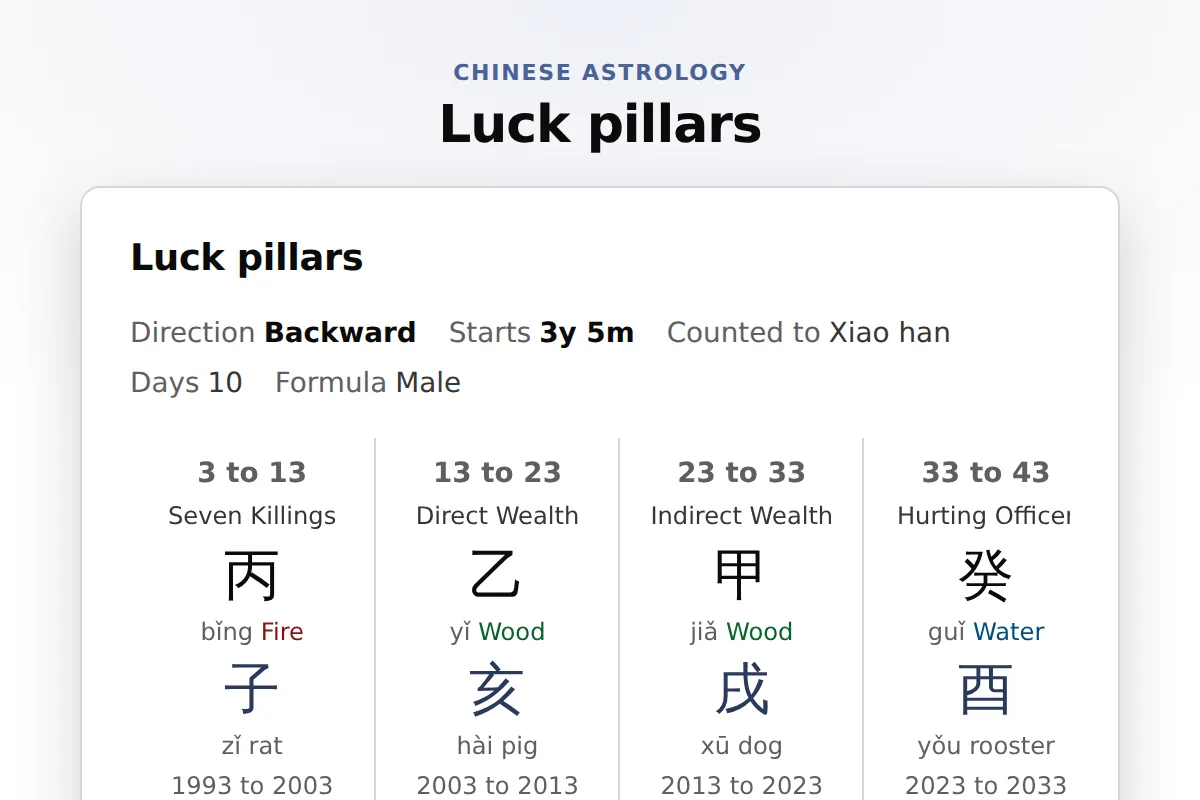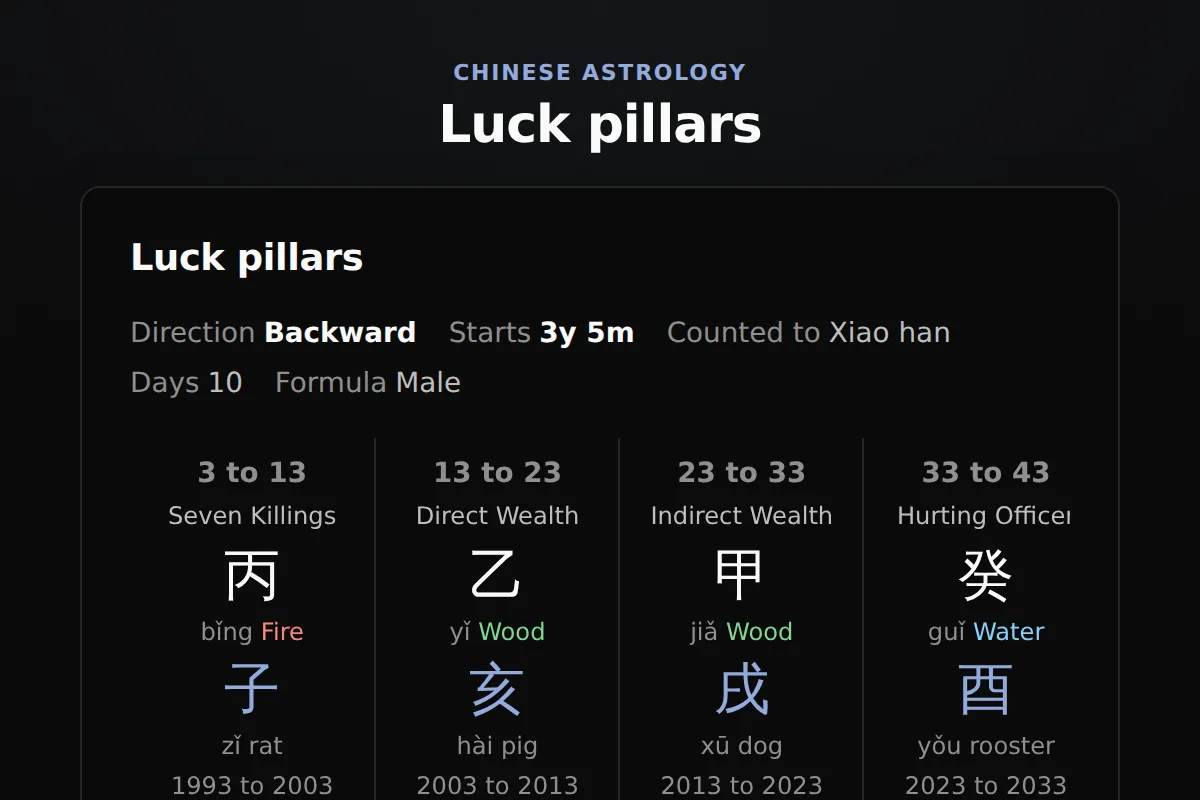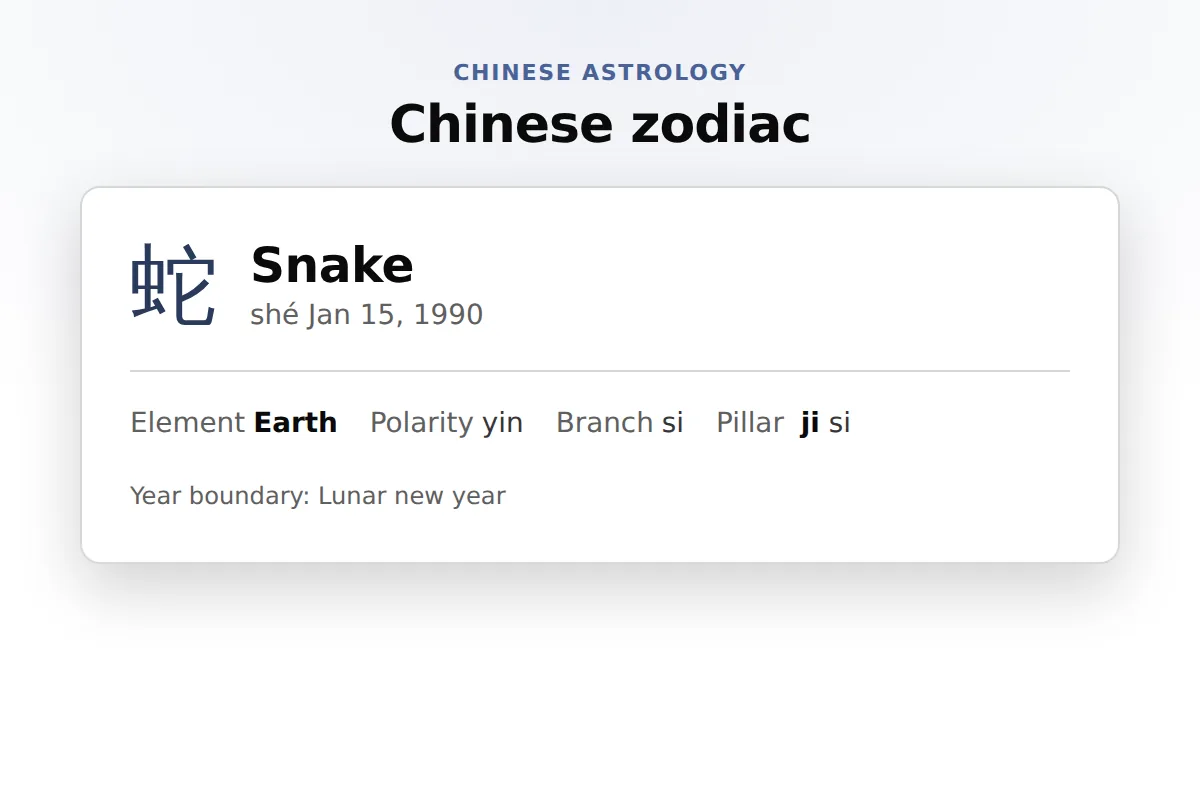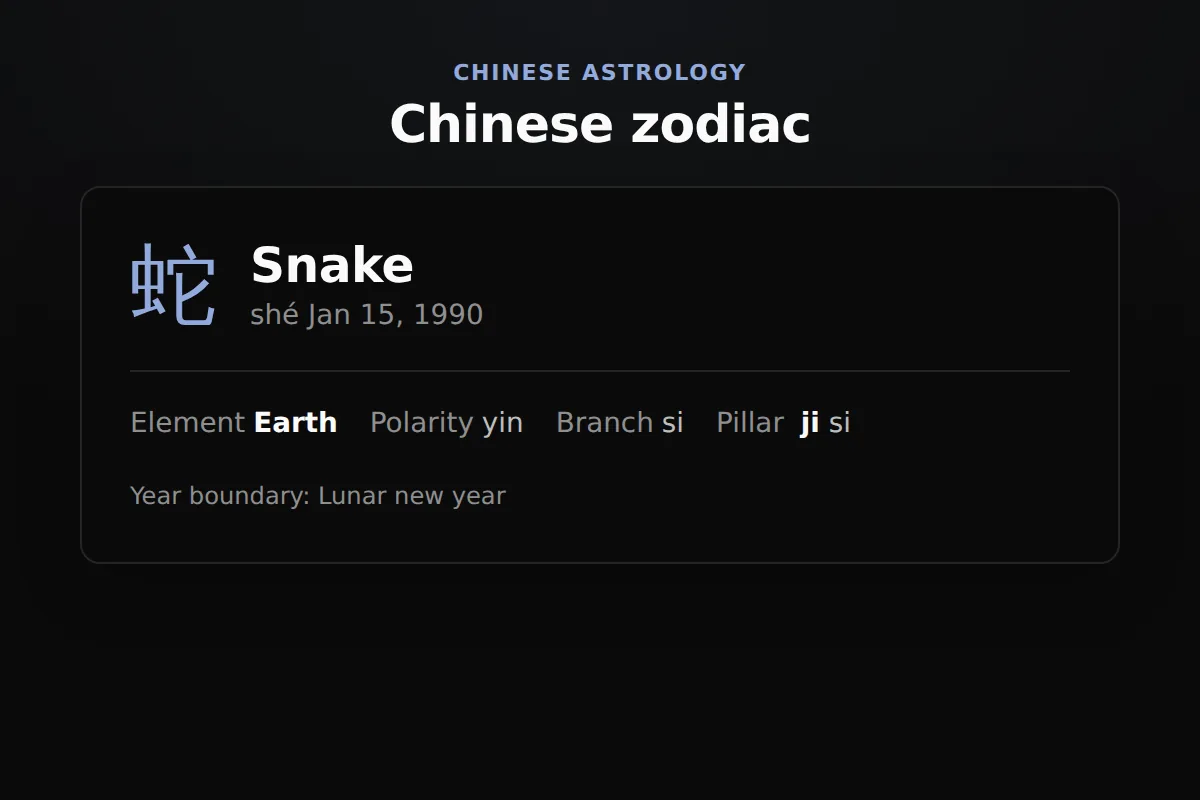
A BaZi Four Pillars chart and Chinese zodiac sign that tell you which school they came from.
BaZi · Four Pillars · Luck Pillars · Day Master · BaZi Compatibility · BaZi Annual Forecast · Chinese Zodiac · Chinese Zodiac Compatibility · Daily Chinese Zodiac · Chinese Lunar Calendar · Tong Shu Almanac · Chinese Date Selection · Solar Terms · Five Elements and 6 more
Included with every plan (at no extra cost)
Year, month, day and hour pillars with hidden stems
Ten Gods and Na Yin on every pillar
Combinations, clashes, harms and punishments
School conventions you choose, echoed on the chart
Da Yun direction, start age and Ten Gods
Liu Nian annual pillars year by year
Any year read against the natal chart
Ben Ming Nian return of the birth animal
Day Master strength with each factor scored
Favorable and unfavorable elements
Five-element balance across the chart
Wu Xing generating and controlling cycles
Animal with its element year, such as Metal Horse
Trine, secret friend, clash and harm partners
Element variants and the double hour per sign
Daily reading from the day pillar
BaZi compatibility pillar by pillar
Day Master relation on the five-phase cycle
Zodiac match by six harmony, trine, clash and harm
Tallied score with every interaction listed
Solar terms as exact astronomical instants
Lunar date conversion both ways with leap months
Tong Shu day officers and lunar mansions
Auspicious day search for weddings and moves
Chinese zodiac and BaZi astrology API: Four Pillars charts, Chinese zodiac signs and the Chinese lunisolar calendar from any birth moment: year, month, day and hour pillars with hidden stems, Na Yin and Ten God relations, luck pillars, day master strength, and animal compatibility. The school splits that make two calculators disagree are typed parameters rather than hidden defaults, and every chart echoes the conventions it was computed under. Solar terms come back as astronomical instants, lunar dates convert in both directions with leap months placed correctly, and the Tong Shu almanac covers day officers, lunar mansions and date selection. One key covers every RoxyAPI domain, with Remote MCP and typed SDKs.
Every Chinese Astrology calculation is covered by 15,481 automated tests per deploy, 3,683 of them gold-standard tests locked to the named references on our methodology page. See how we test.
Interpretations in English, Deutsch, Español, Français, हिन्दी, Português, Русский, Türkçe, 简体中文, 繁體中文, one query parameter away.
Paste a widget into any site builder, install the WordPress plugin, or start from an MIT template you can white-label. Results render from the Chinese Astrology API with no backend.
A Remote MCP server exposes every endpoint as a tool for Claude, ChatGPT, Cursor and any MCP client, with no local install. Opt-in compact responses cut the tokens your agent reads by roughly 40 to 52 percent, and one call stays one request.
Typed SDKs for TypeScript, Python, PHP, C#, Go, Rust, and Dart, generated from the live spec, each with an AGENTS.md so your coding assistant calls the Chinese Astrology API correctly.
This is what your visitors see. Paste one snippet into Wix, Squarespace, or WordPress and the Chinese Astrology API reading appears on your site, with no code and no backend. Developers install the same components from npm for Next.js, React, Vue, Svelte, Angular, or plain HTML. MIT licensed and included in every plan.
| Element | Renders |
|---|---|
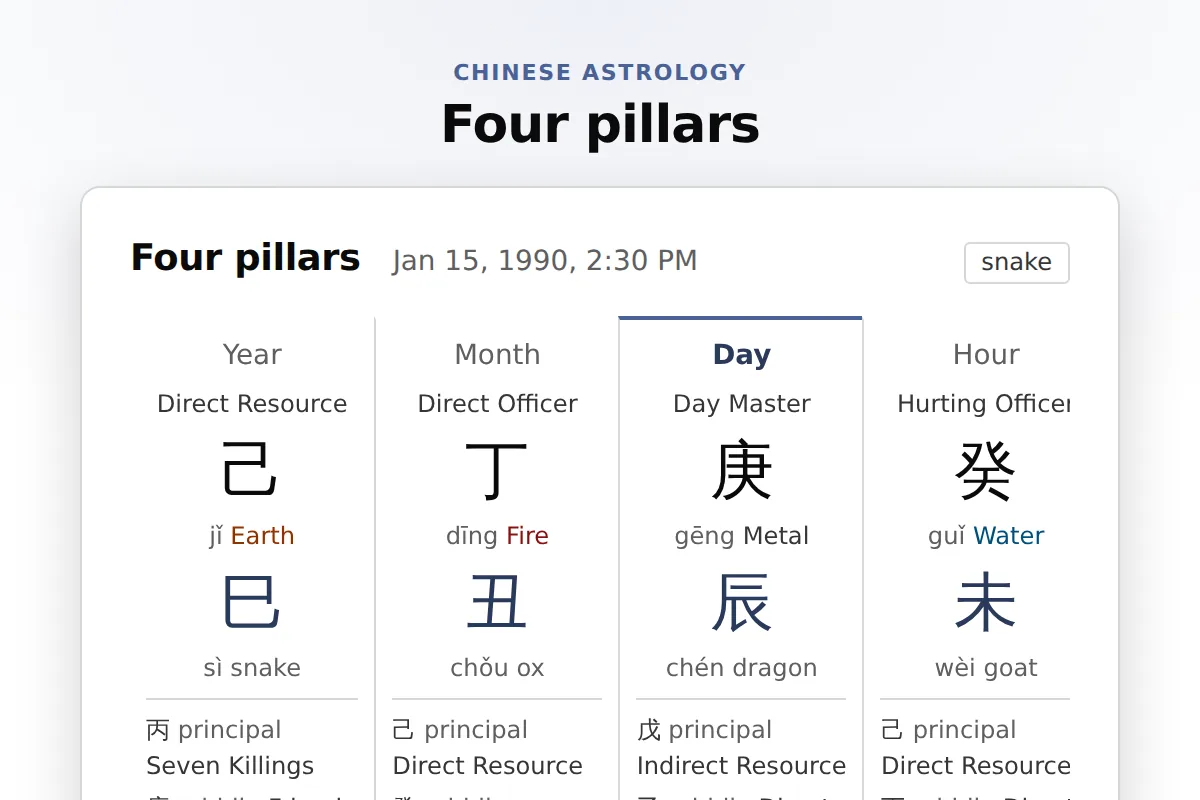
<roxy-bazi-chart> | Year, month, day and hour pillars in hanzi with hidden stems, Ten Gods, Na Yin, element balance and interactions |
<roxy-luck-pillars> | Ten-year luck pillars as a strip with ages and years, the annual pillars, and the direction and start age behind them |
<roxy-zodiac-card> | The animal for a date, one animal in full, a daily reading, or a pair scored |
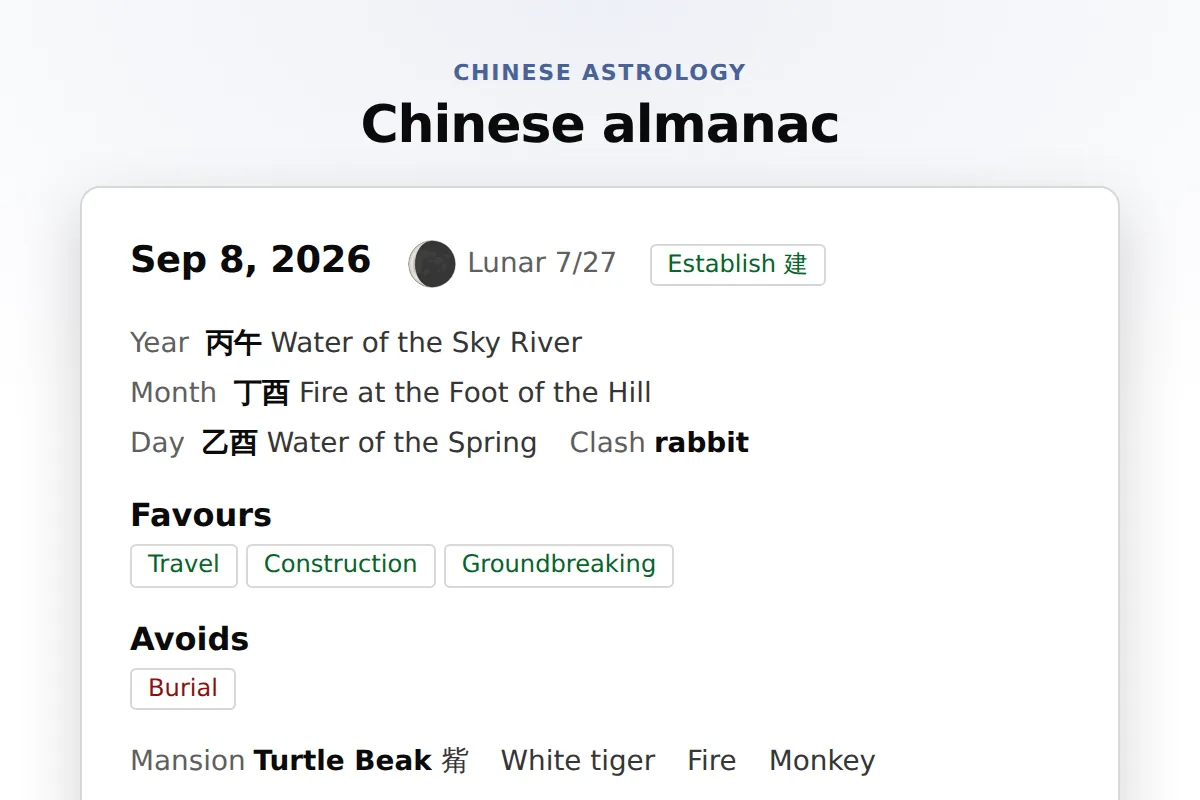
<roxy-almanac-day> | Day officer, favours and avoids, clash animal and pillars, as one day, a month, or a date search |
The depth behind every line above, written out in full.
Want to try without writing code? Try this domain live in API playground →
npm install @roxyapi/sdkimport { createRoxy } from '@roxyapi/sdk'
const roxy = createRoxy(process.env.ROXY_API_KEY!)
const domain = roxy.chineseAstrologypip install roxy-sdkfrom roxy_sdk import create_roxy
roxy = create_roxy("your-api-key")
domain = roxy.chinese_astrologycomposer require roxyapi/sdkuse function RoxyAPI\Sdk\createRoxy;
$roxy = createRoxy(getenv('ROXY_API_KEY'));
$domain = $roxy->chineseAstrology;dotnet add package RoxyApi.Sdkusing RoxyApi;
var roxy = new RoxyClient(Environment.GetEnvironmentVariable("ROXY_API_KEY")!);
var domain = roxy.ChineseAstrology;go get github.com/RoxyAPI/sdk-goimport roxyapi "github.com/RoxyAPI/sdk-go"
roxy, _ := roxyapi.NewRoxy(os.Getenv("ROXY_API_KEY"))
domain := roxy.ChineseAstrologycargo add roxyapiuse roxyapi::Roxy;
let roxy = Roxy::new(std::env::var("ROXY_API_KEY")?)?;
let domain = roxy.chinese_astrology();dart pub add roxyapiimport 'package:roxyapi/roxyapi.dart';
final roxy = Roxy(Platform.environment['ROXY_API_KEY'] ?? '');
final domain = roxy.chineseAstrology;claude mcp add --transport http \
roxy-chinese-astrology https://roxyapi.com/mcp/chinese-astrology \
--header "X-API-Key: YOUR_KEY"AI agents auto-discover all endpoints as callable tools. Zero configuration. Responses can come back token-optimized and lossless, cutting the tokens your agent spends per call by roughly 40 to 52 percent.
Full MCP setup guidecurl -H "X-API-Key: YOUR_KEY" \
https://roxyapi.com/api/v2/chinese-astrology/Generating your own client? Get the Chinese Astrology OpenAPI schema.
Want to ship faster? Clone a free template and white-label it as your own app.
Building with Cursor, Claude Code, or Bolt? Use our AI prompts to generate a complete app.
Building on WordPress? Install the RoxyAPI plugin and drop a shortcode, no code required.
{
  "birthData": {
    "date": "1990-06-15",
    "time": "14:30:00",
    "timezone": -4,
    "latitude": 0,
    "longitude": 116.4
  },
  "conventions": {
    "dayBoundary": "split-zi",
    "yearBoundary": "li-chun",
    "hourClock": "clock"
  },
  "pillars": [
    {
      "position": "year",
      "id": "geng-wu",
      "number": 7,
      "stem": {
        "id": "geng",
        "chinese": "庚",
        "pinyin": "gēng",
        "element": "Metal",
        "polarity": "yang"
      },
      "branch": {
        "id": "wu",
        "chinese": "午",
        "pinyin": "wǔ",
        "animal": "horse",
        "element": "Fire",
        "polarity": "yang"
      },
      "tenGod": {
        "id": "rob-wealth",
        "name": "Rob Wealth",
        "chinese": "劫財",
        "pinyin": "jié cái",
        "category": "peer",
        "keynote": "Drive, nerve, and competition for the same ground"
      },
      "hiddenStems": [
        {
          "stem": {
            "id": "ding",
            "chinese": "丁",
            "pinyin": "dīng",
            "element": "Fire",
            "polarity": "yin"
          },
          "role": "principal",
          "tenGod": {
            "id": "seven-killings",
            "name": "Seven Killings",
            "chinese": "七殺",
            "pinyin": "qī shā",
            "category": "influence",
            "keynote": "Pressure, command, and anything won under real risk"
          }
        },
        {
          "stem": {
            "id": "ji",
            "chinese": "己",
            "pinyin": "jǐ",
            "element": "Earth",
            "polarity": "yin"
          },
          "role": "middle",
          "tenGod": {
            "id": "indirect-resource",
            "name": "Indirect Resource",
            "chinese": "偏印",
            "pinyin": "piān yìn",
            "category": "resource",
            "keynote": "Unusual learning and skill in narrow subjects"
          }
        }
      ],
      "naYin": "Earth by the Roadside",
      "naYinChinese": "路旁土",
      "naYinElement": "Earth"
    },
    {
      "position": "month",
      "id": "ren-wu",
      "number": 19,
      "stem": {
        "id": "ren",
        "chinese": "壬",
        "pinyin": "rén",
        "element": "Water",
        "polarity": "yang"
      },
      "branch": {
        "id": "wu",
        "chinese": "午",
        "pinyin": "wǔ",
        "animal": "horse",
        "element": "Fire",
        "polarity": "yang"
      },
      "tenGod": {
        "id": "hurting-officer",
        "name": "Hurting Officer",
        "chinese": "傷官",
        "pinyin": "shāng guān",
        "category": "output",
        "keynote": "Talent, invention, and impatience with authority"
      },
      "hiddenStems": [
        {
          "stem": {
            "id": "ding",
            "chinese": "丁",
            "pinyin": "dīng",
            "element": "Fire",
            "polarity": "yin"
          },
          "role": "principal",
          "tenGod": {
            "id": "seven-killings",
            "name": "Seven Killings",
            "chinese": "七殺",
            "pinyin": "qī shā",
            "category": "influence",
            "keynote": "Pressure, command, and anything won under real risk"
          }
        },
        {
          "stem": {
            "id": "ji",
            "chinese": "己",
            "pinyin": "jǐ",
            "element": "Earth",
            "polarity": "yin"
          },
          "role": "middle",
          "tenGod": {
            "id": "indirect-resource",
            "name": "Indirect Resource",
            "chinese": "偏印",
            "pinyin": "piān yìn",
            "category": "resource",
            "keynote": "Unusual learning and skill in narrow subjects"
          }
        }
      ],
      "naYin": "Wood of the Willow",
      "naYinChinese": "楊柳木",
      "naYinElement": "Wood"
    },
    {
      "position": "day",
      "id": "xin-hai",
      "number": 48,
      "stem": {
        "id": "xin",
        "chinese": "辛",
        "pinyin": "xīn",
        "element": "Metal",
        "polarity": "yin"
      },
      "branch": {
        "id": "hai",
        "chinese": "亥",
        "pinyin": "hài",
        "animal": "pig",
        "element": "Water",
        "polarity": "yin"
      },
      "tenGod": {
        "id": "day-master",
        "name": "Day Master",
        "chinese": "日主",
        "pinyin": "rì zhǔ",
        "category": "self",
        "keynote": "The self the whole chart is read from"
      },
      "hiddenStems": [
        {
          "stem": {
            "id": "ren",
            "chinese": "壬",
            "pinyin": "rén",
            "element": "Water",
            "polarity": "yang"
          },
          "role": "principal",
          "tenGod": {
            "id": "hurting-officer",
            "name": "Hurting Officer",
            "chinese": "傷官",
            "pinyin": "shāng guān",
            "category": "output",
            "keynote": "Talent, invention, and impatience with authority"
          }
        },
        {
          "stem": {
            "id": "jia",
            "chinese": "甲",
            "pinyin": "jiǎ",
            "element": "Wood",
            "polarity": "yang"
          },
          "role": "middle",
          "tenGod": {
            "id": "direct-wealth",
            "name": "Direct Wealth",
            "chinese": "正財",
            "pinyin": "zhèng cái",
            "category": "wealth",
            "keynote": "Earned assets and the commitments that hold them"
          }
        }
      ],
      "naYin": "Metal of Hairpin and Bracelet",
      "naYinChinese": "釵釧金",
      "naYinElement": "Metal"
    },
    {
      "position": "hour",
      "id": "yi-wei",
      "number": 32,
      "stem": {
        "id": "yi",
        "chinese": "乙",
        "pinyin": "yǐ",
        "element": "Wood",
        "polarity": "yin"
      },
      "branch": {
        "id": "wei",
        "chinese": "未",
        "pinyin": "wèi",
        "animal": "goat",
        "element": "Earth",
        "polarity": "yin"
      },
      "tenGod": {
        "id": "indirect-wealth",
        "name": "Indirect Wealth",
        "chinese": "偏財",
        "pinyin": "piān cái",
        "category": "wealth",
        "keynote": "Opportunity, circulation, and money that moves"
      },
      "hiddenStems": [
        {
          "stem": {
            "id": "ji",
            "chinese": "己",
            "pinyin": "jǐ",
            "element": "Earth",
            "polarity": "yin"
          },
          "role": "principal",
          "tenGod": {
            "id": "indirect-resource",
            "name": "Indirect Resource",
            "chinese": "偏印",
            "pinyin": "piān yìn",
            "category": "resource",
            "keynote": "Unusual learning and skill in narrow subjects"
          }
        },
        {
          "stem": {
            "id": "ding",
            "chinese": "丁",
            "pinyin": "dīng",
            "element": "Fire",
            "polarity": "yin"
          },
          "role": "middle",
          "tenGod": {
            "id": "seven-killings",
            "name": "Seven Killings",
            "chinese": "七殺",
            "pinyin": "qī shā",
            "category": "influence",
            "keynote": "Pressure, command, and anything won under real risk"
          }
        },
        {
          "stem": {
            "id": "yi",
            "chinese": "乙",
            "pinyin": "yǐ",
            "element": "Wood",
            "polarity": "yin"
          },
          "role": "residual",
          "tenGod": {
            "id": "indirect-wealth",
            "name": "Indirect Wealth",
            "chinese": "偏財",
            "pinyin": "piān cái",
            "category": "wealth",
            "keynote": "Opportunity, circulation, and money that moves"
          }
        }
      ],
      "naYin": "Metal in the Sand",
      "naYinChinese": "沙中金",
      "naYinElement": "Metal"
    }
  ],
  "dayMaster": {
    "stem": "xin",
    "chinese": "辛",
    "pinyin": "xīn",
    "element": "Metal",
    "polarity": "yin",
    "nature": "Jewel, coin and finished blade rather than raw ore: cool, smooth and already refined. Heaped earth buries it, which is the one thing it truly fears, while moving water rinses it until it shows what it is. Under summer heat it wants damp earth for cover. In deep winter it wants the small contained fire and never the open blaze, which would only melt what took so long to refine."
  },
  "zodiacAnimal": "horse",
  "fiveElements": [
    {
      "element": "Wood",
      "count": 1,
      "level": "balanced",
      "reading": "Wood is present in proportion. There is enough initiative to begin things and enough give to change course without the chart being governed by either."
    },
    {
      "element": "Fire",
      "count": 2,
      "level": "balanced",
      "reading": "Fire is present in proportion. There is enough heat to be seen and to convince, without the chart burning through what it builds."
    },
    {
      "element": "Earth",
      "count": 1,
      "level": "balanced",
      "reading": "Earth is present in proportion. There is enough ground to hold what the chart produces without so much that nothing moves."
    },
    {
      "element": "Metal",
      "count": 2,
      "level": "balanced",
      "reading": "Metal is present in proportion. There is enough edge to finish and to decide without the chart cutting into what should have been left standing."
    },
    {
      "element": "Water",
      "count": 2,
      "level": "balanced",
      "reading": "Water is present in proportion. Ideas and information move through the chart without washing away the structure they move through."
    }
  ],
  "interactions": [
    {
      "type": "punishment",
      "id": "wu-wu",
      "chinese": "午自刑",
      "pinyin": "wǔ zì xíng",
      "quality": "challenging",
      "positions": [
        "year",
        "month"
      ],
      "members": [
        "wu",
        "wu"
      ],
      "variety": "self",
      "complete": true,
      "meaning": "Branches that grind against each other rather than colliding. A punishment works slowly and internally: friction that accumulates, obligations that turn on their holder, situations that were entered willingly and become difficult to leave. A branch doubled against itself. Nothing external is involved, which is what makes it the hardest of the four to see: the pattern repeats because the chart keeps supplying it."
    },
    {
      "type": "stem-combination",
      "id": "geng-yi",
      "chinese": "乙庚合",
      "pinyin": "yǐ gēng hé",
      "quality": "harmonious",
      "positions": [
        "year",
        "hour"
      ],
      "members": [
        "geng",
        "yi"
      ],
      "transformsTo": "Metal",
      "meaning": "Two Heavenly Stems that pair off. The bond is the strongest tie between two stems and it works both ways: it can settle a stem that was causing trouble, and it can occupy a stem that was needed elsewhere. A stem that is busy being bonded is not doing its job in the chart."
    },
    {
      "type": "six-combination",
      "id": "wei-wu",
      "chinese": "午未合",
      "pinyin": "wǔ wèi hé",
      "quality": "harmonious",
      "positions": [
        "year",
        "hour"
      ],
      "members": [
        "wu",
        "wei"
      ],
      "meaning": "Two Earthly Branches that bind. The pairing is astronomical in origin, the branch the sun and moon meet in set against the branch the Dipper handle points to in the same month, which is why the six are exactly the pairs they are. In a chart it reads as attachment and cooperation, and as a tie that is not easily walked away from."
    },
    {
      "type": "six-combination",
      "id": "wei-wu",
      "chinese": "午未合",
      "pinyin": "wǔ wèi hé",
      "quality": "harmonious",
      "positions": [
        "month",
        "hour"
      ],
      "members": [
        "wu",
        "wei"
      ],
      "meaning": "Two Earthly Branches that bind. The pairing is astronomical in origin, the branch the sun and moon meet in set against the branch the Dipper handle points to in the same month, which is why the six are exactly the pairs they are. In a chart it reads as attachment and cooperation, and as a tie that is not easily walked away from."
    },
    {
      "type": "stem-clash",
      "id": "xin-yi",
      "chinese": "乙辛沖",
      "pinyin": "yǐ xīn chōng",
      "quality": "challenging",
      "positions": [
        "day",
        "hour"
      ],
      "members": [
        "xin",
        "yi"
      ],
      "meaning": "Two Heavenly Stems standing directly opposite, each controlling the other by element. Stems act faster than branches, so a stem clash shows up quickly and on the surface: open disagreement, a decision forced early, a position that has to be defended."
    }
  ],
  "summary": "This chart has a Metal Day Master born in a Fire month. The stem itself reads this way: Jewel, coin and finished blade rather than raw ore: cool, smooth and already refined. Heaped earth buries it, which is the one thing it truly fears, while moving water rinses it until it shows what it is. Under summer heat it wants damp earth for cover. In deep winter it wants the small contained fire and never the open blaze, which would only melt what took so long to refine. As for the season: The season controls the Day Master element, the weakest of the five seasonal states. Everything the chart does from here has to be paid for by support found elsewhere."
}
Structured JSON with documented fields. Not hallucinated text. See all endpoints
Clone. Edit. Ship. Free and open source by Team Roxy.

A multi-agent astrology reader in n8n, on web chat and Telegram, with a forecast every morning.

Independent proof, domain by domain. Every reference value cited, rerun monthly.
Browse all templates or use AI prompts to generate a custom app.
The products teams ship on the Chinese Astrology API.
Real calls against the production API, no account needed. Every endpoint sits in the public OpenAPI spec and is callable as an MCP tool; open one for its parameters and response examples.
Calculate a complete BaZi chart, the Four Pillars of Destiny, from a birth moment. Returns the year, month, day and hour pillars with every Heavenly Stem and Earthly Branch, the stems hidden inside each branch, the Ten God relation each one holds to the Day Master, the Na Yin sound element of each pair, the five-element balance across the chart, and the combinations and clashes running between the pillars. The day boundary, year boundary and hour clock are all selectable and the applied conventions come back on every response, so a chart is self-describing. Built for astrology apps, matchmaking services, and agents that need a Four Pillars reading they can reproduce.
Calculate the da yun luck pillars, the ten-year periods a BaZi chart walks through after birth. Returns the direction the sequence runs, the age it begins at with the day count behind that age, each ten-year pillar with the Ten God relation its stem holds to the natal Day Master, and an optional year-by-year annual overlay. Direction follows the classical rule: a male born in a yang-stem year and a female born in a yin-stem year run forward through the sexagenary cycle, the other two combinations run backward. Built for astrology apps, life-timing features, and agents that need a reproducible forecast spine.
Assess how well the Day Master is supported by the rest of a BaZi chart, and which of the five elements help it. Uses the classical three-factor method: whether the birth month season backs the Day Master element, whether any branch stores a root for it, and whether the other stems and the branches outside the month help or spend it. Returns the verdict, an auditable score with each factor contribution, the seasonal state, the root count, the element headcount, and the favorable and unfavorable element lists that follow from the verdict. Built for chart readers, remedy features, and agents that need the usable half of a Four Pillars reading.
Compare two BaZi charts pillar by pillar, the Chinese astrology reading of how two people match. Returns both resolved charts, how the two Day Masters stand to each other on the five-phase cycle, and every combination, clash, harm and punishment that crosses between them, each naming the two positions it joins. A tallied score summarises the balance and the interaction list behind it is returned in full, so a caller that disagrees with the weighting can recompute its own. Built for matchmaking products, relationship features, and agents that need a defensible two-chart reading.
Read one Gregorian year against a natal BaZi chart. Returns the annual pillar for that year, the Ten God relation its stem holds to the natal Day Master, the same reading for the hidden stem of its branch, how the annual branch stands to the natal year branch including the ben ming nian return of the birth animal, and every combination, clash, harm and punishment the annual pillar forms with each of the four natal pillars. Built for yearly horoscope features, timing tools, and agents that need a year read against a specific chart rather than against an animal sign.
Retrieve all twelve Chinese zodiac animals in cycle order, from Rat through Pig. Each entry returns the machine id, the Chinese character and tone-marked pinyin for the animal, its Earthly Branch, the fixed Five Element phase and yin or yang polarity of that branch, and a set of trait keywords. Built for sign pickers, zodiac cards and compatibility widgets that need the whole set in one call.
Retrieve the complete profile of one Chinese zodiac animal: character summary, strengths, weaknesses, trait keywords, the double-hour its Earthly Branch governs, and its five element variants with the Gregorian years that carry each one. Also returns the four classical branch relationships, the three-harmony trine it belongs to, its six-harmony secret friend, its clashing opposite and its harming partner. Built for sign detail pages and compatibility features.
Resolve a birth date to its Chinese zodiac animal, the sexagenary year pillar behind it, and the Five Element phase of that year, so a 1990 birth returns Horse as a Metal Horse rather than merely a Horse. The year boundary is a request parameter because the two schools genuinely disagree for dates in January and early February, and the resolved convention is echoed back so the answer is self-describing. Built for sign lookups, onboarding forms and birthday features.
Score and explain the relationship between two Chinese zodiac animals from the classical branch relations rather than from a lookup table of opinions. Returns which of the six relations the pair stands in, a score out of 100, the phase the two branches combine into where they combine at all, and a composed reading with strengths, frictions and advice. The six relations are mutually exclusive by construction, so exactly one applies to any pair. Built for matchmaking features, relationship reports and compatibility widgets.
Get the daily reading for one Chinese zodiac animal, built from the sexagenary day pillar rather than from a rotation of stock text. The day carries its own Earthly Branch, that branch stands in exactly one of six classical relations to the requested sign, and the reading is that relation applied to the sign temperament. Returns the day pillar, the relation, an energy rating, overview, love and career guidance, advice, and the sexagenary year in force with its Ben Ming Nian flag. Content is fixed for a given date and rolls over at midnight, by default UTC.
Return all 24 solar terms of a year as astronomical instants rather than dates, each computed from the moment the sun reaches its exact apparent longitude at 15 degree steps. The year is the SOLAR year, which opens at Li Chun in early February, so Minor Cold and Major Cold, the last two terms, are dated in the January of the following Gregorian year. Every instant is returned twice, once in UTC and once at the UTC+8 reference meridian the Chinese calendar is defined on. Built for calendar apps, festival scheduling, and any BaZi feature that has to place a birth on the correct side of a term boundary.
Convert a Gregorian date to the Chinese lunisolar calendar or convert a lunar date back, in one endpoint. The calendar is computed at the UTC+8 reference meridian with the month containing the winter solstice fixed as month 11 and the leap month placed as the first month of the cycle carrying no major solar term, so a lunar date is the same worldwide rather than shifting with the caller timezone. The response reports the length of the lunar month, whether the date sits in a leap month, and which month the year doubles if any. Built for festival calendars, birthday features that follow the lunar date, and any app that has to survive a leap month without shifting every date after it.
Return the full almanac reading of one day: its lunisolar date, the year, month and day pillars with their Na Yin, the day officer from the twelve jian chu sequence, the lunar mansion on duty, the zodiac animal the day clashes with, and the activities the officer favours or opposes. The day officer is the layer a printed almanac reaches its verdict from first, and the response says exactly what it rules on rather than reducing the day to a single score. The year and month pillars here are attributed by whole days, which is what an almanac prints: the day a solar term falls on belongs to the new period for its whole length, however late in the day the term arrives. Built for date pickers, daily calendar widgets, and wedding or opening date tools.
Return every day of one Gregorian month of the Chinese almanac with its lunisolar date, its three pillars, its day officer, its lunar mansion and its clash animal, plus the solar terms that fall inside the month. This is the month view a calendar widget renders in one call rather than thirty one. Omit the year and month to get the month in progress. Built for calendar UIs, almanac pages, and planning tools that show a whole month at a glance.
Search a date range for the days a chosen activity is favoured on, ranked by the jian chu day officer and filtered against a zodiac animal to protect. Every candidate day comes back with its officer, its pillars, its lunar date and the animal it clashes with, so a caller can show the reasoning rather than a bare verdict. The range is capped at 93 days, which is a quarter, because date selection is done inside a planning window rather than across a lifetime. Built for wedding planners, business opening tools, and moving and travel date pickers.
Return the five phases of Wu Xing with the Chinese character, the season and direction each governs, the Heavenly Stems and Earthly Branches that carry it, and both of the cycles that connect them. The generating cycle and the controlling cycle are returned as ordered rings as well as on each phase, so a caller can render either without deriving it. This is the one place the five phase vocabulary is defined: BaZi charts, Na Yin, zodiac element variants and every feng shui star reuse these identifiers rather than restating them.
Founder, United States
I built a living Human Design labyrinth: a free walk through nine gardens with personal chart reports and an AI guide named Phoenix, powered by the RoxyAPI chart engine and 15 of its domains.
A Human Design labyrinth on the web and Google Play, with personal chart reports and an AI guide
Course creator, Denmark
I think you have done an amazing job, it must have taken a long time. Clients are happy, and so am I.
Natal chart, transit, horoscope, tarot, dream and crystal readings inside her online courses
Founder, United States
I use RoxyAPI as the data layer for my astrology assistant. It has been reliable.
An astrology assistant on Vedic and KP, dashas, divisional charts, panchang, Western astrology, numerology and tarot
Every customer story comes from an account we confirmed and is published with the approval of that customer.
Read customer storiesThe receipts are public: the testing methodology, the open MIT benchmark, the transparency report, and the live API playground. Let ChatGPT, Perplexity, or Claude search the web and tell you what they find about RoxyAPI accuracy, MCP, SDKs, and pricing.
Opens a live web search in a new tab.
Your AI agent
your model, your voice
Remote MCP
auto-discovered, no local setup
Token-optimizedRoxy Ephemeris
15,481 tests, 3683 gold standard
Verified result
18+ domains, one flat rate
Your agent uses calculated charts and readings in its replies, with your model and your own voice. Planetary positions are verified against NASA JPL Horizons. No local setup, no AGPL, no hosted-AI markup.
Audit it yourself: every Chinese Astrology endpoint runs live in the API playground
Included in the same plan as Chinese Astrology
Send a birth date, time and timezone to the Chinese Astrology API and the full Four Pillars chart comes back in one response: year, month, day and hour pillars, the hidden stems in each branch, the Na Yin sound element, the Ten God relation to the day master, and the five element balance. No lookup tables to ship and no calendar library to maintain. Typed SDKs and a Remote MCP server are available on the same key, along with every other RoxyAPI domain.
Almost always because they follow different schools and say nothing about it. Three choices move the answer: whether the year turns at Li Chun or at Lunar New Year, whether the day turns at midnight or at 23:00, and whether the hour branch is read from civil time, local mean time or apparent solar time. Each of those is a typed parameter on this API with a named default, and the resolved set comes back on the response, so you can reproduce a chart later or match another calculator on purpose rather than by accident.
Solar terms are computed as instants, not read from a table of dates: each of the 24 is the moment the sun reaches its exact apparent longitude, at 15 degree steps, so a birth an hour either side of Li Chun lands in the right year. Lunar dates follow the published national standard frame, evaluated at the 120 degrees east reference meridian with the winter solstice fixed in month 11 and the leap month placed by the no major term rule. Values are verified against an independent national observatory calendar.
Yes. The almanac endpoints return a day pillar, its day officer from the twelve jian chu sequence, the lunar mansion, the animal the day clashes with, and the activities the day favours or opposes. A bounded search takes an activity and a date range and returns the days that suit it, optionally skipping the days that clash with a given zodiac animal. That is what powers wedding, opening, moving and travel date pickers without a human almanac reader in the loop.
Whichever one you ask for, stated plainly. The folk answer changes at Lunar New Year and the classical BaZi answer changes at Li Chun in early February, so a birth in late January or early February can be either animal depending on the rule. The zodiac endpoints default to the popular Lunar New Year rule because that is what a reader expects, the BaZi endpoints default to Li Chun because that is what the classical texts use, and both echo the rule that was applied.
Yes, in both scripts. Simplified and Traditional Chinese are shipped alongside German, Spanish, French, Hindi, Portuguese, Russian and Turkish. The hanzi and the tone marked pinyin for every stem, branch, animal and solar term are data fields present in every language, so a Simplified response still carries the pinyin and an English response still carries the characters. Machine identifiers stay English so they remain safe to compare in code.
A BaZi Four Pillars chart and Chinese zodiac sign that tell you which school they came from.
All 18+ domains included with every plan. Every endpoint, MCP server, SDK, and templates.
Plans from $39/mo, starting at $1.80 per domain on annual billing. No credit card required for testing.
View Pricing & Get API KeyHi, I am Rosie. I can show you a live reading, or get readings onto your site or app today.